
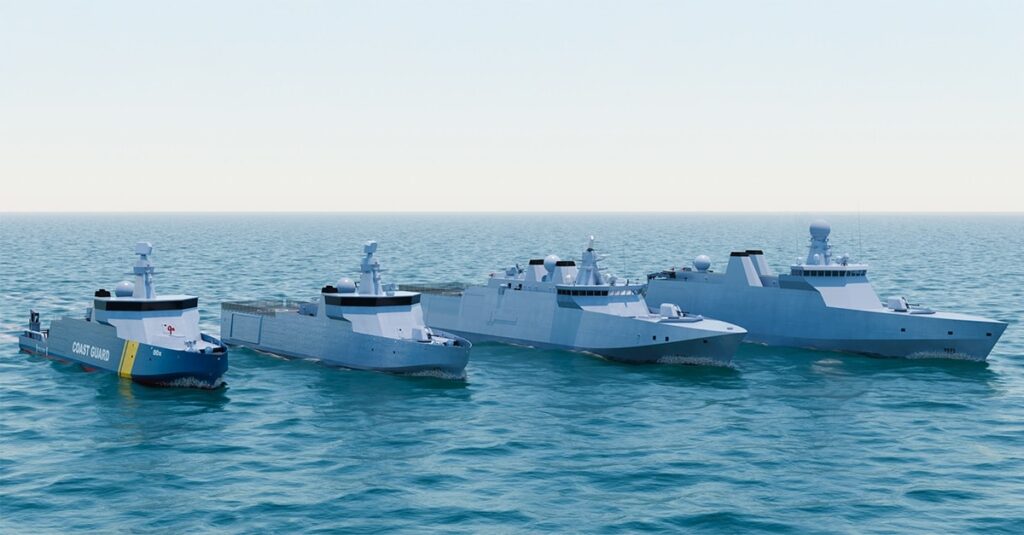
Danish company OMT builds upon its experience with the Knud Rasmussen-class oceanic patrol vessels and the Multi-Role Combat Vessel to present their new O1 family of designs, offering four distinct vessels –85 Coast Guard, 85 Naval, 110 Naval, and 120 Naval Polar, with the number designating the length over all in meters.
The common denominator for the vessels is their modularity centered around a huge mission deck optimized for easy integration, in particular with an eye to solutions fitting standard ISO-containers, such as the Cube ecosystem by SH Defence. The design is largely system agnostic, with the customer able to pick their sensors, systems, and weapons of choice.
The 85 Coast Guard is an OPV for coast guard-style missions, able to fit an optional deck gun and 3D air surveillance radar, while the mission bay can fit 11 TEU ISO container-sized mission modules. The corresponding 85 Naval trades three TEU ISO modules for a helicopter deck and a drone lift to the mission bay. The design also has a deck gun and options including VLS-cells, anti-ship missile box launchers, and torpedoes. While the 85 Naval is a somewhat traditional light combatant, the 110 Naval is a true surface combatant with a somewhat unique design philosophy.
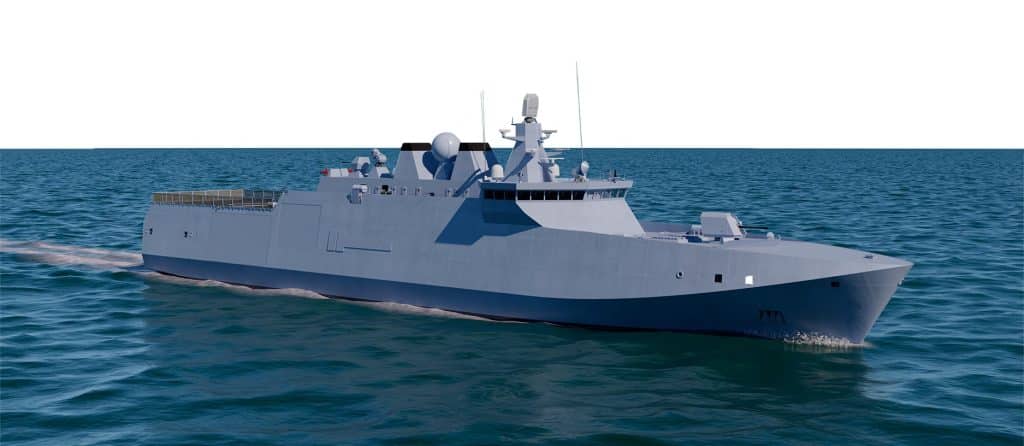
O1 – 110 Naval. OMT image.
“Slower than a corvette, lethal as a frigate,” as Klaus Sørensen, director of naval products, explains. The idea behind that is that with both unmanned and manned platforms able to operate from the vessels mission bay, and in general with every better data links to get information from other platforms, the need to actually shift the position of the vessel to investigate contacts or move the vessels sensors to a new location is decreasing. Instead, a RHIB can intercept suspected vessels or an unmanned platform can reach a better sensor location.
While able to save on size and costs by accepting a limited top speed, the rest of the design include significant capabilities. VLS-cells are strike length, and coupled with dedicated anti-ship missiles, torpedoes, a 57 mm main deck gun, 110 Naval has significant firepower for its size. The 15-ton flight deck, hull-mounted sonar, 12 m stern ramp, and 26 TEU positions add to the flexibility, allowing it to perform a wide variety of tasks from ASW to both minelaying and mine-countermeasures. The 120 Naval Polar in turn builds upon work done for the Danish Arctic Patrol Vessel, though Sørensen takes care to point out that it is not the same design.
The family is an in-house initiative, but programmes such as the Baltic States looking for mine warfare capable multirole vessels seem a natural fit. In case of an order, the designs are at varying levels of maturity. Regarding the maturity of the family, the 85 is able to go from order to first steel cut in less than two years – or faster if the particular configuration requested by the customer is close to the baseline. For the larger vessels, the design are more mature and a shorter time to steel cut can be expected.