
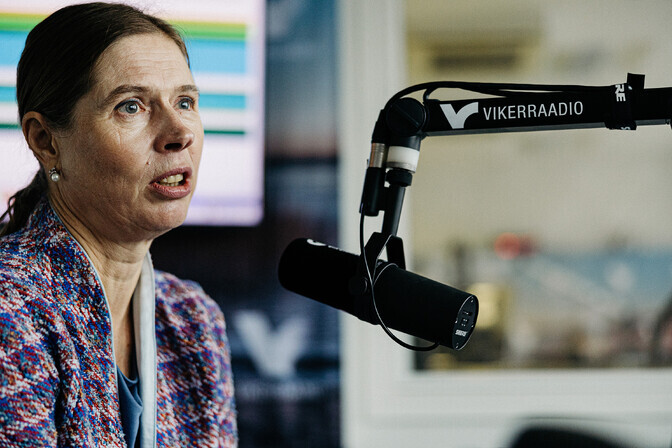
- Europe cannot rely solely on the United States and must build independent defense capabilities within NATO, especially given global power shifts.
- Democracy can’t function without bold individuals who are willing to speak out, including in high offices like the presidency or among lawmakers.
- Lack of long-term energy planning means Estonia playing catch-up on renewables, storage and regional cooperation.
- Addressing low birth rate requires practical, family-friendly solutions rather than moralizing debates.
We talk about a changing world and our place in it. Has the moment finally arrived — the one you spoke of upon returning from the Kremlin, when we must be at every table where our future is being decided? Where do we stand now — are we still at the table or already on the menu?
No, I’m quite sure we’re still at the table. I think it’s precisely because we’re contributing on multiple fronts — maintaining good relations with the United States, showing understanding toward Southern Europeans — that all of this is working out positively for us. And maybe it’s a bit odd to talk about tables and menus right now, but it does feel a bit like jumping between ice floes. Standing on the ice floe called the European Union — or even on a thicker one called the Nordic-Baltic Eight, the NB8 — doesn’t feel like the worst place to be, let’s put it that way.
I hope you’re right and genuinely want you to be. Last week, U.S. President Donald Trump signed the founding document of a peace council in Davos, which does not include Estonia or other Western allies. Some countries have been invited, but it’s been politely stated that their constitutions don’t allow participation. Russia, however, is included. If major decisions are going to be made there, who at that table represents us?
As long as the major European powers are not present at that table, there can be no real talk of Europe there. In fact, over the past year, the United States has tried several times to put Europe in a position where America, Russia and perhaps Ukraine agree on something and Europeans are expected to accept it. We’ve already learned that this approach definitely doesn’t work.
Unconventional diplomacy and politics, Trump-style, is unpleasant to endure and uncomfortable. But ideologically speaking, pushing Europe to stand on its own feet in a world where America recognizes that the world is multipolar — they’re no longer so vastly more powerful than, say, China and the bloc of non-democratic states it is rallying — I think those trends would be happening even without Greenland in the picture. It’s just that if Trump weren’t around, we probably wouldn’t be having the Greenland debate in quite this form.
But why are Trump and the United States doing this — what’s their interest?
It seems to me that they’ve realized the era when America could go it alone and impose order across all continents — if that era ever truly existed — is definitely over now. In reality, they’re nervous. They want their allies to do more and to understand that talk of “waking up by 2040 and being more or less ready” just isn’t satisfying anyone.
Even Shakespeare knew that time is out of joint. Today, there are two prevailing views: one says what we’re seeing now is here to stay — this is the new normal. The other says we just have to get through three more years, Trump will be gone and the good old world will return. Which version do you hope for?
I don’t engage in that kind of forecasting — what’s the point? Nothing has changed since 2008 when Russia attacked Georgia. Europe needs to do one simple thing: defend itself in such a way that the Russians won’t even think about trying something in this region. We haven’t done that so far.
I just listened to Mark Rutte speaking in the European Parliament and he said that Europe still isn’t capable of defending itself. I think all the steps we’re seeing now at an accelerating pace are moving us toward a Europe that is ready to defend itself. And that should have happened regardless of whether Trump is in office or not, regardless of the rhetoric. What was different about Obama saying, “spend 2 percent on defense”? Only the tone.
Isn’t it sad that such a tone has to be used before Europe finally gathers its economic strength and is willing to spend some of it on its own defense, compared to the peace dividend era? I’m not justifying in any way how the United States is treating Europe today. I think it’s doing a lot of damage to America’s future alliances — over the next 50 years, no one will fully trust the United States because it has shown that at a critical moment, the situation can become unpredictable and unstable.
But that doesn’t change what Europe has to do. That’s why it makes no sense to speculate whether Trump leaves and someone like J.D. Vance or someone else takes his place.
Exactly, but there’s also a democracy angle to all of this, which is very important. If you look at how a democracy functions, the U.S. has both a Senate and a House of Representatives. So what does the relatively mild response of Republican senators and congressmen — I’m not talking about the Democrats, as they’re in the minority — tell us? How is it that the checks and balances aren’t working and Congress can’t keep things under control? One person shouldn’t be able to decide how to deal with Denmark or other allies. Where are the Republicans?
The Republicans, as we know, are staying behind their red line. It seemed like Donald Trump was told that if things with Greenland were to escalate further, maybe something would be done. But at the same time, it’s entirely possible that it wasn’t the Republicans who influenced Trump, but the state of the markets. They react immediately whenever he crosses a line.
In my view, what’s happening now shows that democracy cannot exist without courageous and free individuals. I think that’s a universal principle. If people aren’t brave or free — if they worry about their jobs or their status and don’t speak up — then democracy simply dies.
Democracy isn’t just the separation of powers and institutional checks and balances — all of those powers are carried out by people. And if people lack courage, then democracy cannot function. That’s a profound lesson.
You travel around the world and meet with senators and congressmen, including Republicans. How do they explain what’s happening right now in the United States? In private conversations, how do they explain how all of this is even possible?
The “lions” are the ones who’ve decided not to run for office again — they’re the ones who speak openly about how bad things really are. The others say that, aside from the inappropriate tone, this is America adapting to China’s growing power and trying to make its allies understand that the “end of history” never came. You can only shift the balance in your favor if you weigh more.
Of course, no one is defending the way Greenland was brought up or many other things. When we watched Trump’s speech [in Davos], compared to his first presidency, it would’ve seemed like stand-up material back then — but now, it was simply Trump being Trump. No one is justifying it.
And that’s the saddest part — that some of the instincts driving U.S. policy today come with a deeply transactional, commercial mindset. But some of the core principles are actually valid and it’s unfortunate that when those same points were delivered to us in a polite tone, we didn’t listen.
On the other hand, some say that Trump has a mandate and the right to do all this whether we like it or not. How much do you agree with that?
Trump certainly has a mandate, for example, to say that the allies didn’t pull their weight or were in the back rows in Afghanistan, which is simply false.
It used to be that when a politician lied, it was considered the gravest sin. But that has shifted. These days, lying has become a normal part of political life.
Of course, I don’t like that, as I’m old-school, but that’s the reality. All we can do is remind ourselves that there isn’t a single general in the U.S. armed forces who doesn’t know what the Danes and Estonians did in Helmand or what the British did. They all know it and they feel pretty uncomfortable when things are framed that way.
When President Trump was walking around Davos with his team, did everyone want to hear him, to meet with him? Is he one of the biggest superstars of our time?
The president of the United States is always a superstar — no matter who holds the office. Leaders of such a large country simply are. People did listen to him and not just out of politeness — when he finished his speech, they even stood up. I wasn’t in the hall myself, but I have to admit, it would’ve been very hard for me to rise from my chair.
What was Trump’s message to the world in Davos? What did he actually say, how are we supposed to live?
He didn’t actually tell us anything. He talked about everything he’s done for the benefit of the United States and said that if the rest of us do what he asks, we’ll have the best NATO in the world. Honestly, there wasn’t much to take away from it.
What’s more, within 24 hours after his speech, Mark Rutte managed to convince him that the Greenland issue would be better discussed within the framework of the NATO treaty. I assume that right now everyone’s focused on postponing those discussions as far into the future as possible, rather than reopening the topic immediately. That ball has been kicked down the road.
I don’t think Donald Trump’s speech is what we should be analyzing. Rather, Mark Carney and Volodymyr Zelenskyy had more to say to us.
By the way, where were the European leaders? Why did it take Mark Rutte who doesn’t serve in any European institution and isn’t the head of state of any EU country? Why aren’t the people we pay to do this job stepping up?
I met with three commissioners: Andrius Kubilius, Valdis Dombrovskis and Marta Kos. So — enlargement, defense and I honestly can’t even recall what Dombrovskis is currently handling [commissioner for an economy that works for people]. Of course they were in Davos — after all, Davos is an economic forum. Naturally, the commissioner for enlargement was there. Ukraine’s path toward the European Union is part of building a more stable “ice floe,” which is exactly what we’re all looking for right now.
So yes, Europe was present — but this time, it was others who gave the standout speeches.
But what really comes after Trump? You mentioned J.D. Vance. Looking at the Democrats, they still don’t seem to have a plan. The midterms are just over six months away. And the next presidential election isn’t far off either — just three years and that’ll fly by. Is there a chance that after Trump, we get Vance and that he’s Trump on steroids?
Well, here’s the difference: in my view, Donald Trump is transactional, while J.D. Vance actually has an ideology of some kind. They’re different people. But I wouldn’t dwell on this. From our perspective, it’s unpredictable. At least I don’t feel confident enough in my knowledge of U.S. domestic politics. I do speak with people who know a great deal about it and based on that, I can say there’s no strong conviction that things will go one way or the other. In fact, I don’t think even two clear scenarios exist.
So let’s focus on our own work here in Europe. We need to get our economy functioning in such a way that we can shear from its back the wool that allows us to fund defense properly, without putting our social market model under too much pressure. Without that, European citizens likely wouldn’t want to live in this system.
I agree with you. But why have we accepted all of this? According to the Draghi report, innovation in Europe is not happening at the level we would like. Technological progress globally is being driven by China and the United States. Now that the U.S. has wagged a warning finger at us and we simply don’t like China — what’s our plan?
I don’t see EU regulations, which are usually pointed to, as the main obstacle. I think the main problem is that, unlike in the United States, Europe has many mechanisms where the public sector tries to take responsibility for innovation and business through subsidies.
That’s not something we see in the United States. What we see there instead is that private companies are increasingly engaging in deep scientific research themselves. They have access to a lot of capital that can withstand long-term risk and that’s what puts them ahead of us. In my view, the first thing that needs to be fixed is the European capital markets.
What happened to those capital markets?
Well, nothing, really. We’ve been talking for 20 years about how Europe’s capital market isn’t unified — and it still isn’t. The U.S. model is one where a lot of resources have accumulated thanks to long-term economic growth, which has created a willingness to invest in pure science.
In Europe, there are many restrictions on the free movement of capital. Here, it’s always possible to write up a project and apply for funding from either the EU or one’s national government for business or research. But that process is inevitably more time-consuming, more expensive and frankly, the state — in the broad sense, including the EU — shouldn’t be responsible for things that aren’t its job.
The EU’s role is the single market, maintaining the eurozone and now also supporting Ukraine and sharing defense costs. It’s up to national governments to provide education and healthcare. The more narrowly we define the role of the state, the more room and freedom there is for capital to do what it does in the U.S.
That said, I don’t support abandoning the social market economy — quality education in every school and access to healthcare for all are part of Europe’s core identity. When those things are in place, people have the confidence to become entrepreneurs. But if we add on layer after layer of programs and subsidies, it leads nowhere. Among Estonian companies, Skeleton is a good example of one that has managed to navigate this landscape successfully.
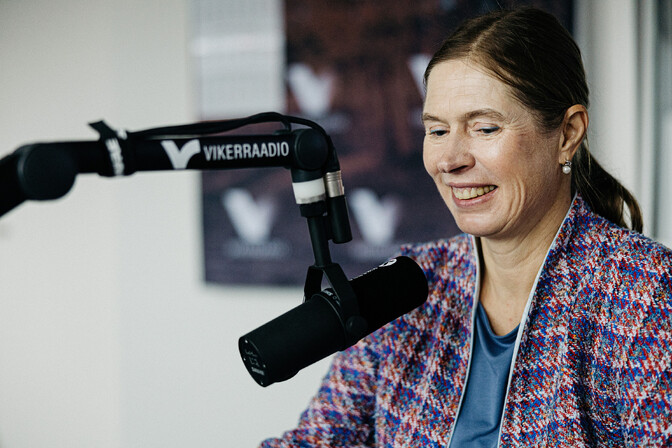 Kersti Kaljulaid. Source: Priit Mürk/ERR
Then there’s also the taxonomy [sustainability classification for businesses], where we’ve set rules about what can and can’t receive funding from capital markets. The U.S. is demanding that the EU lift these restrictions so that investment in the fossil fuel industry is possible. Trump’s position is that those involved in green policy should be punished. But taxonomy is political interference in the market economy. How qualified are politicians to decide which businesses are sustainable?
On the one hand, Europe’s plan is to create an incubator for green technologies so they can develop here, become cheaper and eventually conquer the global market…
That has failed.
It has failed — but at the same time, I think private companies developing green technologies are moving forward fairly quickly. We can’t say for certain that Europe’s actions haven’t accelerated this entire process by decades. For example, Google and Microsoft have adopted similar green goals because running artificial intelligence systems consumes so much energy that it needs to be carbon neutral.
Otherwise, all those temperature rise curves truly do threaten to become dangerously steep. Large companies are starting to take on that responsibility themselves — it doesn’t necessarily have to be state-driven.
But again, if Europe hadn’t been focusing on this issue for several decades, we don’t know whether these major corporations would even have those green targets today.
Right now, I’m convinced that even if green goals are no longer mandated or enforced, companies have already made such significant investments in becoming cleaner that the process won’t reverse. I’ve had that feeling for the past five years.
The United Arab Emirates and other oil-rich states haven’t set energy goals by accident — they’ve done it to ensure their share in the global energy supply remains intact even under cleaner energy conditions. So, do we even need to impose more restrictions today? I’m not sure.
Maybe not. But it would be just as unwise to start restricting green energy investments — that would just be a reversed ideology.
The freer the markets can be, the better. I think we’ve already made that point today.
Let’s take Germany’s auto industry as an example — it’s one of the engines of their economy. This worries us because when Germany catches a cold, the rest of Europe gets the flu. European capital helped build massive car factories in communist China, which are now under state control and engaging in dumping. Meanwhile, factories in Europe are being shut down — we’re no longer competitive. What options do we have if that production has left Europe? We’re encouraging countries to invest in defense, but it’s clear that the economies of all European countries are under pressure.
Well, not entirely. The reality is that if we look at manufacturing in Europe today, highly productive factories — though they may employ relatively few people — are still able to operate very successfully here and many are doing just that. Whether the decisions made about auto factories and where investments went were right or wrong is a separate debate. There’s no use dwelling on “what ifs.”
What’s clear is that China’s own developments had their reasons. Their cities were heavily polluted. Electric vehicles made more immediate sense to the public because they were needed to reduce urban pollution.
Although the Chinese haven’t done a better job than we have when it comes to clean electricity generation overall, they have been more effective in using green energy to clean up their urban environments because the need there was so urgent.
Now we simply have to adapt to this new reality and think clearly about what we want to achieve here in Europe. But one thing is certain: in Europe today, if we want to focus on technologies like artificial intelligence or even basic data centers, then we have to generate electricity — and clean electricity at that. Why? Because the large companies building these centers genuinely prefer clean energy. And more and more, we’re seeing that clean electricity generation is actually quite competitive in terms of cost and capability.
According to scientists at TalTech, if Estonia had fully transitioned to 100 percent renewable energy, it would have been very expensive — the optimal point is around 70 percent. Maybe it’s actually a good thing we didn’t rush into it?
Maybe we could have managed to produce clean energy with support from the European Union if we had moved faster in development. We don’t know that for sure. But Elering says the optimum hasn’t been reached yet, which suggests that we probably could have moved more quickly.
Electricity prices are a major problem. In Ida-Viru County, we have large industrial consumers, like the well-known magnet factory, saying they can’t stay competitive at these prices. It’s a bad situation when cheap electricity becomes a barrier to doing business.
Yes, and that’s exactly why it’s such a bad situation — because for the past 15–20 years, we haven’t seriously thought about how to piece together the bigger energy picture. In Europe, the development of energy production has been left to individual countries, which means countries are now competing with one another.
Still, we should have set clear goals to ensure we’re capable of producing our own energy at any given time. The first Green Tiger energy roadmap came out five years ago and spelled it out clearly: we need to install renewable capacity, build gas turbines and expand storage capacity. This has been known for a long time and we simply haven’t acted on it. There’s no one to blame but ourselves.
Looking at the past three to five years in Estonian politics — how well have we used our time? Just a year ago, coalition politicians were celebrating long-term decisions. A few weeks later, the coalition collapsed and those decisions were overturned.
We haven’t used our time well. I used to talk about a lost decade, but by now we’re talking about two lost decades. It’s time to hit the gas.
When it comes to nuclear power, the question is whether it makes more sense to build a plant in Estonia or in Olkiluoto where the conditions already exist.
Another argument is that electricity production should be as decentralized as possible — Ukrainians say anything larger than 50 megawatts is a mistake. If you’re going to build a nuclear plant, doing it for 300 or 600 megawatts isn’t sensible. But we also lack unified support mechanisms for serving the region.
We haven’t been good at reaching regional agreements. Now Poland, Lithuania and the Nordic countries are moving much faster in the energy sector and we’re left in the position of being price-takers on the market.
Isn’t one downside of a nuclear plant in Finland that the electricity has to cross the Gulf of Finland?
There are many downsides, including the concentration of production. What really resonates with me is what the Ukrainians say: build small-scale capacity. That means small gas plants that can also run on biogas. Small, fast-starting plants in multiple locations seem like a smart solution.
In addition, we already have wood-fired cogeneration plants and, of course, storage systems. The Paldiski storage project is something we still need and the fact that we haven’t managed to put forward a workable financing model reflects a weakness in public-private cooperation.
Technological dependence — last week it was reported that French judge Nicolas Guillou had U.S. sanctions imposed on him. He can no longer use credit cards or Microsoft services because he helped place an Israeli politician on a wanted list. Is this how the world works now — that as a European, you can suddenly be cut off from essential services?
In today’s world, that’s not uncommon at all. Even within the U.S., the administration has tried to block companies from hiring former Democratic advisers. It’s not normal for such massive administrative power to be directed at a single individual. It goes against the principles of personal freedom.
Sure, you can replace an email account, but if you’re suddenly unable to buy an iPhone, that’s a real problem.
You can use other providers instead of Azure for cloud services. In fact, global companies have started partnering with local providers to reduce U.S. government influence over their services. These companies don’t want to lose access to the European market. India also comes under pressure at times. Companies actually prefer tariffs to sanctions — tariffs change the price, but sanctions can stop service altogether. This kind of unpredictable enforcement is not in the interest of global businesses.
In the end, it’s the companies that lose because if major countries no longer want to take the risk of working with Microsoft or Apple, that’s a serious issue.
Businesses fall into two categories: those trying to ride the political wave and those who base their strategy on the principles of the democratic world. The latter believe that, in the long run, this approach benefits their stock price because it diversifies their risk and makes them less dependent on any single administration.
It’s the same story with national defense — for years, the U.S. said, “Feel safe, we’ll protect you.” Now we realize it’s not that simple. Should we be moving toward a European army?
I don’t see the need for that. Right now, there are capabilities the U.S. provides that Europe’s puzzle doesn’t yet solve on its own. But within NATO, we are absolutely capable of strengthening Europe’s independent defense capacity. In fact, the United States is actively encouraging that.
Europe is strongest when it comes to funding — EU budget money isn’t tied to nationality, which allows for smart decision-making.
The defense structure must remain NATO. However, I do see blocs emerging within NATO, such as the Northern-Baltic group together with the United Kingdom (JEF – Joint Expeditionary Force). The Nordic and Baltic countries combined make up a region of 30 million people with significant economic strength. Those are the paths we need to be looking toward.
How strong is the company we’re keeping, how united are we really? We’re talking about the Nordics and the Baltics and I would also add Poland because, like it or not, from a national defense standpoint, Poland is very important. How strong does NATO’s eastern flank feel right now?
We’re in very good company. The accession of Finland and Sweden is of enormous value. Alexander Stubb said in Davos that they have a million trained men who can fight in the Arctic. That’s exactly the kind of confidence we need to have.
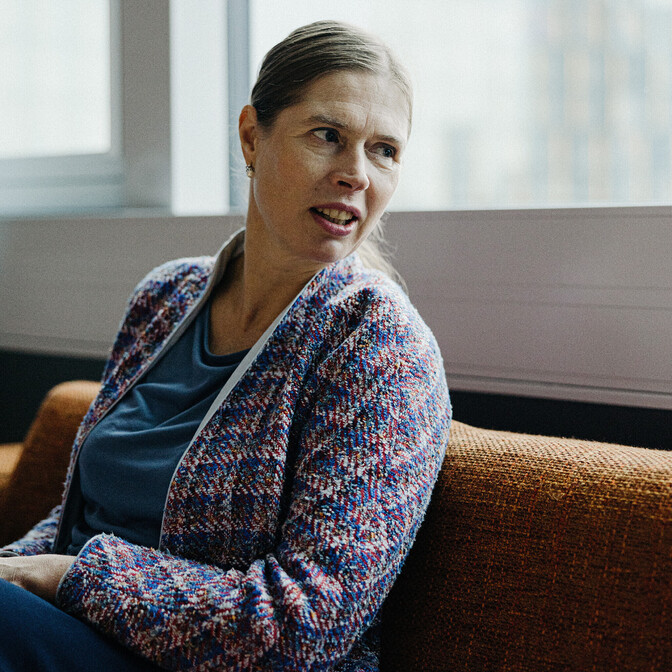 Kersti Kaljulaid. Source: Priit Mürk/ERR
And then there are the Latvians who have to hold a lottery to find enough conscripts.
And the French who are only now starting to bring people back into military service. We shouldn’t do less just because the Latvians are struggling. The Finns have always done a lot. No one in Finland is asking how much Latvia is doing — their long eastern border needs to be defended. If someone else is doing too little, that’s no reason for us to sit around crying about it.
But how do we make Russia and Putin understand that this is not a group worth testing?
That’s exactly our goal — that he thinks NATO’s northeastern corner has strong enough armed forces to hold the line until the slower part catches up. That’s the objective we have to maintain. General Merilo’s view is that we must have that kind of capability at all times. Warfare is constantly evolving and we have to keep working on it continuously.
The Estonian Defense Forces will need extra funding for quite some time. That money has to come from somewhere — likely at the expense of social spending. How long can society tolerate that?
General Herem has said that a secure economic environment is one where we destroy the Russians before they reach our territory. Defense spending is part of our stable economic environment. When investors see that a region is capable of defending itself, there’s no reason to be afraid of doing business here.
Entrepreneurs say it’s clear from the state budget where the money is being spent, but not where it’s coming from. The government is borrowing and that debt will have to be repaid. What’s your concern — should Kristen Michal be honest about where the money is coming from?
I’m sure Kristen Michal is thinking about what happens the moment markets start reacting to Estonia’s foreign debt and interest rates rise. That moment isn’t here yet because our debt burden isn’t very high, but the trend is worrying.
Often, I find myself asking why we’re spending money on certain things at all. I would support a leaner and bolder approach at EAS (now the Estonian Business and Innovation Agency or EIS – ed.) — ideally, it would just operate a guarantee fund and support for building insulation.
And I still have questions, for example, about children with special needs. If the doctors, the school and the parents all agree, why is it still necessary to get additional approval from Rajaleidja? We have a business council, but who is looking at the regulations that get in the way of parents raising children with special needs?
The government decided to let people earning over €2,100 a month keep an extra €100 after taxes. How does it feel to be a winner?
I’ve always felt a sense of responsibility and have supported various organizations. If our tax burden is 35 percent and the European average is 48 percent, then that gap has been left to society so we can take initiative ourselves — whether that’s supporting the Cancer Treatment Fund or the Instrument Foundation. These are different causes, but the point is that individuals can choose. I’ll certainly continue doing that.
When I think about the future — how the state is borrowing on my behalf and expects it to be paid back with interest — it seems likely that we’ll end up paying more. At the same time, regional inequality is deepening, educational stratification since the restoration of independence is among the worst and our birth rate is in serious decline.
I have four children and a pretty decent CV and not once in these 35 years of raising kids and trying to work has anyone asked me what I’ve lacked the most. Maybe it’s after-school programs. Maybe it’s a preschool where parents don’t feel obligated to be there by 4:55 p.m. sharp. Maybe it’s a childcare group where you can leave your child overnight for a business trip or two nights away. We could have a society that doesn’t look down on that.
Just a few simple examples of things that could help people realize that the cost of parenting doesn’t have to be so high. We should be addressing the “parenting penalty” in our society.
Even something like this — I’ve spent quite a bit of time with my family in Central Europe and I get the sense that my kids feel more welcome there. You go to an outdoor concert and there’s a designated area that doesn’t disrupt the music where little kids run up and down a hill, getting great exercise, while the parents enjoy the concert — and everyone’s happy, right?
There are so many things in a society that aren’t about money, things we could genuinely do better to help ensure we have more children.
What’s your advice on how to talk about birth rates and population growth? It feels like the topic has become somewhat taboo. As soon as it’s brought up, you hear voices saying, “Don’t force women to have children,” but that shuts down the debate. There is a problem, but there are also solutions…
That’s just it — there aren’t. I just described a whole range of solutions that don’t currently exist in Estonia. Sorry, but they simply don’t exist. And these aren’t solutions you can buy with money.
But we could move in that direction, right?
We could, but I don’t see it happening right now. This debate needs to be had, but it needs to be framed differently. Not in the tone of “Why do we have so few children?” but rather, “What can we do to make it administratively easier to support families?”
Let’s start with something basic: if you have four children, then four times you’ve been seriously worried whether you will get a kindergarten spot for your child. And four times you’ve worried whether you’ll get a school place that’s either close to home or matches your specific hopes. These are real concerns that should be easier to resolve.
Or take the situation when your child is sick — there are countries where parents can request a nurse to come to their home, not at full price but subsidized. That way, the parent can still go to work. Another example — my kids went to daycare in Luxembourg. It was completely normal there for a child who was already feeling better to bring their antibiotics along and go back to daycare.
The presidential election is coming up in the fall. Is the road back to Kadriorg beckoning you?
I generally have nothing to say on that topic. That’s a matter for the Riigikogu and I don’t relate to it.
But what if Lauri Hussar comes to you with 68 signatures and says the only thing missing is your “yes”? Would you give it to him?
Sixty-eight votes definitely isn’t enough. Last time I had, I think, 90 pledges and only ended up with 80. Alar Karis faced the same issues, so 68 votes in our Riigikogu isn’t any kind of real currency. That’s one thing.
Secondly, politicians have told me, “It would be great to have Kaljulaid in Washington or Davos, but domestically, she’s a real pain.” So the only people who talk to me about this are journalists.
Do you regret being somewhat of a “pain”?
So would it be better to stay quiet just to keep your seat longer? I’m not that old — I can still let go of the chair.
But why do some politicians become like that?
Democracy depends on courageous people. It’s the job of the president, the chancellor of justice and the auditor general to boldly defend democracy and individual freedoms and to speak up when money is being wasted. I encourage voters to make sure they’re choosing brave people.
By the way, several politicians and officials are already preparing for Urmas Reinsalu to come to power. People are trying to come up with schemes to make laws “Reinsalu-proof.” How wise do you think it is to pre-empt elections this way by building legal defense walls?
It’s a pointless waste of time. Any law can be changed. There are things I disagree with and things that have led us to a worse macroeconomic position. If state debt keeps rising, the outside world will step in and say: this can’t go on.
Do you have a sense of what it means for sports and for culture more broadly that tax revenue wasn’t collected from online casinos?
First of all, the share of sports funding from the Cultural Endowment is microscopic. Secondly, the Ministry of Finance is better equipped to assess the impact of tax changes than the Estonian Olympic Committee. The majority of sports funding comes from the state budget, not just gambling taxes.
And the good news is that no Winter Olympic medals will be lost due to this funding issue?
That certainly won’t happen — of course not. Our national team has been announced and the equipment crates are already packed in the Olympic Committee’s meeting room. It looks like Santa’s workshop in there and I think our athletes will head out in good spirits and deliver strong performances.
It’s funny how success in sports is so often defined solely by medals. I remember a legendary interview — Marko Kaljuveer, then head of sports at ERR, asked President Toomas Hendrik Ilves at the opening of the London Olympics: so, what would count as a success? He defined it like this: if we win one medal, that’s good, two is great and three is beyond expectations. If the classics have defined success that way, do you agree that two medals is great and one is good?
I’d say that if an athlete delivers their best performance, then the final placement depends on others. Of course, a medal is meaningful to the broader public and creates emotion. It has intrinsic value — it lets us step out of geopolitical reality for a moment and feel joy over a sporting achievement.
Russian athletes will also be present at the Olympics. They can’t wave their own flag, but that day seems to be getting closer. Is it inevitable?
Together with the presidents of the Baltic Olympic committees, we sent a letter to the IOC and the response was basically: go take a hike. That doesn’t mean we’re giving up the fight. The sports administrative system may be losing that battle, but we’re not walking away without trying.
If an Estonian athlete ends up facing a Russian competitor in a match, what do we do? We still allow the competition to happen and try to win, right?
As I said at the Sports Stars of the Year gala: we’ll put a blue-and-yellow ribbon in our hair and try to win. The athlete isn’t to blame for ending up in that situation. It’s our failure — we haven’t managed to prevent it.
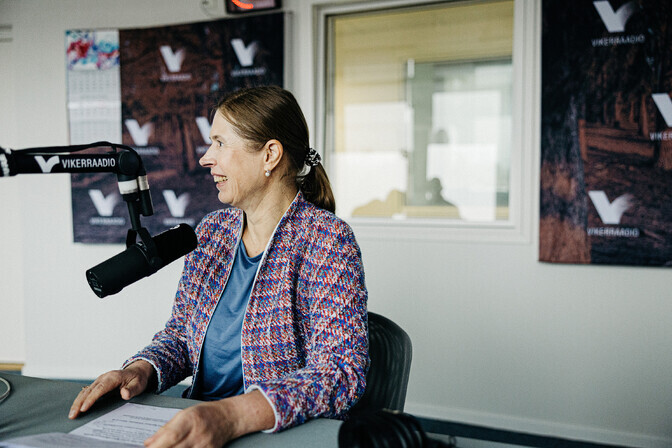 Kersti Kaljulaid. Source: Priit Mürk/ERR
—