
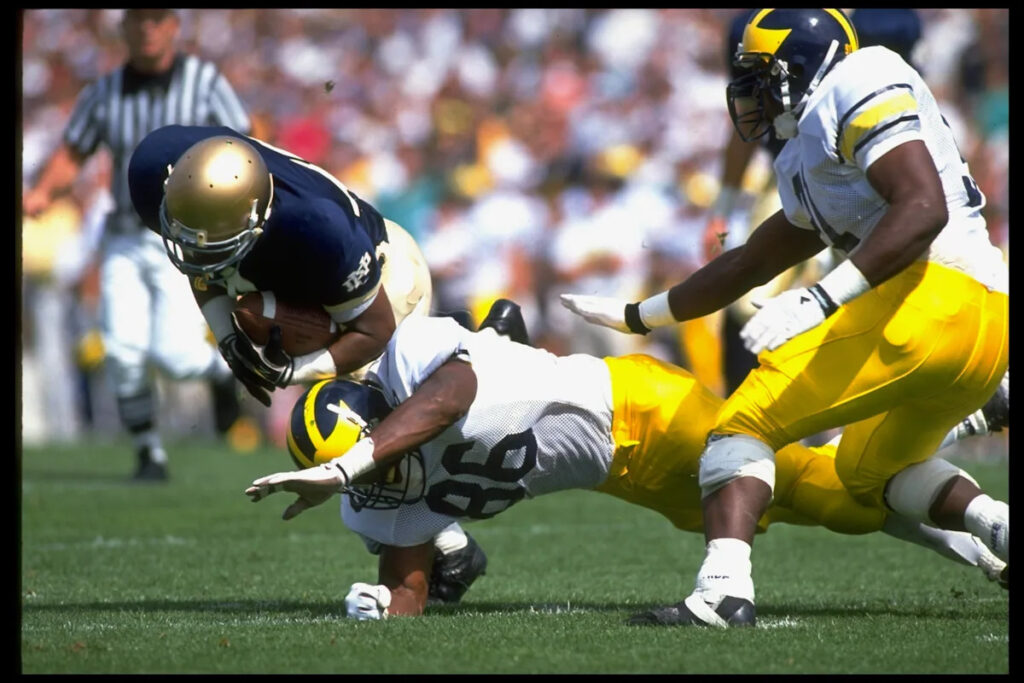
This week’s Throwback Thursday takes us back to one of the most emotionally charged games ever played inside Notre Dame Stadium — the 1992 showdown between Notre Dame and Michigan. I chose this game in honor of Reggie Brooks, whose birthday we just celebrated on January 19th. Reggie’s legacy at Notre Dame extends far beyond statistics, and this particular game remains one of the most unforgettable chapters of his Irish career.
What unfolds below is a moment-by-moment account of a contest that ended in controversy, tension, and a rare tie — a game that left fans, players, and coaches searching for answers long after the final whistle. The final 72 seconds alone are etched into Notre Dame football lore, capturing the emotion, uncertainty, and drama that defined an era before overtime rules rewrote how games like this would end.
Advertisement
The below excerpt is from the 1992 Football Review, in the Scholastic Magazine, Vol. 134, No. 13, written by Jim Kuser.
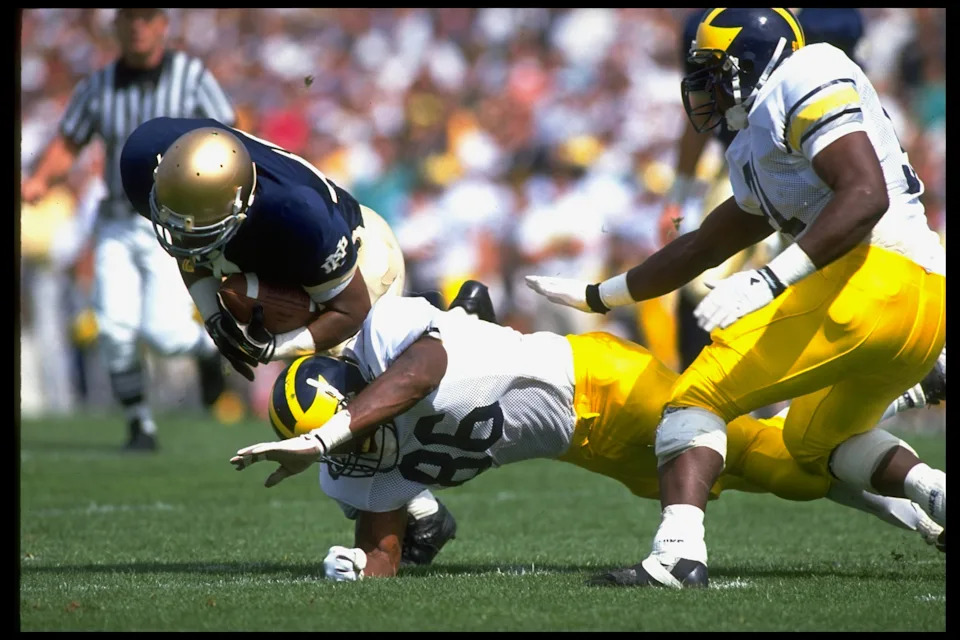
Gridiron Grudge Matchby Jim Kuser
Notre Dame fought back from a 17–7 fourth quarter deficit to even the score at 17. Michigan, however, took control of the ball with 5:28 to go in the game and composed a methodical drive that milked the clock down to 1:12. Then, be it justified or not, a series of events occurred that looms largely over Notre Dame head coach Lou Holtz, just as a similar series of events occurred in 1966 that still looms largely over former Notre Dame head coach Ara Parseghian. The play-by-play for the final 72 seconds of the 1992 Notre Dame–Michigan game tells the tale.
Advertisement
There are 72 seconds to go in the game. The 69,075 fans in attendance are on their feet. Notre Dame Stadium is really rocking. It’s first-and-ten for the Michigan Maize and Blue at the Notre Dame 30. A few short-yardage gains could set up a game-winning field goal. Wolverine quarterback Elvis Grbac — he’s their leader — steps to the line to take the snap from center. Receiver Derrick Alexander — he’s their game-breaker — is split wide to the right. Tailback Ricky Powers is in the slot. Grbac audibles. The ball is snapped. Grbac drops. Here comes a fierce rush from Irish cornerback Greg Lane on the left. Grbac scrambles right. Grbac sets, throws … Interception! Irish free safety Jeff Burris has intercepted Grbac at the Notre Dame 12.
First-and-ten for the Irish with 1:05 remaining. This has been a barn-burner throughout. The score is deadlocked at 17; Mirer steps to the line. He hikes and hands to fullback Jerome Bettis, who rumbles up the middle for seven. Second-and-three from the Irish 19. Penalty flags are down. Illegal procedure on Notre Dame for a five-yard loss and a repeated down. Second-and-eight from the Irish 14. Mirer again steps to the line. He hikes and drops to pass. He sees receiver Lake Dawson but overthrows out of bounds at the Notre Dame 40. Third-and-eight from the Irish 14. Time out assessed to Notre Dame with 0:07 left. It will take a Hail Mary to win this one.
Mirer lines up. Center Tim Ruddy snaps. Mirer curls right, sets, throws deep … broken up at the Michigan 32 by free safety Corwin Brown. Final score: Notre Dame 17, Michigan 17.
Anger. Apathy. A myriad of mixed emotions amounting to nothing more than emptiness. Not since 1969, when Notre Dame tied Southern Cal 14–14, had the 59,075 faithful Fighting Irish football fans witnessed a tie at Notre Dame Stadium. This tie, however, was criticized as being comparable to the much more memorable 10–10 tie at Michigan State in 1966. In that game, Coach Ara Parseghian admittedly played for a tie in a match-up between the number-one Irish and the number-two Spartans. Notre Dame went on to win the national championship, and Parseghian made no excuses for a tie.
Advertisement
“We’d fought hard to come back and tie that game up,” said Parseghian. “After all that, I didn’t want to risk giving it to Michigan State cheap. If we’d gotten reckless, it could’ve cost us the game.”
There is a distinct difference, however, between Holtz’s tie against Michigan in 1992 and Parseghian’s tie against Michigan State in 1966. Unlike Parseghian, Holtz explained emphatically that he did not play for a tie.
“We’ve worked too hard for too long to settle for a tie,” said Holtz. “We were going for the win.”
So why a running play up the middle and into traffic with 1:05 left — a play that cost Notre Dame precious time — instead of a passing play out of bounds and away from traffic?
Advertisement
Holtz explained, “On our last possession, we were backed up. Michigan did a good job of mixing its coverages. We wanted to find out what coverage Michigan would be in, so we ran the ball. I thought we could spring it loose, and we almost did.”
Michigan head coach Gary Moeller defended Holtz’s decision. “I was nervous when they had the ball,” said Moeller. “I would never second-guess Holtz’s thinking, especially when he has a lot of time to think about a game plan.”
Moeller might, however, second-guess his own thinking. Referring to his decision to let Grbac throw on first-and-ten from the Notre Dame 30 with 1:05 to go in the game, he said, “I know what I was doing. I just wanted to punch the ball downfield a little bit and get a field goal. I guess I got too fancy.”
Grbac, maligned by many Michigan fans for turning the ball over with time running out, apologized by saying, “I was just trying to throw the ball high. I didn’t take into account the defensive player back there. It was just a very stupid mistake on my part. What more can I say? I’m sorry.”
Advertisement
Neither coach was happy to tie.
Said Holtz, “It’s been a long time since I’ve been in a tie (in 1982, as head coach at Arkansas, Holtz tied SMU, 17–17). It just doesn’t seem like the game should be over. I don’t know how you’re supposed to feel. It was a crazy game that left me with an empty feeling.”
Said Moeller, “No way am I happy with a tie. We came in here fully expecting to win. I’m very disappointed.”
The players seemed to be a bit more upbeat about it.
Mirer said, “A lot of people were second-guessing, but it’s easier when you’re behind than when you’re tied up. If you’re behind, you just go for it, and you have nothing to lose. We had only one time out left, and we came at them the best we could. We didn’t want to give the game away. I’m disappointed in people’s reactions. That was a great football game. We played well enough to win, but it just didn’t work out. Those things happen.”
Advertisement
Grbac shared Mirer’s sentiments. “We should’ve won the game,” he said, “but we didn’t. We really played so well as a team. It really hurts not to win a game like this. This is just like two years ago [a 24–19 Irish victory made possible by the heroics of Raghib ‘Rocket’ Ismail, who returned two second-half kickoffs for touchdowns and consequently graced the cover of Sports Illustrated that week with the words ‘Rocket Man’ written across his chest].”
Not only did Notre Dame and Michigan tie each other on the scoreboard, but they also tied each other in turnovers. Notre Dame, boasting one of 1992’s most effective rushing backfields, fumbled four times, losing three. Michigan, boasting one of 1992’s most efficient passing quarterbacks, was intercepted three times.
“I guess it is typical of an early season game, but you never like to see it, especially in a game of this magnitude,” said Holtz.
What makes this game even more remarkable is that one of its most iconic moments isn’t even mentioned in the recap above. The 1992 Michigan game is also remembered as the day of Reggie Brooks’ “Unconscious Touchdown.” After taking an option pitch from Rick Mirer, Brooks spun, broke a tackle, and was knocked out just shy of the goal line — only to wake up in the end zone, having somehow completed one of the most astonishing touchdown runs in Notre Dame history.
Advertisement
Reggie has shared that he has no recollection of the play at all — a detail that somehow makes the moment even more legendary. I’ll close this week’s Throwback Thursday with a video of Reggie recounting that unforgettable run in his own words, a reminder that sometimes the most enduring moments in college football aren’t just about wins and losses, but about stories that live on long after the scoreboard fades.
Cheers & GO IRISH!