

Company Logo
The Swiss ecommerce market offers growth opportunities in multiple sectors, including retail shopping, travel, and technology. With a diverse array of payment methods and strong consumer demographics, businesses can capitalize on digital trends and evolving consumer preferences to enhance market presence and performance.
Swiss B2C Ecommerce Market
Swiss B2C Ecommerce Market · GlobeNewswire Inc.
Dublin, Jan. 29, 2026 (GLOBE NEWSWIRE) — The “Switzerland B2C Ecommerce Market Size & Forecast by Value and Volume Across 80+ KPIs – Databook Q4 2025 Update” report has been added to ResearchAndMarkets.com’s offering.
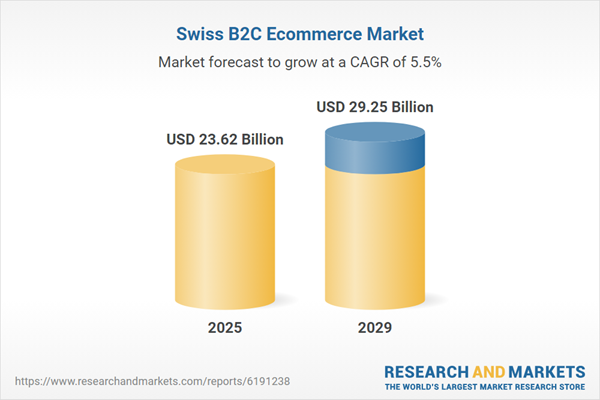
The ecommerce market in Switzerland is expected to grow by 6.3% annually, reaching US$23.62 billion by 2025. The ecommerce market in the region has experienced robust growth during 2020-2024, achieving a CAGR of 12.7%. This upward trajectory is expected to continue, with the market forecast to grow at a CAGR of 5.5% from 2025 to 2029. By the end of 2029, the ecommerce market is projected to expand from its 2024 value of US$22.21 billion to approximately US$29.25 billion.
This report provides a detailed data-centric analysis of the ecommerce industry in Switzerland offering comprehensive coverage of both overall and ecommerce markets. It includes more than 80+ KPIs, covering gross merchandise value, gross merchandise volume, and average value per transaction.
The report provides a detailed assessment of the ecommerce market across all major segments, including retail shopping, travel, food service, media, healthcare, and technology categories. It analyzes sales channels, engagement models, device and operating system usage, as well as domestic versus cross-border flows and city-tier contributions. The study also covers payment instruments and consumer demographics by age, income, and gender to map evolving purchasing behavior. Together, these datasets offer a comprehensive view of ecommerce market size, customer behavior, and digital channel performance.
The research methodology is based on industry best practices. It’s unbiased analysis leverages a proprietary analytics platform to offer a detailed view of emerging business and investment market opportunities.
Reasons to Buy
-
Comprehensive Market Intelligence: Develop a complete understanding of the B2C ecommerce landscape in Switzerland with fundamental ecommerce metrics such as gross merchandise value, gross merchandise volume, and average value per transaction across all major ecommerce segments.
-
Granular Segmentation and Cross-Analysis: Analyse the online retail ecosystem through detailed segmentation covering ecommerce segments, retail product categories, travel and hospitality verticals, media and entertainment services, sales channels, devices, operating systems, cities, and payment instruments, enabling deep insight into evolving consumer shopping patterns.
-
Operational and Performance Benchmarking: Benchmark marketplaces, direct-to-consumer platforms, aggregators, and category-focused players using KPIs such as GMV share, category-level performance, channel efficiency, device contribution, and payment mode penetration, supporting comparative assessment of platform strengths and competitive positioning.
-
Consumer Behavior and Ecosystem Readiness: Understand how demographics, income groups, gender mix, device usage, and payment preferences shape online purchasing decisions, influencing category demand, cart abandonment behavior, product return tendencies, and the shift toward digital-first commerce.
-
Data-Driven Forecasts and KPI Tracking: Access a structured dataset of 80+ ecommerce KPIs with historical and forecast values up to 2029, providing clarity on growth drivers, category expansion, sales-channel transitions, and payment-instrument evolution across the B2C ecommerce value chain.
-
Decision-Ready Databook Format: Delivered in a standardized, analytics-friendly databook format aligned with financial modeling requirements, enabling ecommerce companies, consumer brands, payment providers, technology firms, and investors to conduct evidence-based market assessment and strategic planning.
Story Continues