
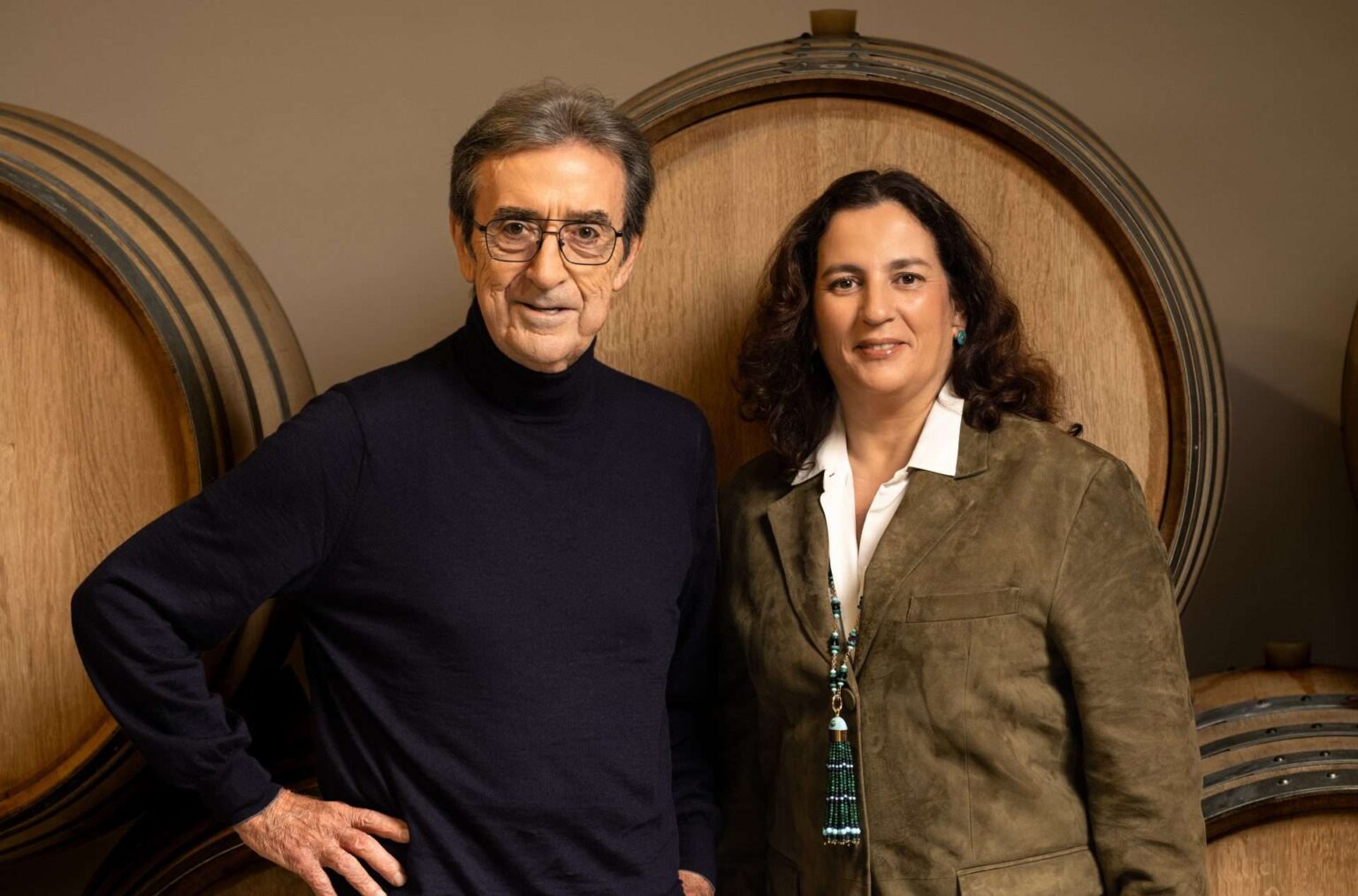
Internationally renowned consultant Riccardo Cotarella has entered into his first Portuguese collaboration, joining forces with Luisa Amorim and Amorim Family Estates to explore mountain viticulture across some of Portugal’s most important wine regions.
Announced on 22 January 2026 in Porto, the partnership will see Cotarella work across the Amorim family’s Quinta Nova de Nossa Senhora do Carmo in the Douro and Taboadella in the Dão, as well as Luisa Amorim’s personal project, Herdade Aldeia de Cima, in the Alentejo.
The collaboration brings together two long-standing winemaking families from Italy and Portugal, with a shared focus on indigenous grape varieties, blending and site-specific viticulture.
A first for Cotarella in Portugal
The project marks Cotarella’s first professional engagement in Portugal, prompted by what he describes as the country’s “vast diversity of native grape varieties” and its long tradition of blending.
“In Luisa Amorim’s projects, I found a deep attention to detail and local craftsmanship, with each estate having its own winemaking and viticulture team, its own scale and philosophy, and mountain environments with a mosaic viticulture that explores nano and micro-parcels of native grape varieties,” Cotarella said.
“Portugal has a truly unique intelligence for blending. The natural way in which winemakers combine dozens of indigenous varieties while preserving the balance and identity of each wine is a rare art in the wine world. Working here is inspiring: there is rigor, sensitivity and a natural harmony that transforms complexity into beauty, providing the conditions to create wines of truly global expression. I, myself, come here to learn and to share.”
His work will be carried out alongside resident winemaking teams at each estate: António Bastos and Eduardo Leite at Quinta Nova de Nossa Senhora do Carmo, Rodrigo Costa at Taboadella, and António Cavalheiro at Herdade Aldeia de Cima.
Shared philosophies across regions
Luisa Amorim, whose family heritage is rooted in cork production dating back to 1870, has been a central figure in the modernisation of Portuguese wine. At the age of 26, she launched a Port aimed at younger consumers and created what is described as the first unoaked red wine from the Douro.
Today, she oversees three projects spanning Douro, Dão and Alentejo, with a focus on sustainability, indigenous varieties and what she calls “mosaic viticulture”, working with nano- and micro-plots of different grapes. Her estates also incorporate wine tourism initiatives designed to preserve local culture and heritage.
“Working with Riccardo means working with wisdom, and with a great friend,” Amorim said. “His meticulous attention to phenolic ripeness, micro-vinification and varietal purity, combined with his vast experience in iconic Italian and international estates, makes him a true master at elevating each terroir to its highest expression of excellence.”
The collaboration is positioned as more than a technical exercise, bringing together different generations, cultures and geographies. According to the partners, the aim is to reinforce Portugal’s standing on the global wine stage while remaining rooted in local identity and ancestral practices.
Amorim Family Estates focuses exclusively on indigenous grape varieties and a parcel-driven approach, combining traditional methods with modern technology. Alongside wine production, the group has developed some of Portugal’s most prominent wine tourism projects, centred on historical preservation and regional authenticity.