
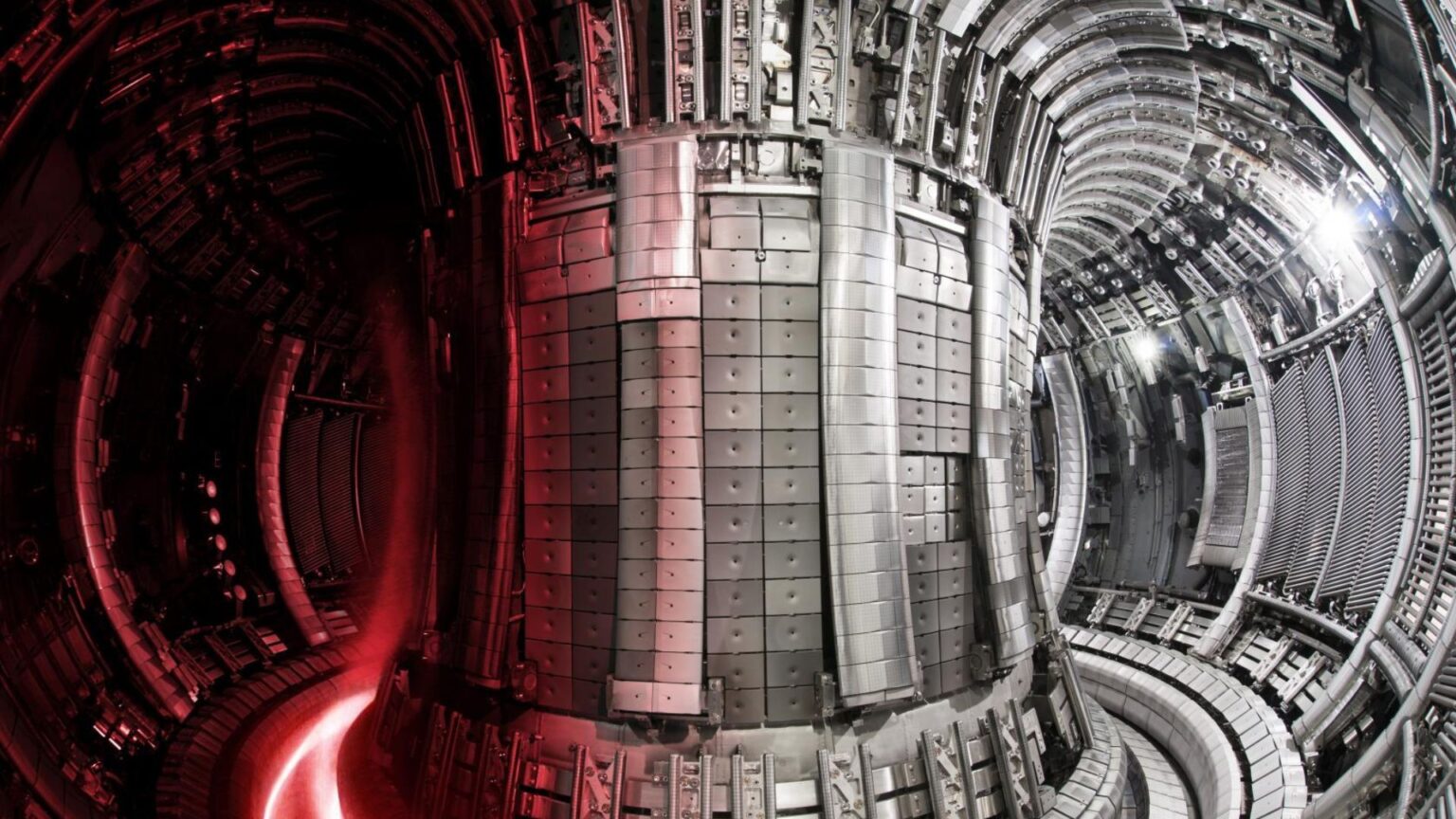
Engineers at the UK’s STEP (Spherical Tokamak for Energy Production) program have successfully tested a “plug-and-socket” magnet technology.
This breakthrough is expected to dramatically lower the cost and complexity of operating fusion power plants by addressing one of the primary engineering challenges of the tokamak design.
The latest development, shared with Interesting Engineering through an email, involves the successful trial of Remountable Joints (RMJs)—precision connections that allow massive fusion magnets to be disassembled and reassembled for maintenance.
Traditionally, fusion magnets are built as solid, permanent structures, which makes any internal repair or component replacement incredibly slow, complex, and expensive.
By utilizing these precision joints, sections of a magnet can be taken apart much like industrial-scale connectors, tackling a hurdle that has long hindered the commercial outlook for fusion energy.
A “bladder-based” innovation
The STEP magnets team, working alongside the UK Atomic Energy Authority (UKAEA) and UK Industrial Fusion Solutions (UKIFS), has also unveiled a novel mechanical clamping system to support these joints. For fusion to occur, fuel must be held in place by extremely powerful magnetic fields.
These magnets must not only perform at high levels but also withstand the immense mechanical forces generated during operation.
The new system utilizes a specialized bladder-based clamp filled with a liquid that expands as it freezes during the cooling process.
This expansion creates an even contact pressure across the electrical interfaces at cryogenic temperatures, ensuring the magnets remain stable and efficient.
This innovation enables faster and more targeted maintenance while significantly reducing plant downtime to improve overall availability.
The technology lowers operating and lifetime costs and supports the development of compact, high-performance magnet systems that are essential for commercial power plants.
Adoption in future fusion plants
The clamping system is currently being prepared for patenting, with a view to adoption in future fusion power-plant designs beyond the STEP program.
Manufacturing studies conducted alongside the testing have shown that these joints can be produced using several different industrial techniques. This variety in production methods helps to de-risk future large-scale production and supports the development of a robust supply chain within the UK.
Aurobindo Siddarth Swaminathan, Principal Engineer for magnets at STEP Fusion, noted the speed of the project’s progression.
He stated that the team moved from a concept sketch to delivering and shipping a product for testing within a single financial year.
Road to 2040 for STEP
“STEP (Spherical Tokamak for Energy Production) Fusion is developing a prototype fusion plant at West Burton in Nottinghamshire, with the ambition of generating electricity for the grid in the 2040s,” highlighted the engineers in a press release.
This timeline requires the transition of fusion technology from a laboratory experiment into a reliable, industrial-scale energy source.
One of the key barriers to this transition is ensuring that the reactor components are not just powerful, but also maintainable over several decades of continuous operation.
Current testing in the UK is focused on how multiple joints perform together in realistic, fusion-specific magnetic environments. These tests aim to simulate the extreme conditions the magnets will face during a full fusion reaction.
“By proving that magnets can be both powerful and maintainable, STEP is tackling one of the key barriers to turning fusion from an experiment into a reliable source of clean energy,” concluded the press release.