
This article was written as part of NK TechLab, a project of 38 North that serves as a central hub for ongoing investigation and analysis into how North Korea uses technology to serve and suppress its citizens. To read other research like this, visit NK TechLab here.
North Korea’s cellular network has continued to expand since 38 North last mapped its footprint in late 2022, but the most significant change in the last several years has been the debut of 4G service. The launch of 4G brings faster data service that enables easier use of bandwidth-intensive applications such as streaming videos and making video calls.
For the North Korean government, network expansion is an important element of its drive to deliver more services to the public via electronic networks. The Law on Prevention of Procedural Order Violations provided the foundation for e-government, and subsequent laws have created legal frameworks for things such as electronic signatures and identification. But without a strong mobile network, the policy will be hampered.
Therefore, further enhancement of North Korea’s cellular network is expected, although with greater emphasis placed on technical and capacity enhancements rather than expansion of geographic coverage.
Cell Network Coverage
The biggest change to the map of cellular service access throughout the country has been the construction of new cellular base stations in rural areas. Additionally, access to higher resolution commercial satellite imagery has enabled the identification of a few pre-existing base stations. This has resulted in the addition of coverage in northern areas including North and South Hamgyong province and Ryanggang province.
Less obvious on the coverage map, but notable nonetheless, are efforts to increase network coverage in built-up areas, such as more populated cities. In North Korean media, for instance, it is becoming more common to see cellular antennas on the top of buildings in Pyongyang and other cities, supplementing areas that are already covered.
These efforts reflect the need to provide additional capacity in areas with many existing subscribers and are further evidence that smartphone use is expanding.
The map is based on locations of over 1,400 cellular base stations in North Korea identified on satellite imagery. This analysis includes around 400 more locations than the 2022 coverage map.
This analysis relies on recent high-resolution, commercial satellite imagery to capture the full extent of the network. As such, additional base stations have likely been missed in this analysis. It is also possible that some sites identified as cellular towers are for other purposes, such as broadcasting relay, however, North Korean cellular sites typically have a distinctive imagery profile, consisting of a small building, solar array and transmission tower.
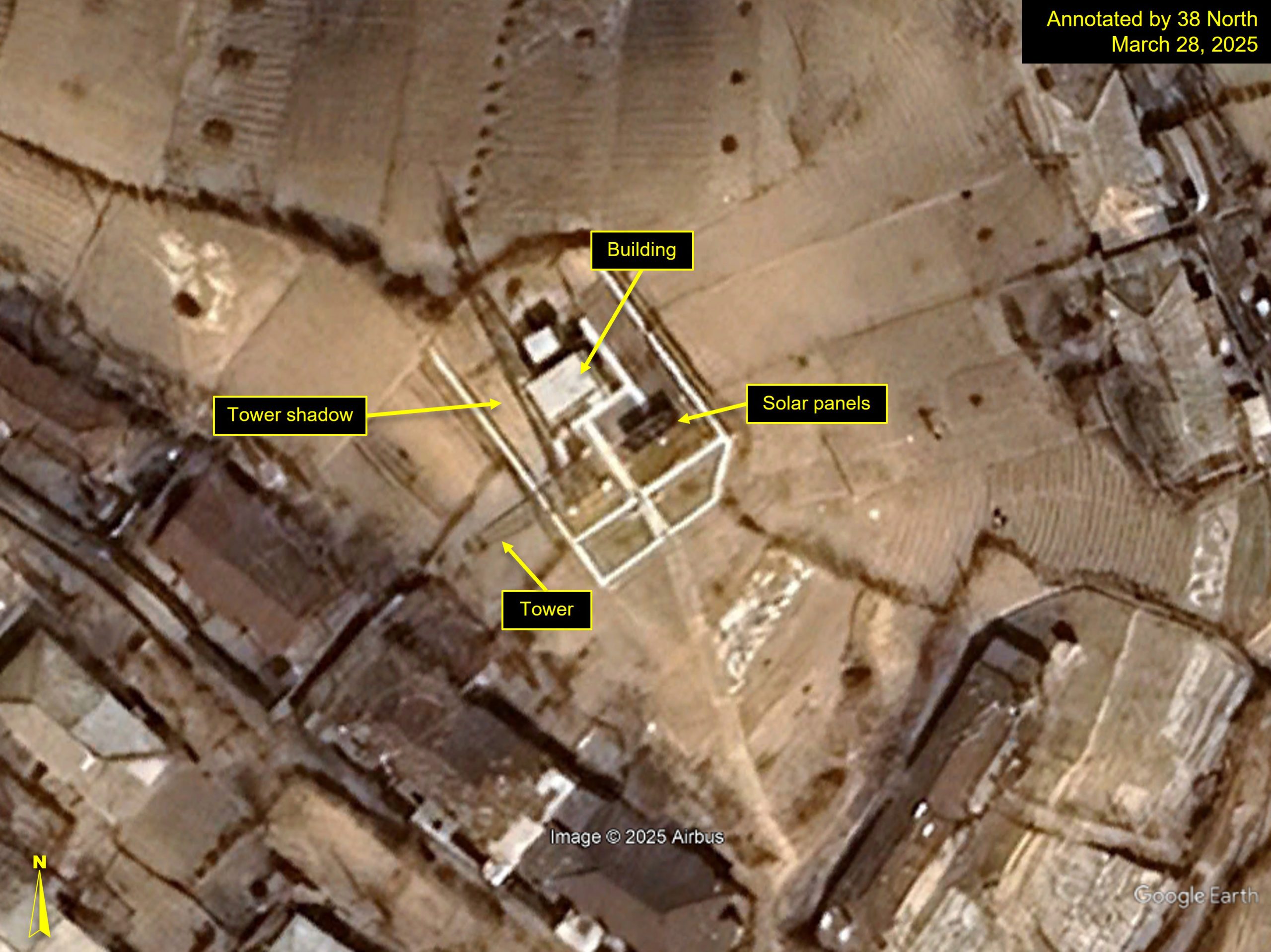 Figure 1. A cell tower in Sinpyong, North Hamgyong province. Image: Google Earth, annotation by 38 North. For media licensing options, please contact [email protected].
The Debut of 4G
4G was launched in North Korea in September 2023 by Kangsong, one of the country’s two cellphone network operators. The 4G LTE network operated by Kangsong is likely capable of speeds of around 10-30Mbps, or about ten times that of 3G networks. This estimate is based on the reported use of used 4G equipment, which is likely earlier generation gear than current 4G networks in other countries.
The network first opened in Pyongyang, but coverage appears to have spread far beyond the capital.
It is unclear if Koryolink, North Korea’s other carrier, has also launched a 4G service and it is impossible to determine such information via satellite imagery.
The 2023 launch of 4G keeps North Korea one technology generation behind cellular services in most developed nations. That is not necessarily a bad thing for the country, which can benefit from wide access to second-hand cellular networking equipment. For instance, it was reported that Kangsong built its 4G network with second-hand Huawei equipment.
Handsets
After the launch of 4G, it appears that most—if not all—cellular handsets available in North Korea support 4G. Modern handsets based on Chinese Android designs from the last few years were recently on show at exhibitions in Pyongyang. All appeared to support 4G networks.
 Figure 2. New phones on display at the Development of Light Industry 2025 expo in Pyongyang in November 2025. (Source: Korean Central Television)
Conclusion
With the state focused on using mobile communications to drive efficiencies in the economy and delivery of state services, and the apparent popularity of smartphones with the North Korean public, network expansion is expected to continue. This will be driven by both a desire to expand geographic coverage, and also a growing demand for increased network capacity in built-up areas.