
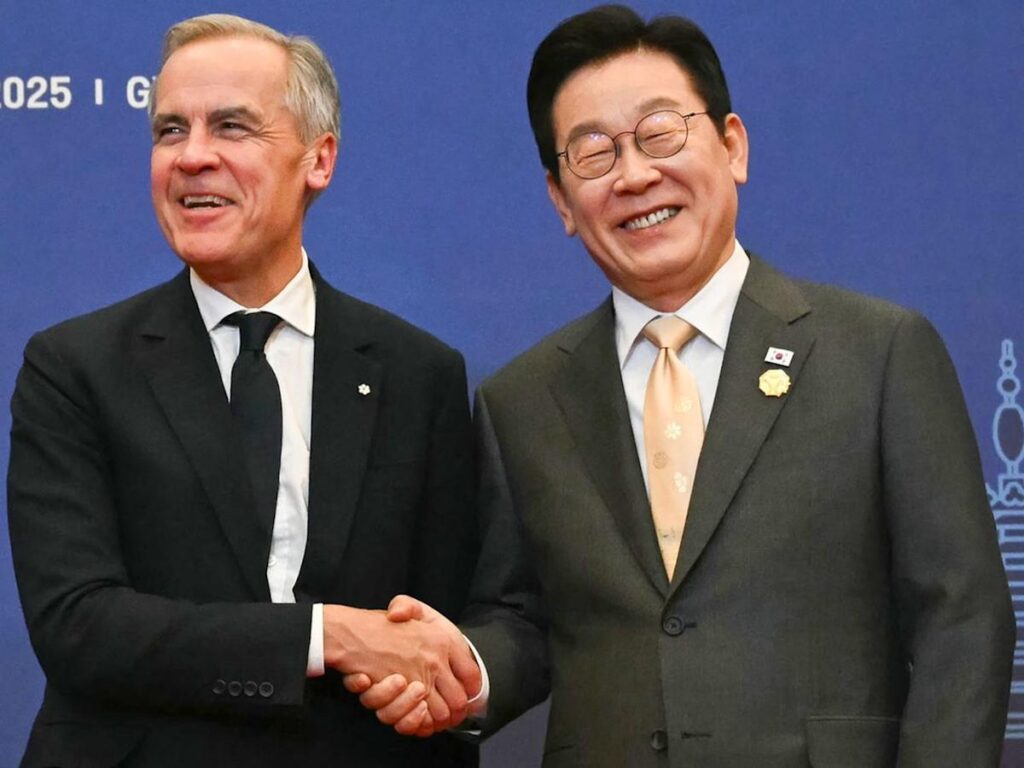
Canada has signed a memorandum of understanding (MOU) with South Korea to strengthen industrial cooperation, including potential investment in automobile and battery manufacturing here.
The MOU arrives as auto executives, labour representatives and policymakers search for ways to stabilize Canadian auto manufacturing sector, which is coming under pressure from United States tariffs, a slowdown in electric vehicle sales here and heightened competition from Chinese automakers.
South Korean automakers sold roughly 228,000 vehicles in Canada in 2024, amounting to about 12 per cent of the market, and have increased their market share in the past decade. But its main automakers, including Hyundai Motor Co. and Kia Corp., do not manufacture any vehicles here.
“Our automotive industry contributes $16.8 billion to Canada’s (gross domestic product) and supports more than 550,000 jobs, and deeper industrial collaboration will help keep the sector competitive as advancements in electric vehicle and battery technologies continue to accelerate,” International Trade Minister Maninder Sidhu said in a statement.
A press release about the MOU said there’s an “intention to cooperate on advancing a Korean automotive industrial footprint in Canada.”
Although South Korea’s automakers, which produced four million vehicles in 2024 — more than double the number produced in Canada — do not have operations here, some of its companies have invested in this country’s nascent battery and electric vehicle supply chain.
For example, Nextstar Energy Ltd., which built Canada’s first major battery plant — a 4.23-million-square-foot complex in Windsor, Ont. — is majority-owned by South Korea’s LG Energy Solution Ltd. It started commercial production last year, shifting its focus to producing batteries for energy storage until EV demand picks up.
Other South Korean companies have also invested in Canada’s battery supply chain, too.
But as automakers with manufacturing operations in Canada, including those based in the U.S., have scaled back their presence here by closing plants, eliminating shifts and delaying investments, some auto-sector professionals have been questioning why South Korean automakers have duty-free access to the Canadian market if they do not build here.
The recent MOU signed by Canada shows policymakers are talking to South Korean officials about that prospect.
The two countries signed a free-trade agreement in 2015, and bilateral merchandise trade extended far beyond autos to reach $24.5 billion in 2024.
South Korea is also vying with Germany to win a multibillion-dollar contract to supply Canada with a dozen submarines. As part of its efforts, it sent a delegation of government officials and company executives, including from Hyundai, to Ontario this week to meet with cabinet officials and local industry players.