
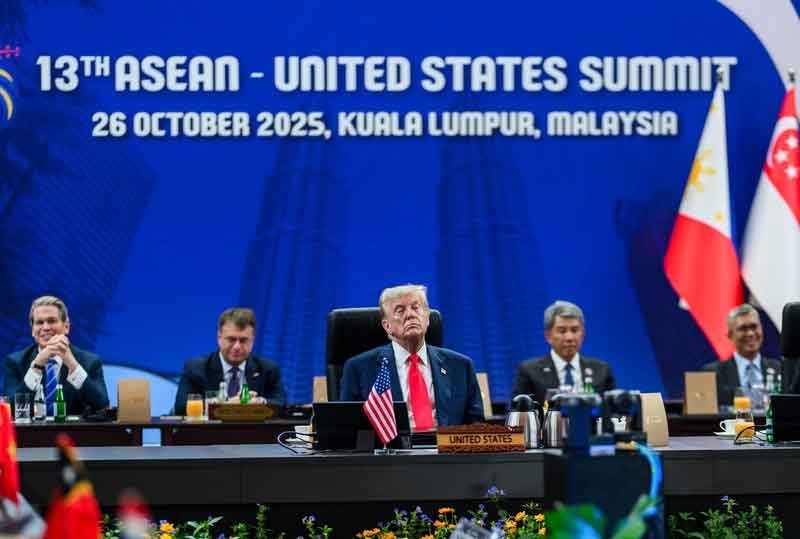
 President Donald Trump attends the ASEAN Summit at the Kuala Lumpur Convention Center Sunday, October 25, 2025, in Kuala Lumpur, Malaysia. (Official White House Photo by Daniel Torok, via Flickr/Wikimedia Commons)
One of the important stated aims of high and arbitrary increases announced by the USA in recent times is to increase market access of US farmers in Asian countries, but the reality is that the problems of US small and medium farmers have been steadily increasing due to the exploitation of farmers by big business interests. The same big business interests and giant multinational companies that are increasing the problems of US farmers are also increasing the problems of farmers in Asian countries. Farmers of both places will be helped by placing much needed restraints on the arbitrary exercise of power by big agro-business interests. Farmers everywhere should demand this and the adoption of policies that protect common farmers and family farms and help to spread ecologically protective farming. In a separate companion article being released today I have described in detail how US farmers are being squeezed and exploited by big business interests. Here we examine the harm caused by recent US trade agreements in several Asian countries.
GRAIN, an international civil society organization known for its thoughtful analysis of food and farming related policy issues, has released on 24 January 2026 a paper titled ‘US Tariff Policy Bulldozing Asia’s Agriculture’. This paper states, “After last April’s “tariff wars” announcement, the Trump Administration rushed to finalise trade and investment deals in Asia, negotiating market access for its agricultural commodities with many governments in the region. Calling it “negotiating” is probably a stretch. Countries were forced to facilitate a 0% import duty on most US imports and allow Washington to bypass domestic standards and regulations. This authorised the US to unload its genetically modified (GM) foods and other products considered hazardous by other countries. In the likes of a typical neo-colonial power, the US used tariff threats to achieve economic, political, and trade concessions.”
Further this paper states, “Between July and October 2025, the US clinched trade deals (preliminary, upgraded or limited ones) with Vietnam, Indonesia, Japan, South Korea, Pakistan, Philippines, Thailand, Malaysia, Cambodia and China. The US is currently negotiating a trade deal with India.”…In most of these trade negotiations, Asian economies were so terrified of US tariffs that they gave in like a house of cards. They accepted nearly every US demand in order to secure lower fees for their goods entering the US, giving away broad concessions and accepting harsh conditions. For the food and agriculture sector these demands included to:
- Eliminate tariffs on 99% to 100% of the US products,
- Purchase of US agricultural products, including soybeans, soybeans meal, maize, wheat, rice, and cotton (over 90% of soya, maize, and cotton produced in the US is genetically engineered),
- Provide market access for US dairy products,
- Lower or drop various non-tariff barriers to ensure uninterrupted US exports,
- Align to US policies on supply chain security (to avoid sourcing from entities deemed high risk by the US government), dumping, trans-shipment (to avoid shipping goods through an intermediate country to disguise their true origin), and export control issues (to avoid transactions with sanctioned entities or prohibited end-users listed on various US watch-lists),
- Recognise US regulatory oversight, and accept the US’s inspection system of meat, poultry, and dairy facilities as equivalent to its own standards, besides accepting certificates issued by the US regulatory authorities (side-lining domestic regulations as in the case of Halal certification in Malaysia),
- Eliminate pre-shipment inspection or verification requirements on imports of US goods,
- Harmonise domestic regulations to align with US regulations and standards (especially for granting fast approval to GM seeds and crops, GM food imports, and giving clearance to non-GM shipments containing any low-level presence occurrence of genetically modified organisms (as in the case of US-Cambodia deal),
- Take steps to resolve long-standing intellectual property issues, e.g., acceding to the International Convention for the Protection of New Varieties of Plants (UPOV) 1991 (as accepted by Malaysia and Cambodia).”
Regarding the impact of this, the GRAIN paper says, “Through its tariff policy, the US succeeded in imposing one-sided commitments on standards and technical processes, forcing countries to automatically acknowledge US food and agricultural control systems and all certificates issued by US regulatory authorities. Disturbingly, all these engagements are made without obliging the US to make any reciprocal pledge to Asian countries to facilitate the access of their agricultural and dairy products into US markets.
“Japan, which rarely compromised on rice imports, was forced to increase its imports of US rice by 75%, on top of a major expansion of import quotas and the purchase of US$8 billion worth of US goods, including maize, soybeans, fertilizer, bioethanol, and aviation agro-fuel. In the case of Bangladesh, even though it does not have any trade deal with the Washington, in order to secure lower import tariffs in the US, Bangladesh agreed to purchase 700,000 metric tons of wheat annually over the next 5 years and US$1 billion worth of soybean in the coming twelve months. Some countries, like Thailand, Malaysia, and Cambodia even accepted US demands to refrain from signing trade deals with a country that can jeopardise essential US interests.”
The GRAIN paper tells us that some countries are now regretting having accepted one-sided US conditions. Indonesia is one. It is now pushing back against the coercive clauses of the trade deal, arguing that they impinge on its political and economic sovereignty by restricting deals with US rivals like China. In Malaysia, the US trade deal has sparked significant controversy, with critics arguing it undermines national sovereignty and the country’s long-standing neutrality on foreign policy. Groups like Sahabat Alam Malaysia, and the Consumers’ Association of Penang, have condemned the agreement as a “surrender of Malaysia’s sovereignty”. They accuse the government of failing to explain the deal’s implications, warning it would grant US companies tax exemptions, reduce regulations for US investors, give US regulators veto power over Malaysian standards, and allow US interests to shape Malaysian foreign policy.
The US is now in the final stages of negotiating a trade deal with India. Given the trend across the region, GRAIN warns that US is likely to push for one-sided obligations and severe conditions in the trade deal with India, particularly in sensitive sectors such as agriculture, dairy, and fisheries- areas critical to India’s food security and the livelihoods of millions of small-scale producers. “While India currently maintains strict biosafety controls-prohibiting GM products and permitting only one GM crop (Bt cotton)-the proposed trade deal could severely threaten these regulations. Based on precedents in other Asian countries, the agreement is expected to pressure India to harmonize its food safety and biosafety standards with those of the United States.”
The Indian Forum for Trade Justice has cautioned the government about signing such an unfair trade deal with the US, stating that in the current negotiations, “India’s interests will not be safeguarded by being subservient…Instead, they will be served by being resolute and firm and keeping our long-term economic prospects, developmental goals, and ecological security in mind.”
All of these concerns are very important, not only in terms of immediately visible contexts, but also in terms of longer-term concerns some of which may not be very visible just now but may be of very great significance in the longer-term context of environment and health harm. Under the highly harmful influence of big business interests, US authorities have allowed the country to suffer great environmental and health harm by spreading GM crops widely. Now there is a feeling that other countries which remain GM free can have the ability to provide safe food in many markets. This is sought to be denied by exerting highly unethical pressures to spread GM crops. It is well known that spread of very harmful herbicides and weedicides whose use has been widely recommended along with GM crops have resulted in very serious diseases leading also to many, many legal cases. So why are such crops being pushed into more and more Asian countries, something highly unethical and harmful particularly in view of the fact that genetic contamination caused by them may be irreversible? It is like saying—we won’t keep our country safe but in addition we won’t allow you to keep your country safe either. Hope wisdom prevails and this changes to—safety for us and safety for all. If people’s movements in the USA can bring this change, then the entire world will thank them. But till this happens, the spread of health and environment hazards must be resisted.
It is important to realize that what is being pushed in US trade deals can cause longer-term large-scale destruction of farming and food systems and hence must be firmly resisted.
Get the latest CounterCurrents updates delivered straight to your inbox.
Bharat Dogra is Honorary Convener, Campaign to Save Earth Now. His recent books include Protecting Earth for Children, Planet in Peril, Man over Machine, A Day in 2071 and India’s Quest for Sustainable Farming and Healthy Food.