
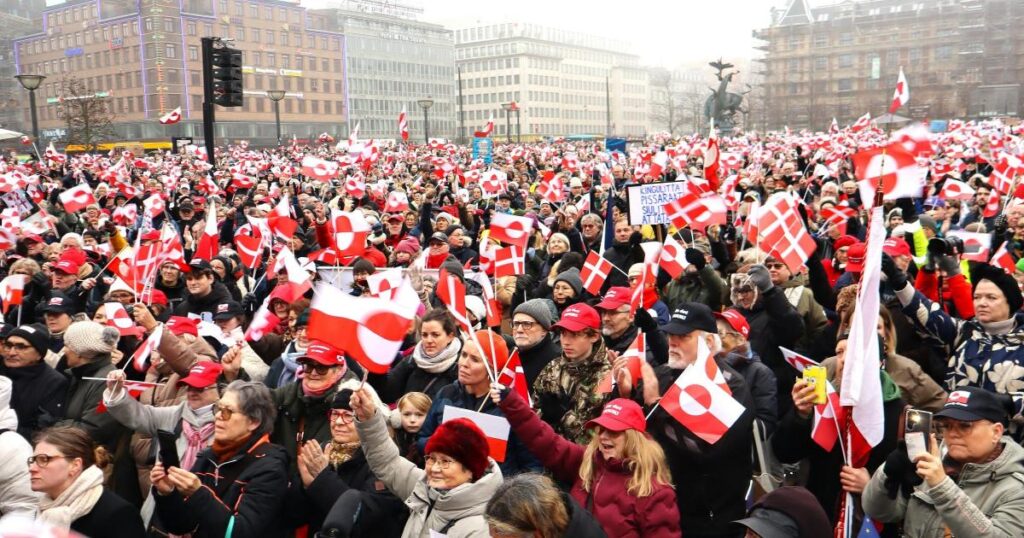
When he returned for his second term last year, he declared he would take control of the autonomous Danish territory “one way or another”, and since the turn of this year, he has doubled down and doubled down again on his ambition to annex the island, to the point where for a long time, he refused to rule out taking the country “by force”.
But while sitting in Scotland between the three parts of the Danish kingdom – Denmark, Greenland and the Faroe Islands – and never knowing just how seriously we should treat the so often outlandish words of the US president, it has always been hard to know how Greenlanders and Danes have felt about it all.
The answer?
“Around January 6 and 7, my colleagues from Greenland called me and said, ‘How many can you evacuate? Can you take 5000, if this really happens or America take over?’,” said Christian Friis Bach, the chair of the Danish foreign policy committee, as he spoke to me in his office in the Folketing – the Danish Parliament building – in Copenhagen.
READ MORE: I visited the Scottish Government Denmark base – here’s what I found
“They also had contacts with Iceland and the Faroe Islands. That was the level of fear you had in Greenland, young people and kids not sleeping. It was an extreme period for the Greenlanders.
“I said to them, ‘Of course, you are Danish citizens, you can come all of you’, but then the next question was, ‘How many planes do you have?’ That was the level of anxiety you had in Greenland.”
But in this moment of immense pressure, two nations that have had a troublesome relationship over the years have miraculously managed to come together to fight for Greenland’s freedom, safety and right to self-determination.
Tensions have existed between Denmark and Greenland for decades. Greenland was a Danish colony from 1721 to 1953 before Denmark integrated Greenland as a county. Home rule began in 1979, and in 2009, Greenland became a self-governed nation with its people now having the right to vote for independence, though Denmark still has control over foreign affairs and defence.
One of the key grudges Greenlanders have held against Denmark stems from a Danish birth control programme to limit population growth in the 1960s and 1970s, which saw thousands of Inuit women and girls in Greenland fitted with contraceptive coils without their consent or knowledge.
A group of 143 women filed a lawsuit against the Danish state in 2024 demanding compensation. Denmark has now made a formal apology and in December last year, announced it would compensate victims.
Christian Friis Bach (Image: Marie Hald)
While Denmark is working hard to make up for the mistakes of the past, it has still had to face the generally settled will of the people in Greenland for independence. Most political parties in Greenland want to achieve independence at some stage – mainly disagreeing on when and how – and three of them are in government together.
Bach has said all of this has made it tricky over time for the two foreign policy committees – as Greenland has its own – to unite, but Trump’s threats have seemed to force the issue.
“I have been responsible for the parliamentary co-operation between Greenland and Denmark. That has been crucial,” he said.
“It has been very difficult to get this co-operation up and running; we have tried for a couple of years between the Danish and Greenlandic parliament, but it has been very difficult because of [politics], but certainly now we are together.
“There were bumps along the road, but we have now strengthened the co-operation significantly.”
Looking back on when American senators visited the Danish Parliament recently, he said: “My Greenlandic colleagues stood at the forefront, and we allowed them to have a much more prominent space in a way in foreign policy discussions than would not have happened a few months ago.”
Bach said both nations knew they could not be seen to show any cracks in their relationship, as this would leave them vulnerable to the US administration.
While there is no doubt Greenlanders have been treated poorly by Denmark at points in time, Bach said there have been efforts to ensure Greenlanders are able to have the same quality of life as Danes.
READ MORE: Scotland cannot hide behind limited powers over Trump ‘abduction’
And beneath clear differences between the two nations, there has been a realisation of shared values that have not been understood by the Trump administration.
“If you go to [see] the Indian population in the US or the indigenous people in Alaska and Canada, I think Denmark has always tried its best to provide Greenlanders with a welfare state at the level of what you can find in Denmark,” Bach said.
“I would also say that this option of buying Greenland is still on the table [from the US perspective] and that shows a lack of understanding on the US side of what values the Greenlandic society is founded upon.
Greenland’s prime minister Jens-Frederik Nielsen waves the Greenlandic flag during a protest (Image: Marko Djurica/Reuters)
“You cannot buy private property in Greenland because land is not something you can acquire or have. There is a sacred relationship with the land, and of course, there is some contrast there to the US administration with the president’s wish to acquire and own and build.
“Denmark has not been a perfect partner to Greenland throughout history, but there are some things we understand and respect and that unite us in terms of values, history and culture, and this bond, I think, has become more visible throughout this crisis.”
Virtually any Dane you speak to now will tell you they feel much closer to Greenlanders and vice versa.
Jens B Frederiksen, a former vice-premier in Greenland, told me: “What has been important is that in Denmark, the politicians have realised that it is something which matters for the people of Greenland [reconciliation].
“I think they are in a good place now, where the Greenland and Danish governments have had some negotiations and are talking together. They are facing these problems.
“There will still be people who find it more important that Denmark has done this and that in the past, but you have to look at the majority and there’s a lot of people in Greenland who are very fond of the clear speech from the premier in Greenland that he said we are a part of the Danish Kingdom and we are working with Denmark.
US president Donald Trump (Image: Carlos Barria, REUTERS)
“On the other hand, you see the prime minister of Denmark reach out her hand and say, now we have to make things in the future so the three countries in the Kingdom of Denmark are more equal.”
Even parties within Greenland have had to put their differences aside for the country’s security. Three of the ruling parties support independence – Democrats, Siumut and IA – while the other – Atassut – favours closer ties with Denmark.
It’s another sign of how, when you are faced with an existential threat, you do what it takes for the safety of your people.
“You couldn’t imagine three months before these four working together, and I think that’s very beautiful,” said Frederiksen.
“Some of these are parties that really want to be independent, so I think it’s beautiful that they said now, we have a threat against Greenland, and we have to work together.”
READ MORE: Pro-Israel MSP group appears to break Holyrood transparency rules
It is clear since Trump made his speech at the World Economic Forum in Davos – where he appeared to rule out taking Greenland by force before announcing the “framework of a future deal” – that diplomacy has returned for now.
Nato is now considering a joint operation to defend the Arctic from future Chinese and Russian aggression and neutralise US ambition, with a possible “Arctic Sentry” being discussed.
It is thought this would be like the Baltic Sentry – a mission to increase the surveillance of ships in the Baltic Sea.
Bach said he can breathe easier now that politicians have come to the table to peacefully discuss how Arctic security can be enhanced, and hopes this can continue.
“I hope they sleep better in Greenland right now,” he said.
“Things have calmed down. I take note of what the Danish prime minister has said that the crisis is not over, but it now has to find a way, and it is now between allies, mainly in peaceful, diplomatic dialogue, and this is how it should be.
“Denmark has been one of the closest allies of the US since the Second World War; we have stood by the US on all major issues of security, including Afghanistan, where we did not stand at the back; we were at the very front line and we lost as many soldiers as the US, if you measure per capita.
“We are happy now, [and] we sit at the table and discuss.”