
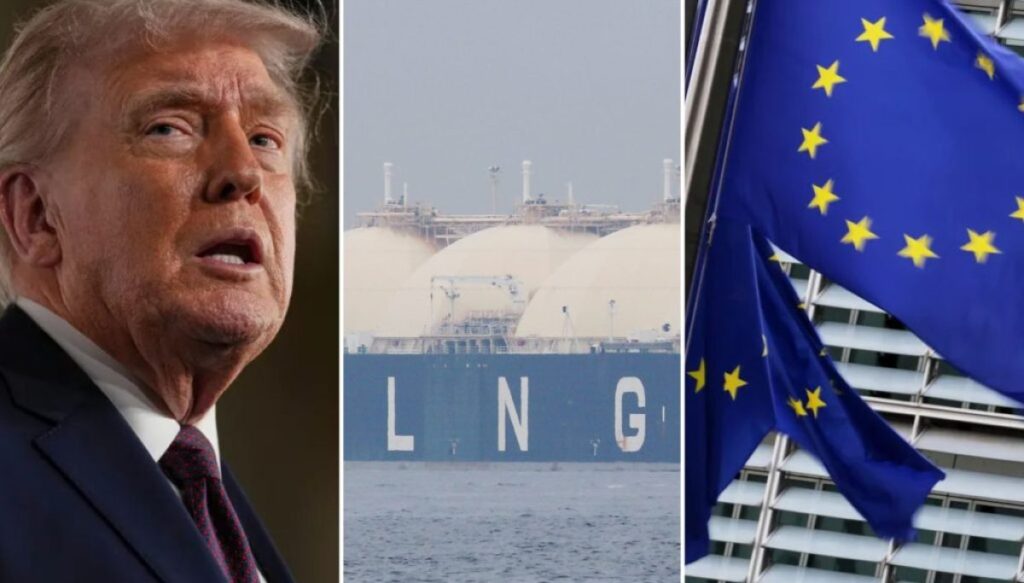
The European Union is growing concerned with its increased reliance on the United States for energy resources such as natural gas, as the Trump administration seeks to expand its influence in the Western Hemisphere and acquire Greenland.
European Commission for Energy Dan Jorgensen said earlier this week that President Donald Trump’s pressure campaign on the bloc over Greenland has been a “clear wake-up call” for EU officials, forcing them to reassess their trade ties with the U.S.
“These are very turbulent times,” Jorgensen said. “What has made the situation more serious and complex is the strained relationship to the U.S. and the fact that we have an American president that does not exclude using force against Greenland.”
As a result, the EU is considering increasing imports of liquefied natural gas from alternative suppliers, including Canada, Qatar, and Northern Africa.
It is a somewhat ironic move for the EU, as it originally turned to the U.S. as its solution for reducing reliance on Russian energy supplies.
Europe has dramatically drawn down its imports of Russian oil and gas since Moscow invaded Ukraine in February 2022, and is moving to bar the imports completely.
On Monday, ministers from the EU states gave the final approval for the bloc’s ban on imports of Russian gas by 2027, making the decision legally binding. Only Slovakia and Hungary voted against the ban, and Bulgaria abstained.
The ban will go into effect by the end of 2026 for Russian liquefied natural gas and by the end of September 2027 for pipeline gas. The agreement does allow the pipeline gas deadline to be delayed until Nov. 1, 2027, if a country is unable to fill its storage systems with non-Russian supplies before the 2027-2028 winter season.
This divestment in Russian energy has quickly increased Europe’s dependency on U.S. gas.
A report released this month by the Institute for Energy Economics and Financial Analysis found that EU imports of LNG from the U.S. increased almost fourfold from 2021 to 2025. Last year, the block imported roughly 81 billion cubic meters of natural gas from the U.S., accounting for around 57% of its total LNG imports worldwide, the report found.
In an effort to bolster the oil and gas industry, the Trump administration has sought to grow that percentage even more.
In July 2025, the Trump administration signed a trade deal with Europe, with the EU promising to buy $750 billion worth of U.S. energy by 2028.
Since the deal was signed, numerous EU member states, such as Italy, Greece, and Spain, have signed long-term purchase agreements with U.S. LNG producers like Venture Global.
If these long-term contracts remain in place and other member states follow suit, the IEEFA estimated that 75% to 80% of the EU’s global annual imports of LNG would come from the U.S. as soon as 2030.
As Trump threatened to impose 10% tariffs on several EU nations until a deal was reached for the purchase of Greenland, concerns have been raised that the administration might use energy exports as leverage to assert its dominance in the Western Hemisphere.
“It has never been our policy to start trading less with the U.S., and we don’t want trade conflicts,” Jorgensen said Wednesday. “But it is also clear that geopolitical turmoil … has been a wake-up call. We have to be able to take care of ourselves.”
In response to the tariff threat, the European Parliament swiftly suspended its approval of the July 2025 trade deal. While Trump has since walked back the threat, the legislative branch of the bloc has yet to vote on whether it will unfreeze the deal.
Earlier this week, EU lawmakers agreed to postpone that decision until early February, as some wish to get greater clarity on some terms. The Parliament is next expected to meet on Feb. 4, according to Politico.
TRUMP’S GREENLAND BID DRAWS FOCUS TO RARE EARTHS MINING POSSIBILITIES
While no new agreements have been reached with other countries over their LNG supplies in recent days, Canadian officials have indicated keen interest in diversifying their exports.
“We will never use our energy for coercion,” Canadian energy and natural resources minister Tim Hodgson said in India this week. “Canada used to provide 98% of its energy exports to a single country. We are committed to diversifying.”