
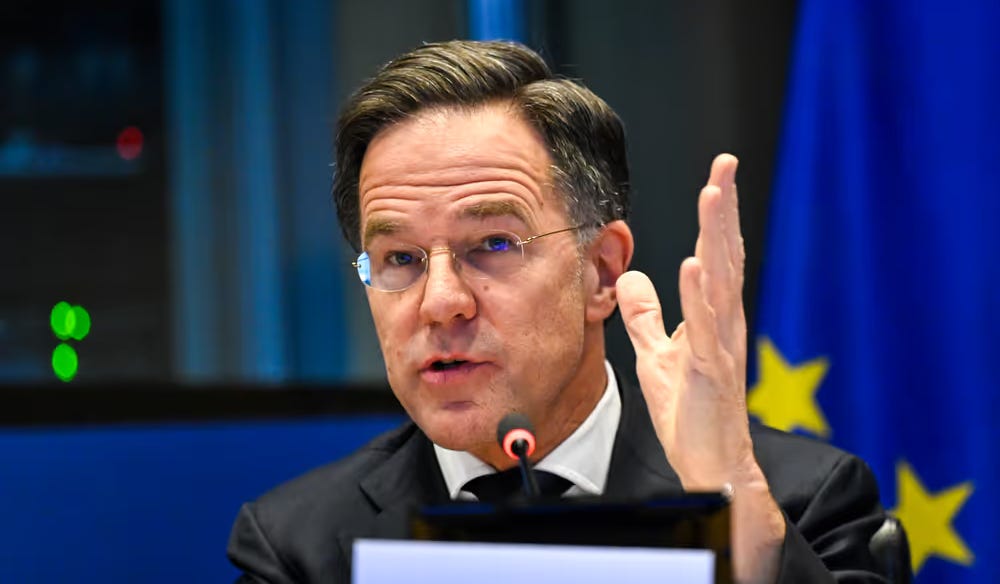
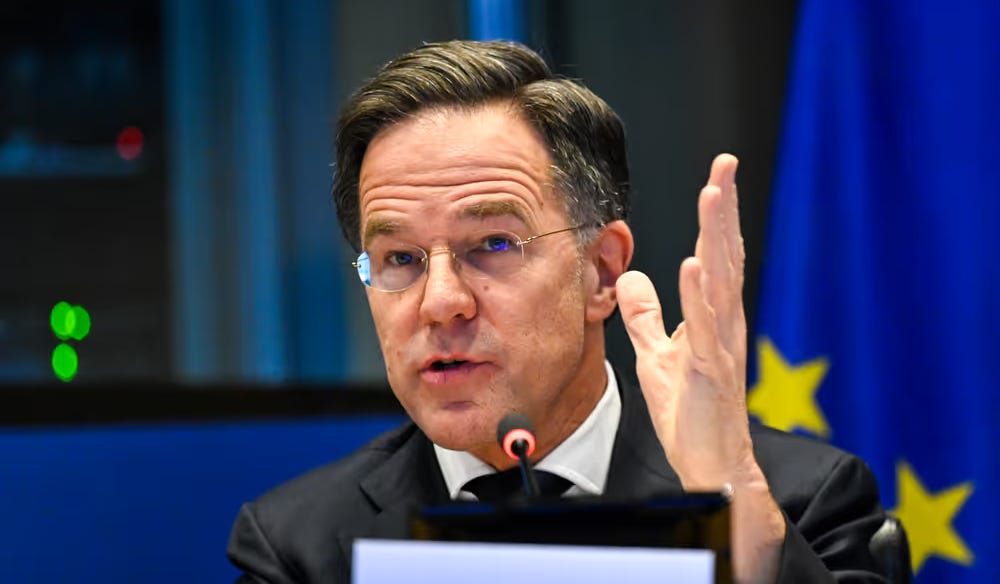
Over the years, many speakers have come to the European Parliament and insulted MEPs. But I have seen few enrage the EU’s directly-elected legislature more than Mark Rutte with his ‘dream on’ comments this past week.
The NATO secretary general was being peppered with questions during his appearance before the parliament’s defence committee on Monday about what exactly he gave away to Trump on behalf of Denmark which made the US president back off his threats to acquire Greenland through invasion or economic coercion for the time being. He was also asked about his general closeness with Trump and the impression he is leaving that in his mind he has only one boss – the US president. MEPs asked him why he has been repeatedly disparaging efforts to build a sovereign European defence that would enable the continent to defend itself without US help. Clearly triggered by the questioning, the Dutchman – who was prime minister of the Netherlands from 2010 to 2024 – responded with his characteristic bluntness (also known as rudeness outside the Netherlands).
“If anyone thinks here…that the European Union or Europe as a whole can defend itself without the US, keep on dreaming,” he scolded the EU lawmakers. “You can’t.”
It didn’t seem like advice, it seemed like a command. And the already-angered MEPs were made even more furious by the remark. “Are you the [US] ambassador to [NATO] or the secretary-general representing the alliance and its members?” Nacho Sánchez Amor, a Spanish centre-left MEP from the party of Pedro Sanchez, asked Rutte in a heated exchange. French MEP Nathalie Loiseau, an ally of President Macron who previously served as his Europe minister, called it “a disgraceful moment”. “Rutte thinks that being rude with Europeans will please Trump. We don’t need a Trump zealot. NATO needs to rebalance between US and European efforts.”
The complaints didn’t just come from inside the parliament. The French foreign minister Jean-Noël Barrot posted on X: “No, dear Mark Rutte. Europeans can and must take charge of their own security. Even the United States agrees. This [concept] is the European pillar of NATO.” Muriel Domenach, France’s former ambassador to NATO, concurred: “brandishing European weakness to secure the US guarantee is an outdated approach and sends the wrong message to Russia.” But Rutte made clear what he thinks about the long-standing French idea of a European pillar of NATO at the hearing, calling it “an empty word”.

Jean-Noël Barrot@jnbarrot
Non, cher Mark Rutte. Les Européens peuvent et doivent prendre en charge leur sécurité. Même les États-Unis en conviennent. C’est le pilier européen de l’OTAN.

BFM @BFMTV
💬”Si quelqu’un pense que l’UE peut se défendre sans les États-Unis, continuez à rêver”
L’Europe et les États-Unis ont “besoin l’un de l’autre”, affirme le chef de l’Otan, Mark Rutte #BFM2
10:14 PM · Jan 26, 2026 · 491K Views
6.28K Replies · 1.06K Reposts · 4.65K Likes
But this wasn’t just the usual French sabre-rattling. “Saying half of NATO is useless gives Trump the green light to extort more from NATO allies,” Garvan Walsh, Senior Researcher at the centre-right EPP think tank the Martens Centre think tank told Euronews. Criticism came even from the Eastern EU – the most America-loving part of the union. Gabriel Landbergis, the former former minister of Lithuania who has been more clear-eyed about this than most others from his part of Europe, wrote an opinion piece in response entitled “Dear Mr Rutte: I’m not dreaming, I’m having nightmares”:
“This de facto defeatism diminishes Europe’s ability to deter Putin. Bullies aren’t deterred by loud declarations of vulnerability, they are emboldened and encouraged.”
“I hear a lot about pragmatism. Mr. Rutte’s ‘pragmatic’ approach seems to be declaring, and even exaggerating, weakness in order to justify the need for US support. But nobody was really questioning that need for that. Nobody is seriously saying Europe should choose to go it alone and burn all bridges, but some of us are saying we might not get a choice, and Mr. Rutte’s assumption that the US would split its forces to save Europe from Russia is looking more and more dreamlike as time goes on.”
“The important question Mr. Rutte side-stepped is this: What must be done to prepare Europe to fight in the increasingly likely and terrifying scenario B, i.e. without our main ally? In the light of recent developments, it seems to me that the pinnacle of pragmatism would be to at least have an honest conversation about this very real possibility.”
This is the heart of the dispute. Rutte didn’t say anything new here – the reason this got so much attention is because of the venue he was in and the arrogance with which he said it. For years, Rutte has insisted “there is no alternative to NATO”. And as EU foreign affairs chief (and former Estonian prime minister) Kaja Kallas pointed out in September, “there is no NATO without the US.” NATO is not an alliance, it’s a protectorate. Remove the protector and there is no NATO. That’s because there is no European pillar of NATO that can act without the United States. And the reason it does not exist is because people like Rutte and Kallas have spent the past decades blocking efforts to create it while they were prime ministers.

Dave Keating@DaveKeating
“There will be no EU caucus in NATO” 🇺🇸Defence Secretary commanded to Europeans in 2000. And for 25 years our European leaders have dutifully obeyed.
“There is no alternative to NATO” Mark Rutte says now. But there is none because PMs like him have for years blocked creating one

2:04 PM · Dec 3, 2025 · 2.15K Views
1 Reply · 2 Reposts · 9 Likes
They did so at American command. Back in 2000, the drafters of the planned EU constitution (the one later rejected in French and Dutch referendums) were going to use that treaty change round to create a European Defence Union that would pool the EU’s militaries into a single command and control structure as an equal pillar to the US within NATO. But those efforts were killed by a US intervention – a story that I retell in my new book The Owned Continent which came out in December (page 180). US Defence Secretary William S. Cohen gave a now-notorious command during a NATO summit in Brussels in 2000, saying, “There will be no EU caucus in NATO”. In other words – don’t you dare try to establish a two-pillar NATO made up of the EU and US as equal partners.
But as Landbergis pointed out, the messaging coming from the US has now changed (whether or not this messaging is genuine is another story). The new US National Defense Strategy published on 23 January (I do wonder why it wasn’t consistent with the rebranding of the department and titled the US National War Strategy) spelled out the new talking point. It said Europe is responsible for defending the continent from Russia, and that it is economically and militarily capable of doing so. It notes that the European NATO members are far more economically powerful than Russia and it’s absurd to be begging for help from America. “Germany’s economy alone dwarfs that of Russia,” it stresses, noting that European countries are “strongly positioned to take primary responsibility for Europe’s conventional defense.”
It isn’t just the administration’s words, its also their actions. In December we saw the unprecedented step of a US secretary of state declining to come to a NATO summit in Brussels simply because he didn’t feel like it. On 12 February we will see a new step into the unprecedented as the US Secretary of War declines to attend a defence ministers’ summit. The signal couldn’t be clearer: the US protectorate is now a paper tiger. For the moment we have a kind of ‘Schrödinger’s NATO’, where US protection is both the raison d’être and completely uncertain. The alliance is simultaneously alive and dead, and we only find out which after Russia opens the box by invading.
So that begs the question – why then is the Trump whisperer Rutte blocking Europe from making the structural changes that would be necessary to defend this continent without American help? It’s because these words in the US National Defense Strategy, and even the signals they are sending by not coming to Brussels for NATO summits, are BS. It’s theatre. The Americans don’t really want a militarily independent Europe, they simply want the Europeans to spend more on American military equipment but remain under American military control. They want to have the option of not defending Europe while also keeping the benefit of occupying the continent with bases and troops. They want the Europeans to do the fighting at the behest of American orders, just as it has been over the past 80 years. They don’t want anything to structurally change, they just want Europe to pay the bill for NATO protection. Because without this protectorate system, MAGA could no longer extort Europe on trade and economics as they’ve so enjoyed doing over the past year.
That’s why the June NATO summit was a victory for Trump and a humiliation for Europeans. They committed to increasing their spending without asking anything from the US in return – for instance a commitment to allowing the Europeans to develop a European pillar of NATO with an autonomous command and control structure. Despite all the new rhetoric, on paper the US still hasn’t changed it’s position opposing that (even if they are asking for NATO to be nominally “Europe-led” by 2027). Hence why Rutte is opposing anything that would actually make Europe militarily independent from America.
Despite the incident in the parliament’s defence committee, Rutte still has plenty of defenders. And they were eager to give their two cents in an analysis of the fallout in Politico on Tuesday. Anonymous Atlanticist sources insisted that though Rutte may be genuflecting to Trump in public, in private he is more forthright and that “if pushed, he will be direct.” But these people seem to forget that we know what Rutte says to Trump in private because Trump keeps leaking the exchanges. And in those, the former Dutch prime minister is shown making even more flattery than he does publicly.
“The reality is, Rutte is delivering…for the benefit of the alliance, [he’s] sucking up” to Trump, one senior NATO diplomat told Politico. “Unlike some other leaders, he never doubted the alliance — I chalk it up to experience,” added a second, clearly referring to Macron who warned NATO was becoming “brain dead” in 2019.
Others have been willing to only go so far as stated US policy allows. Though she said that there is no NATO without the US five months ago, in a speech last week Kaja Kallas acknowledged that the situation has changed. The recent events have “shaken the transatlantic relationship to its foundation”, she said. But she went on to simply parrot what was in the US defence strategy. “Let me be clear: we want strong transatlantic ties. The US will remain Europe’s partner and ally. But Europe needs to adapt to the new realities. Europe is no longer Washington’s primary centre of gravity,” Kallas told a defence conference in Brussels. “Especially now, as the US is setting its sights beyond Europe, NATO needs to become more European to maintain its strength. For this, Europe must act.”
But act how? Not with an EU army, Kallas said the day after the speech as she entered a foreign affairs council. Asked to react to calls for a European Defence Commission Kubilius’s call for a European defence capability, she seemed to shoot it down. She noted that what we’re really talking about here is common command of individual national militaries – noting “I can’t imagine that countries will create a separate European army” (as I write in The Owned Continent, what we’re talking about here with an “EU army” is really something more like the US National Guard). But her next sentence signalled that she’s not yet ready to endorse the critical step of establishing independent European command and control. “It is understandable that in the military, you have to have a very understandable chain of command so that when something happens it’s clear who gives orders to whom,” she said. “If we create parallel structures, then it is just going to blur the picture.” It’s still the classic argument that has prevented development of European military sovereignty for decades: no duplication that could undermine NATO. It may sound innocuous, but this one phrase is what keeps Europe beholden to America.
The argument that Rutte and Kallas are making is that Europe needs the US security umbrella because without it, Russia will invade and Europe would be defenceless. But there are two major problems with this thinking. One is, as Landbergis pointed out, anyone who still thinks the US is committed to defending Europe in the event of a Russian invasion is living in a fantasy world. The trust is gone, and it is never coming back. So blocking the development of a European self-defence capacity because it could undermine an illusory protection guarantee is lunacy.
The other flaw in the Rutte reasoning is that it assumes that Russia will invade the EU within the next five years, an assertion Rutte has repeatedly been making in the past few months as if he is a psychic (and one that may well become a self-fulfilling prophecy). Yes, if Russia invades in the next few years Europe is royally screwed. The continent cannot defend itself at the moment (thanks to leaders like Rutte who blocked efforts to build European defence for years), and we just don’t know if the US would honour its Article 5 commitment or not. My feeling is that the US most likely would not come to Europe’s defence. It would either not declare war on Russia or it would declare war on paper only but then not devote any resources to repelling the invasion.
But also we need to stop and challenge Rutte on his assertion. Do we really think Russia is likely to invade within the next few years? Or do they need more time to prepare for such an effort after being exhausted by the war in Ukraine (whether or not they win or lose)? Analysts say that Europe would need up to five years to develop an independent military capacity with sovereign command and control that could resist Russia at its peak military power. Realistically, that’s also the amount of time Russia would need to recuperate and prepare for an EU invasion.
So, we’re looking at two possible scenarios here:
-
We do it the Rutte way and focus only on increasing European military spending under an American command and control structure which means Europe would still rely on US protection if Russia invades in five years.
-
We do it the Kubilius way and increase military spending while also establishing new structures for an independent European command and control that can defend the continent from Russia on its own if need be in five years.
Rutte is assuming that if we choose option two, it destroys NATO because it makes the US pull out. But if dependence is the only thing holding NATO together, then that doesn’t sound like a very strong “alliance”. The Rutte route puts all Europe’s eggs in one basket: praying that the US honours its Article 5 commitment. But as I’ve written before, hope is not a strategy.
Where would you as a European rather be in five years: still dependent on the US, or having achieved the means to act independently in fighting the Russian invasion even if it meant some significant sacrifices and nervous times from 2026 to 2030 with the risk of Russia invading a defenceless Europe? If Russia attacks in 2030, how would you have preferred to have spent the previous five years? The Rutte way or the Kubilius way?
Rutte may be right about the US losing interest in Europe if it’s no longer in control of the continent militarily. But to that I say, don’t threaten us with a good time. In the long run, Europe will be better off with the US out of its hair. Such an argument is anathema to this continent’s Atlanticists who have been running the show for the last decades, but it’s true. And it may be that the only way for Europe get its act together and build sovereign defence is to definitively lose the US as a protector now.
Unlike with Schrodinger’s NATO, a European Defence Union would be real and verifiable. We could see its capabilities, for better or worse, spelled out as it is built. We would know that in the first years it cannot defend the continent (but luckily, at the same time, Russia may not have the capability to invade during those first years). As each new capability arrived, we would see it demonstrated. We would not know, in the end, whether it will be successful or whether European unity would survive the Russian invasion test. But from my vantage point, which I know is not how most Eastern Europeans see it, Europe is much more likely to defend its own territory than Trump’s America is to defend foreign territory. Those in the East who think differently are living in the past, and are refusing to acknowledge all that their eyes and ears are witnessing right now.
Back in 2018, following Trump’s buddy-buddy press conference with Putin in Helsinki, I wrote a think piece asking whether the US should be pushed out of NATO before it jumps. It was deliberately provocative, but it asked whether the American military protectorate will always stand in the way of developing independent European defence (both logistically and psychologically) as long as it is there. To my surprise, it was rejected by the editor of the publication I regularly wrote for because it was considered too extreme (something that had never happened with any other piece – I published it on my Euroblog instead). Is Europe finally ready to talk about this possibility? Can we now entertain the fact that, in the long run, losing the American protectorate right now could end up being the best thing to happen to Europe for decades? Or is this still so taboo it can’t even be mentioned?
Europeans who want to have a strong and independent Europe need to push back against Rutte’s “daddy” brand of Atlanticism. To me, the wisest choice of the two I outlined above is the second one. If that means losing US protection, so be it. In the short term, it may leave Europe vulnerable. But there are ways to protect Europe during this period other than slavishly doing whatever Trump asks – as I controversially explored in my piece exploring the possibility of a military pact with China a few weeks ago.
As Europeans makes this choice, they should keep one thing in mind. The Trump administration’s threats to pull out of Europe are disingenuous bluster. They know that to be a leader, the US needs followers. And its followers are in Europe. Without its system of US bases and soldiers occupying European soil across the continent, America can no longer stage its global military adventures across the world – particularly in the Middle East. It’s time Europe called their bluff. The US is not going to leave voluntarily, and even if they did, it should be welcomed by Europe.
The real question we should be asking ourselves is not what we can do to keep the US in Europe, but what we can do to get them out.