
By Francesca Montillo, ISDA Food + Travel Writer
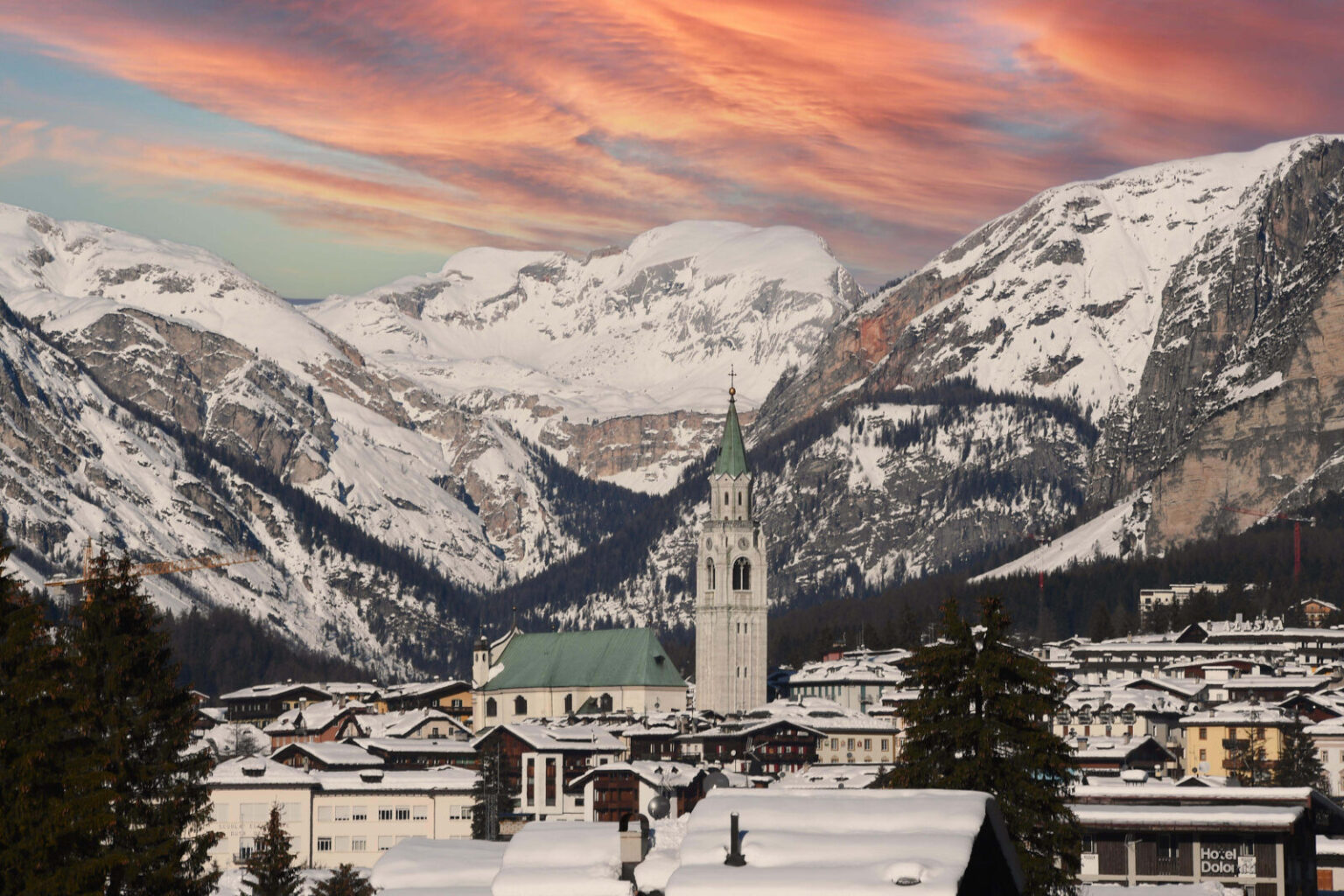
In a few short days, the Winter Olympics will arrive in Italy, with events spread across Milan, Cortina d’Ampezzo, (pictured above) and the dramatic sweep of the Italian Alps. For a few weeks, the world’s attention will focus on medals, records, and ceremonies. But long after the final podium is cleared, what will linger is something far more enduring: Italy itself.
Because Italy does not merely host events. It absorbs them, reshapes them, and folds them into its own layered story. The Olympics may come and go, but Italy remains—complex, beautiful, contradictory, and deeply human.
A Landscape Made for Drama
Northern Italy in winter feels almost theatrical. The Dolomites rise like sculpted stone cathedrals, their pale limestone faces catching the low winter sun and glowing pink at dusk, a phenomenon locals call enrosadira. These mountains are not simply a backdrop; they are characters in the story. For centuries, they have shaped how people live, build, eat, and move.
Cortina d’Ampezzo, long known as the “Queen of the Dolomites,” carries a quiet confidence earned over generations. It has hosted royalty, artists, climbers, and skiers long before Olympic planners arrived. There is an elegance here that feels unforced—wooden chalets, iron balconies, and cafés where espresso is taken seriously even in sub-zero temperatures.
Meanwhile, Milan sits at the other end of the spectrum. Fast, modern, design-obsessed, and industrious, it is Italy’s engine room. Snow is rare, but winter sharpens the city’s edges: tailored coats, fog-softened streets, trams slicing through the cold air. Hosting parts of the Olympics here feels symbolic—Italy showing not just its postcard beauty, but its contemporary pulse.
Italy’s Relationship With Time
One of the most fascinating things about Italy is its refusal to rush, even when the world demands speed. Infrastructure projects may move slowly. Bureaucracy can feel eternal. And yet, this relationship with time is part of Italy’s strength.
When the Olympics arrive, they will land in places that already carry centuries of memory. Roman roads still underpin modern highways. Medieval towns sit a short drive from ultramodern stadiums. Churches built before the concept of “nation-states” still ring their bells on schedule.
Italy does not erase the past to make room for the future—it stacks the future on top of it.
This layering will be visible everywhere during the Games. Athletes will compete in cutting-edge venues, then walk out into towns where recipes, dialects, and customs have been passed down through generations. The contrast is not jarring; it is quintessentially Italian.
Food as Cultural Language
Any global event in Italy inevitably becomes a conversation about food—not because Italians are showing off, but because food is how Italy communicates.
In the north, winter cuisine is hearty and rooted in survival as much as pleasure. Polenta, slow-cooked until creamy. Canederli (bread dumplings) floating in broth. Game meats, mountain cheeses, butter replacing olive oil as the fat of choice. These dishes reflect altitude, climate, and history more than trends.
Visitors arriving for the Olympics may expect spectacle, but what they’ll remember is the warmth of a meal after the cold. A bowl of pasta eaten slowly. A glass of local wine poured without ceremony. The realization that in Italy, nourishment is never just physical—it’s social, emotional, and deeply tied to place.
Even Milan, often seen as business-first, reveals itself through food: risotto alla milanese glowing with saffron, ossobuco simmered patiently, aperitivo culture turning early evenings into communal rituals. The Olympics may bring crowds, but Italians will still pause for lunch.
They always do.
Style Without Performance
Italy is famous for style, but what’s often misunderstood is that Italian style is not about spectacle—it’s about instinct. In winter especially, this becomes clear. Wool coats are cut to last decades. Scarves are wrapped, not arranged. Boots are chosen because they work, then happen to look good.
During the Games, cameras will capture crowds bundled against the cold, and Italy’s fashion sensibility will quietly assert itself. Not flashy. Not loud. Just assured.
Beyond the Closing Ceremony
When the Olympic flame is extinguished, Italy will remain much as it was before—because it has endured empires, wars, renaissances, and revolutions. A sporting event, no matter how grand, is simply another chapter.
What the Winter Olympics truly offer is an invitation: to look past the event and into the country hosting it. To see Italy not as a destination, but as a way of living. To understand that beauty can coexist with imperfection, that history can be alive, and that progress doesn’t require forgetting who you are.
In 2026, the world will come to Italy for sport. It will leave remembering something else entirely.
Read more from Francesca on her travel and blog website: Lazy Italian Culinary Adventures.