I live in MA. I would say 80% of my friends are not having children. The ones that are got married in early 20s (but half of them are divorced lol).
kaybee915 on
No one has money, it’s all being hoarded by capitalists. Kids cost money.
ragnarockette on
* Money, especially housing costs
* Teens are better educated about preventing pregnancy (don’t overlook this, it’s a big one!)
* Social media
* Cultural shift towards autonomy, independence, and self fulfillment
* Women having/wanting fulfilling careers
* Later marriage
* Insane expectations of parenting
* Worry about money/housing/school/climate and how that will impact your children
* Uninvolved grandparents
* Everything is insanely expensive!
There are many reasons and they *all* have made this an irreversible trend. On some level I also think this is an ecological response to what we’ve done to the planet – the species knows it needs a rapid reduction in headcount to survive.
RandomRedditName586 on
Yeah can’t afford children
SnooPears5432 on
Interesting factoid, the US fertillity rate in 1960 was almost 3.6, about the same as it is today in many sub-Saharan countries like Malawi, Rwanda, and Zinbabwe, and higher than it is in countries like Kenya and Ghana. I was born in the early 1960’s, and nearly every house on our block while growing up had multiple kids. Different world then.
GrievousInflux on
Interesting, it correlates with cost of living.
FalseCredential on
It’s almost like no one has enough money to afford having children.
PeanutButter_Tommy on
Middle class is disappearing. The wealth gap between the average person and the top 1% has widened to where having children is becoming exclusive to wealthier people.
Ninjamin_King on
Population decrease always shown red like it’s a bad thing. Higher productivity with fewer people means more to go around! This is *good*.
_n00n on
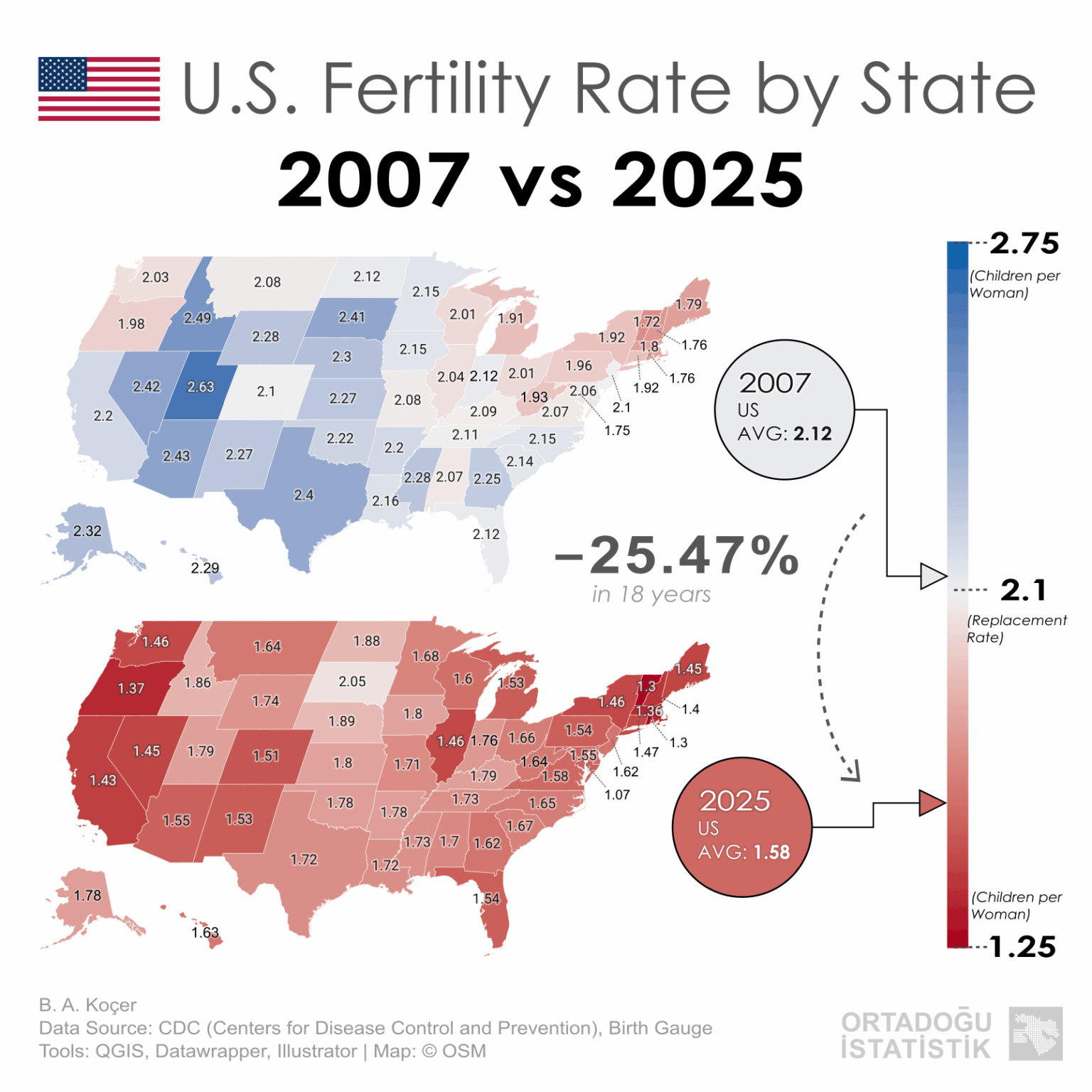
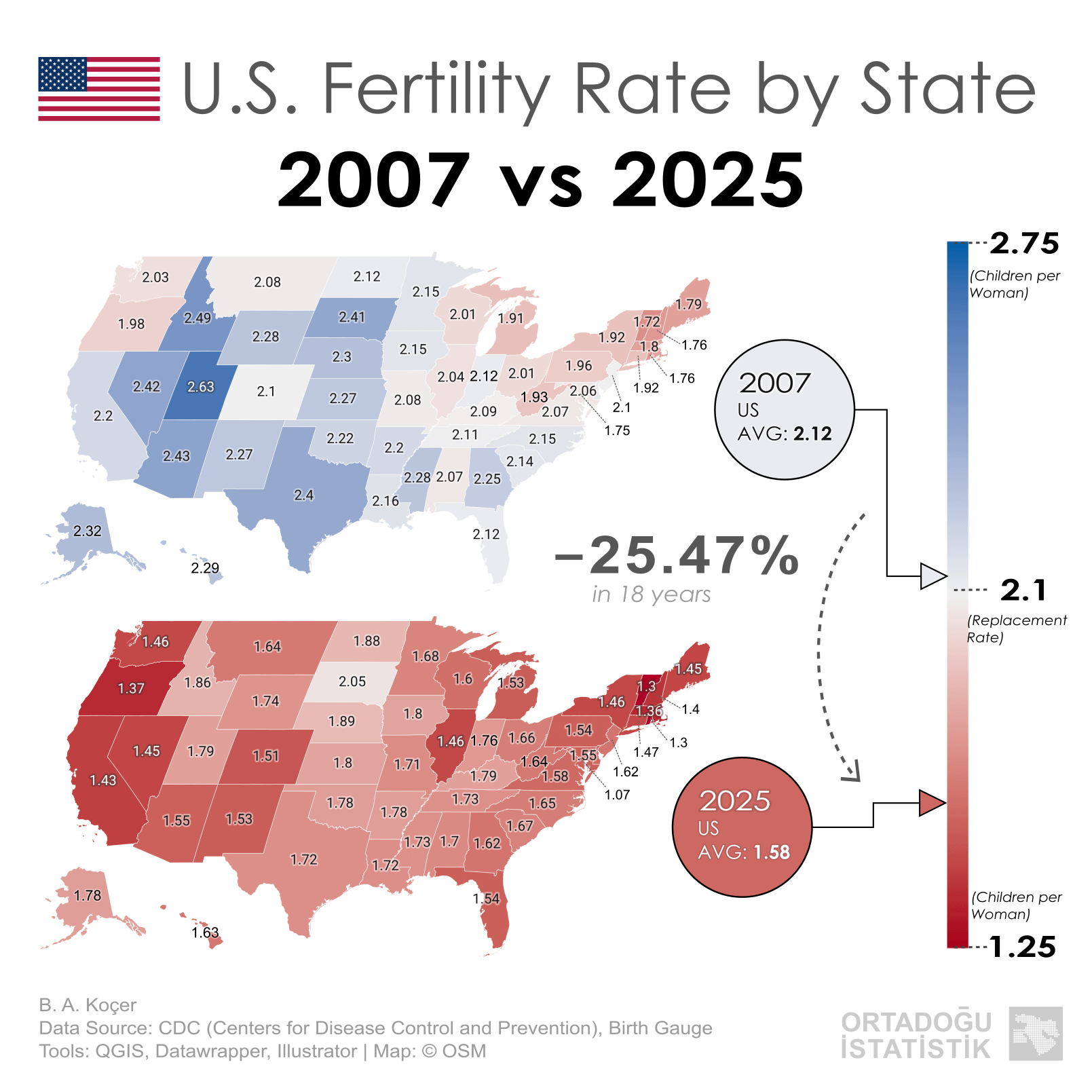
That’s a massive drop for Utah.
Anxiousah23 on
Everyone is going to get mad at the obvious and correct solution to this.
Anxiousah23 on
It has not and has never been about affordability. The highest birth rates are observed in poorer communities, immigrants, religious people. All the social democracies that provide free nannies and years long maternity leave have it worse. It’s not affordability.
HappyChandler on
I wonder the effect of the ACA regulations for long acting reversible birth control. I’m pretty sure the teen birth rate as a percentage has dropped a lot.
I’m amazed that Utah is below replacement.
Did Covid have fertility effects?
pasgames_ on
Now do rates of teenage pregnancy
skyXforge on
Somehow still better than most of the world. The next hundred years is going to have some weird population stuff happening.
BCMBCG on
Hmmmm lemme look at these numbers and ascribe my own anecdotes and values to them.
Why Mormon states fall drastically, especially Utah
Calm-Juggernaut6099 on
Maybe because life is so god damn expensive even without children.
aliveinjoburg2 on
I would love to have more kids but I don’t have that kind of money.
BouncyBhaal on
I want to raise children. Make it affordable and I will.
babyshaker1984 on
Utah dropping off that much is nuts…or not nuts
nowhereman86 on
Only the second time in history we’ve slipped below replacement. The other time was during the Great Depression if that tells you anything.
somafiend1987 on
If this were to show 1970, 80, 90, 2000, 2010, and 2020, the sharp cut line would be Reagan. The MFer ended the middle class. The economic policies resulted in more than 30% of the population losing job security that has never recovered. Pile on Bush, Clinton and GeeDub Bush and we’re closer to 60%. You having to be irresponsible to consider having kids when your job can be gone simply because an investor wants to play chicken with politicians.
Run_with_scissors999 on
I didn’t have children (not by choice, just circumstance). My life is very full and I feel a sense of peace and freedom my friends with children do not. Sometimes I wonder “what if”, but I do not dwell in that long. There are many ways to live life.
Cerulean_IsFancyBlue on
Wealth disparity.
Wage stagnation.
And we also are in the process of stomping on immigration which was the only thing actually keeping us out of the negatives.
TheAmazingGamerNA on
People blaming country specific issues like housing need to know this is a global trend, even in places where housing is very affordable. But “smartphones” seem like the most consistent thing everywhere.
Dragontastic22 on
We are way below replacement rates, but let’s panic about immigration. This country is ridiculous sometimes.
joaomsneto on
The lower, the better.
NotTheRightHDMIPort on
You know.
Everyone freaks out about fertility and replacement but long term this is probably a good thing. We may actually see a global population decline and that may have a better impact on resources.

32 Comments
I live in MA. I would say 80% of my friends are not having children. The ones that are got married in early 20s (but half of them are divorced lol).
No one has money, it’s all being hoarded by capitalists. Kids cost money.
* Money, especially housing costs
* Teens are better educated about preventing pregnancy (don’t overlook this, it’s a big one!)
* Social media
* Cultural shift towards autonomy, independence, and self fulfillment
* Women having/wanting fulfilling careers
* Later marriage
* Insane expectations of parenting
* Worry about money/housing/school/climate and how that will impact your children
* Uninvolved grandparents
* Everything is insanely expensive!
There are many reasons and they *all* have made this an irreversible trend. On some level I also think this is an ecological response to what we’ve done to the planet – the species knows it needs a rapid reduction in headcount to survive.
Yeah can’t afford children
Interesting factoid, the US fertillity rate in 1960 was almost 3.6, about the same as it is today in many sub-Saharan countries like Malawi, Rwanda, and Zinbabwe, and higher than it is in countries like Kenya and Ghana. I was born in the early 1960’s, and nearly every house on our block while growing up had multiple kids. Different world then.
Interesting, it correlates with cost of living.
It’s almost like no one has enough money to afford having children.
Middle class is disappearing. The wealth gap between the average person and the top 1% has widened to where having children is becoming exclusive to wealthier people.
Population decrease always shown red like it’s a bad thing. Higher productivity with fewer people means more to go around! This is *good*.
That’s a massive drop for Utah.
Everyone is going to get mad at the obvious and correct solution to this.
It has not and has never been about affordability. The highest birth rates are observed in poorer communities, immigrants, religious people. All the social democracies that provide free nannies and years long maternity leave have it worse. It’s not affordability.
I wonder the effect of the ACA regulations for long acting reversible birth control. I’m pretty sure the teen birth rate as a percentage has dropped a lot.
I’m amazed that Utah is below replacement.
Did Covid have fertility effects?
Now do rates of teenage pregnancy
Somehow still better than most of the world. The next hundred years is going to have some weird population stuff happening.
Hmmmm lemme look at these numbers and ascribe my own anecdotes and values to them.
Vermont being Vermont
Having a child? In this economy?!
[Less than one-fifth of homes on Salt Lake market considered affordable](https://kutv.com/news/eye-on-your-money/less-than-one-fifth-of-homes-on-salt-lake-market-considered-affordable)
Why Mormon states fall drastically, especially Utah
Maybe because life is so god damn expensive even without children.
I would love to have more kids but I don’t have that kind of money.
I want to raise children. Make it affordable and I will.
Utah dropping off that much is nuts…or not nuts
Only the second time in history we’ve slipped below replacement. The other time was during the Great Depression if that tells you anything.
If this were to show 1970, 80, 90, 2000, 2010, and 2020, the sharp cut line would be Reagan. The MFer ended the middle class. The economic policies resulted in more than 30% of the population losing job security that has never recovered. Pile on Bush, Clinton and GeeDub Bush and we’re closer to 60%. You having to be irresponsible to consider having kids when your job can be gone simply because an investor wants to play chicken with politicians.
I didn’t have children (not by choice, just circumstance). My life is very full and I feel a sense of peace and freedom my friends with children do not. Sometimes I wonder “what if”, but I do not dwell in that long. There are many ways to live life.
Wealth disparity.
Wage stagnation.
And we also are in the process of stomping on immigration which was the only thing actually keeping us out of the negatives.
People blaming country specific issues like housing need to know this is a global trend, even in places where housing is very affordable. But “smartphones” seem like the most consistent thing everywhere.
We are way below replacement rates, but let’s panic about immigration. This country is ridiculous sometimes.
The lower, the better.
You know.
Everyone freaks out about fertility and replacement but long term this is probably a good thing. We may actually see a global population decline and that may have a better impact on resources.