
For more than five decades, the United States and Russia (and before it, the Soviet Union) maintained a series of treaties aimed at limiting nuclear weapons and reducing the risk of catastrophic conflict.
The last surviving pact in this series was the New Strategic Arms Reduction Treaty (New START), first signed in 2010 by U.S. President Barack Obama and Russian President Dmitry Medvedev and entered into force in February 2011.
It capped each country’s deployed strategic nuclear warheads at 1,550, imposed limits on delivery systems such as intercontinental ballistic missiles and bombers, and established a verification regime featuring on-site inspections and data exchanges.
New START was extended once, in 2021, for five years under Presidents Joe Biden and Vladimir Putin, making its new expiration date 5 February 2026. But unlike past extensions, no replacement or renewal was agreed, and diplomatic frictions, especially since Russia’s full-scale invasion of Ukraine in 2022, derailed vital verification mechanisms. Russia suspended participation in 2023 and halted inspections, weakening the treaty even before its formal expiry.
With New START lapsing, no legally binding constraint remains on the nuclear arsenals of the world’s two largest nuclear powers. This is a profound shift from decades of arms control cooperation that, at least in theory, had reduced the likelihood of nuclear escalation.
Why the treaty expiration matters
New START had two very important functions. First, it limited the size of U.S. and Russian strategic arsenals, preventing unrestrained quantitative growth. Second, its verification measures built transparency and predictability between rivals. Experts have long argued that such openness reduces the risk that routine military movements are misinterpreted as preparations for a nuclear strike, lowering the chance of escalation.
Without the New START the institutional brakes on nuclear buildup are no longer in place, both sides could, in principle, begin increasing their deployed warheads and delivery systems. Reuters reported that without the treaty, the United States and Russia “would be free to increase their deployed nuclear warheads considerably, possibly doubling their current arsenals.”
This setback also means a gradual breakdown of trust and cooperation that defined arms control since the Cold War. Former treaty signatories and analysts, including New START’s original co-signer Medvedev, have warned the expiry “should alarm everyone” and reflects a broader deterioration in U.S.–Russia relations. Analysts quoted in a The Guardian report, such as Daryl Kimball of the Arms Control Association, argue that the treaty’s end “could ignite a new arms race quite rapidly.”
This prospect is especially worrying given that both countries are already investing hundreds of billions in modernizing their arsenals. The report also notes that Russia and the U.S. are not just maintaining their nuclear capabilities but actively updating them with advanced delivery systems.
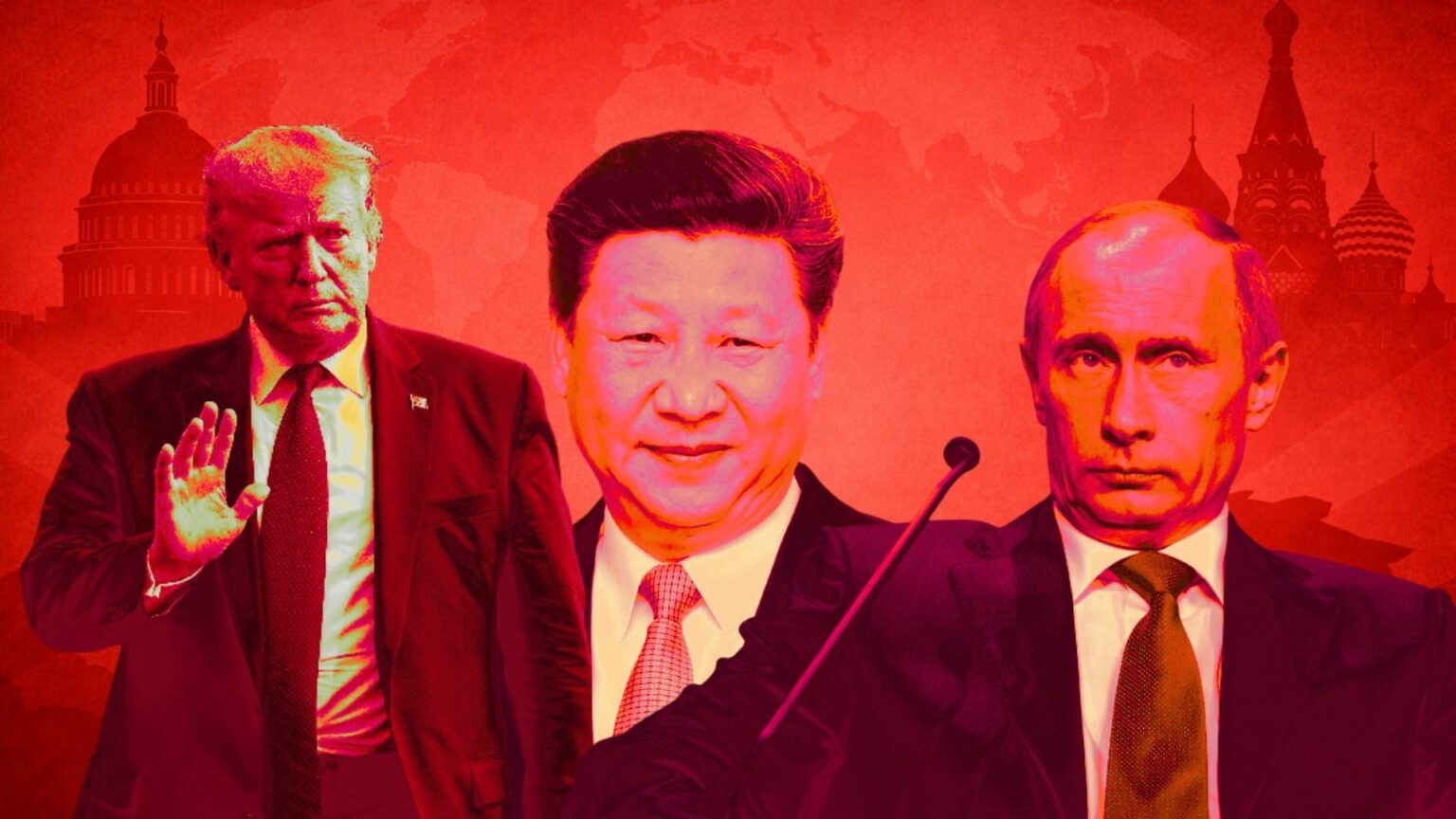
A tripolar nuclear challenge: U.S., Russia, and China
The nuclear strategic scene has shifted from a largely managed U.S.-Russia bilateral restraint to a more complex three-way nuclear environment involving China.
Until recently, the bulk of global nuclear weapons, about 90 percent, have been held by the United States and Russia. Even with New START’s limits, both sides maintained large stockpiles. U.S. President Donald Trump acknowledged that the treaty’s expiration, without a successor, would leave “no constraints” on long-range arsenals. At the same time, Russia proposed adhering to existing limits for another year, but Washington did not formally accept the offer.
China, long outside U.S.-Russia arms control frameworks, has now become a major player due to rapid military development and expanding nuclear capabilities. Estimates by think tanks such as the Federation of American Scientists and the Stockholm International Peace Research Institute (SIPRI) put China’s nuclear warhead stockpile at around 600 as of 2025, making it the world’s third-largest arsenal. China is modernizing and diversifying delivery systems, including missiles, submarines, and bombers.
Unlike the United States and Russia, whose historic arsenals peaked during the Cold War and have since declined, China’s stockpile is growing faster than that of any other country in recent years. According to expert analysis, Beijing may increase its arsenal to 750-1,500 warheads by 2035, even though most warheads remain in central storage rather than deployed on platforms.
South China Morning Post (SCMP) notes that Beijing has consistently resisted joining U.S.-Russian negotiations, arguing that its arsenal is far smaller and that parity-linked talks are unrealistic. China’s diplomatic posture emphasizes a no-first-use policy and claims its capabilities are kept at the “minimum level required for national security.”
The absence of a binding U.S.-Russia treaty could create a vicious circle involving all three powers. With no formal constraints on U.S. and Russian strategic forces, and a rapidly modernizing Chinese arsenal outside any legal caps, strategic incentives may shift toward competitive expansion rather than cooperation.
While Beijing has urged the United States to respond to Russia’s proposals on limits to maintain “global strategic stability,” it continues to refuse to engage in trilateral nuclear negotiations.
The three-way problem is not only about numbers but also about trust and predictability. New START’s verification provisions once allowed U.S. and Russian militaries to monitor each other’s strategic forces directly, reducing uncertainty. With these mechanisms gone and China outside similar frameworks, each side must rely more on intelligence and assumptions, increasing the risk of misinterpretation and miscalculation.
Strategic dynamics are further complicated by emerging technologies, such as hypersonic weapons, missile defenses, and cyber operations, which could make it difficult to distinguish between conventional and nuclear escalation. Nuclear stability has historically endured even tense geopolitical periods because arms control has provided communication and risk-reduction channels. Tools that are now weakened or absent.
Strategic vacuum, risks, and what comes next
This lapse weakens not just U.S.-Russia stability, but the broader global nuclear order, including the core bargain of the Nuclear Non-Proliferation Treaty (NPT). Many non-nuclear states base their compliance with the NPT on the expectation that nuclear-weapon states are actively reducing and controlling their arsenals.
Political signals from Washington suggest differing priorities. Former U.S. President Donald Trump publicly stated that “if it expires, it expires” and that the U.S. could pursue a “better agreement,” potentially one that includes China, though no formal negotiations have begun and Beijing has shown no willingness to join binding limits.
Reuters notes that extending or replacing the treaty would require years of complex negotiations on definitions, counting rules, and verification, all amid mistrust and geopolitical tensions, making a successor pact difficult to achieve in the near term.
When the largest nuclear powers abandon formal caps without clear replacements, it weakens the NPT’s normative power and risks fueling proliferation pressures in regions like East Asia and the Middle East, where security dilemmas already encourage nuclear hedging. SIPRI experts argue that, without predictable limits and transparency, debates in countries such as Japan, South Korea, and even Ukraine could intensify over acquiring their own deterrents.
What comes next is not simply a question of whether the U.S., Russia, or China will build more weapons but whether the global nuclear governance architecture can adapt. In the near term, options include voluntary transparency measures, crisis communications channels, and limited data exchanges among nuclear powers to partially fill the void left by New START. But as current diplomatic stances make clear, with Washington signaling interest in a future agreement, Moscow is prepared to live without caps, and Beijing does not want any formal limits, the path to renewed nuclear stability will be a difficult one.