
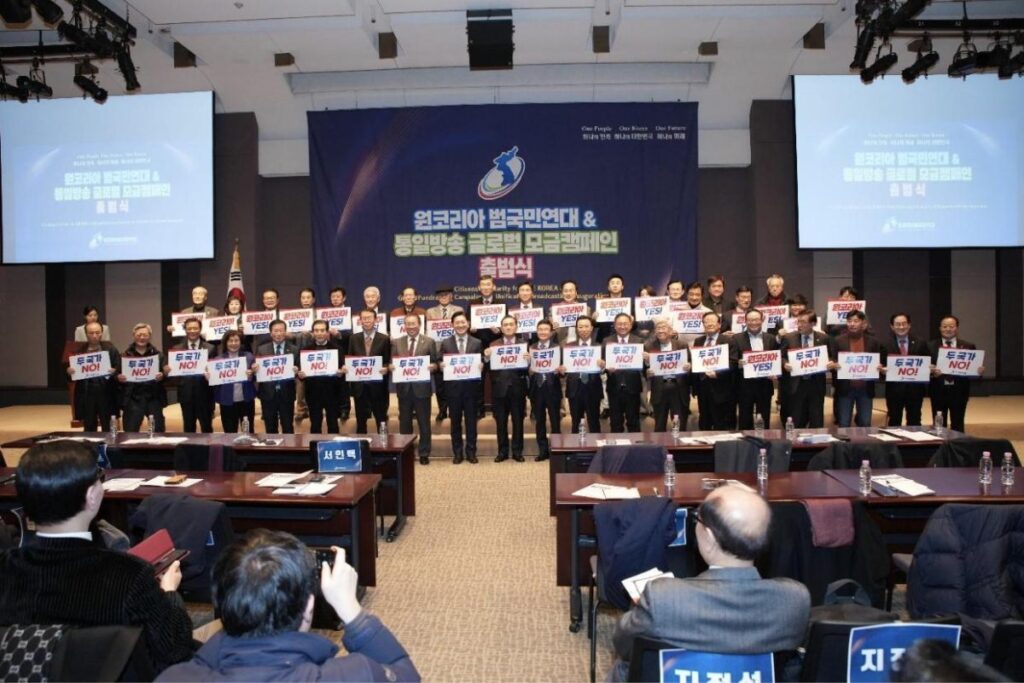
Photo caption: Members of the Citizens’ Solidarity for One Korea hold placards rejecting the “two-state” policy during the coalition’s launch ceremony at the Korea Press Center in Seoul on Feb. 4, 2026. Photo by the Citizens’ Solidarity for One Korea
SEOUL, Feb. 4 (UPI) — A broad coalition of over 50 civil society organizations, North Korean defectors, and overseas compatriots officially launched the Citizens’ Solidarity for One Korea on Wednesday, rejecting growing “two-state” policy proposals and calling for a renewed commitment to peaceful unification.
The inauguration, held at the Korea Press Center in Seoul, brought together around 350 leaders across the political and social spectrum, including civic activists, legal experts, and youth representatives. The alliance declared a mission to transition from merely “managing division” to actively “realizing unification,” asserting that accepting a permanent split would be a historical and humanitarian failure.
Rejecting the ‘two-state’ policy
The alliance was formed as a direct response to recent proposals to formalize North and South Korea as two separate, sovereign states — a policy the group argues undermines constitutional principles and national identity. Some policymakers argue that a two-state framework reflects current geopolitical realities, a view the alliance strongly disputes. Leadership of the group is shared by six co-standing chairs: Jang Man-sun (Committee for the 10 Million Separated Families), Lee Hee-bum (Korea NGO Federation), Heo Kwang-il (Committee for the Democratization of North Korea), Kenneth Bae (Nehemiah Global Foundation), Seo In-taek (Action for Korea United), and Kang Chol-hwan (North Korea Strategy Center).
“The ‘two-state’ policy is a dangerous approach that institutionalizes division,” said Jang Man-sun during the vision declaration. “Unification is not a matter of choice; it is a collective responsibility before our Constitution and history. With the first generation of separated families passing away daily, treating division as a permanent policy is tantamount to abandoning our ethnic duty.”
Kim Chun-sig, former vice minister of unification, provided a legal critique in his keynote address. “The South Korean Constitution defines the entire peninsula as its territory,” Kim noted. “A two-state system is not only a violation of our constitutional principles but also fails to address the long-term peace and stability of the region.”
Concrete initiatives: ‘Korea Link’ and ‘One Million Signatures’
The group outlined a roadmap for action, centering on breaking the information monopoly in the North. Seo In-taek, co-standing chair, announced the launch of “Korea Link,” a global fundraising project aimed at expanding North Koreans’ access to outside information.
The coalition set an ambitious fundraising target of 100 billion won (approx. $75 million) for the project. “Expanding information access is essential to the unification process,” Seo said, adding that the group plans to explore satellite-based technologies to bypass the North’s stringent information restrictions.
In tandem with the media project, the alliance launched the “One Korea One Million Signature Campaign.” The initiative aims to demonstrate broad public support for unification to both the South Korean government and the international community. Citing Germany’s reunification experience, Thae Yong-ho, former secretary-general of the Peaceful Unification Advisory Council, stressed the urgency of the movement. “Developments inside North Korea point to the need for a coordinated national effort to achieve unification by 2030,” Thae said.
Human rights as a moral mandate
Other prominent figures highlighted the humanitarian stakes. Kim Tae-hoon, chairman of the Council for Human Rights in North Korea, emphasized the link between human rights and unity. “Recognizing two states is an admission that we will overlook crimes against humanity occurring in the North’s political prison camps,” he said.
The event featured a series of speeches representing diverse stakeholders, including Kang Chol-hwan of the defector community and youth representative Kim Ga-young, who both argued that the two-state policy abandons those suffering under the current regime.
The Citizens’ Solidarity for One Korea concluded the ceremony with a formal declaration, vowing to preserve the “special relationship” framework between the Koreas and to keep the vision of a unified peninsula at the forefront of the global diplomatic agenda.