
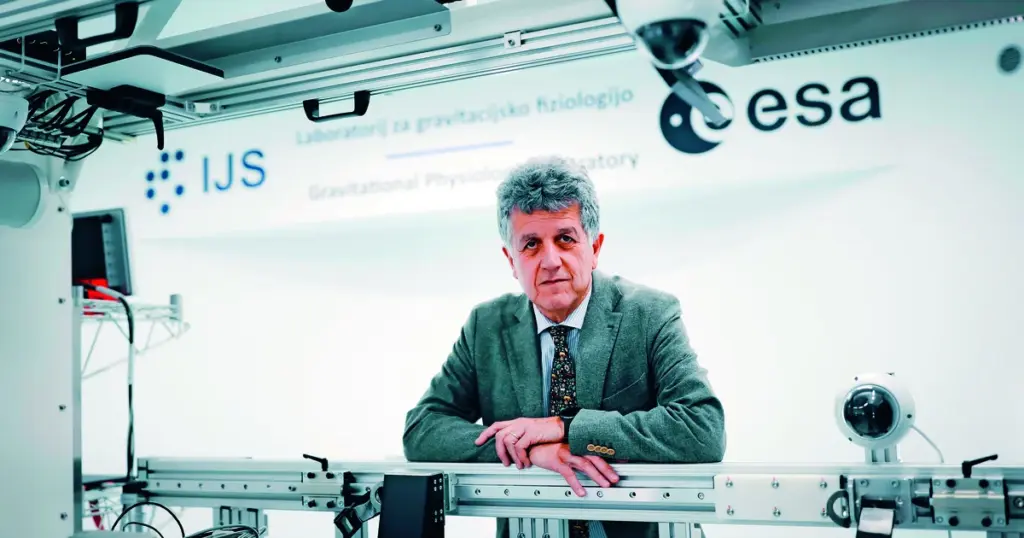
With full membership in the European Space Agency (ESA), Slovenia has gained more than a symbol; it has gained the same access to the European space ecosystem as the larger member states. In Planica, where Prof. Dr. Igor Mekjavić leads the Laboratory for Space Physiology at the JSI, space begins with the human body. His team researches space physiology, human protection in demanding environments, and the impact of heatwaves, and the laboratory increasingly acts as a partner to the industry.
Recently, you participated in an event in Planica with astronaut of Slovenian descent, Sunita Williams. The audience, especially the young, behaved as if they were in the presence of stars. How do you explain this?
I think the key is that we managed to establish the Erasmus Mundus program: Human Physiology and Medicine in Space and Extreme Environments. This is a magnet for students from all over the world. When they come here, they are really focused and motivated.
What is the essence of this program and why is it important for Slovenia?
It is about systematically educating personnel in the field of space physiology and medicine. Students move between institutions: first France, then Berlin (Charité), and then the Jožef Stefan International Postgraduate School. In Slovenia, they then complete practical research work.
So, we are talking about a real influx of talent and not just a one-time visit.
Exactly. The first group is currently in Slovenia, and it is very encouraging to see how seriously they approach the field.
Part of the program is also caving training in Sežana. Why?
This is not a sport or adventure; this is work. In companies, you have to think long-term to maintain people’s health and their working capacity.
Because caves are part of astronaut training at ESA. They simulate remote environments, isolation, and conditions relevant to missions to the Moon and Mars. It’s not about spectacle but about training and understanding the environment.
What does the European Space Agency gain from Slovenia?
Knowledge and trained personnel who understand human physiology in extreme conditions. And an environment where relevant training and research can be conducted.
Let’s pause for a moment on Sunita Williams. Is her visit to Slovenia important only symbolically or also concretely?
It is very important on both levels. She travels all over the world, but here, as seen in Planica, she somehow feels at home; Slovenia is one of her homes. Her father was from India, and interestingly, one of our students comes from the same area as her father. That is also why she will now visit India. This personal component means a lot. We hope we have also connected her with our program because she has become an ambassador for the Erasmus Mundus program.
You are the head of the Laboratory for Space Physiology at the JSI in Planica. What do you do in this laboratory?
We are currently working on three research pillars. The first is space physiology and medicine, the second is human protection in various environments – we do this in projects with the Ministry of Defense of the Republic of Slovenia. The third is global warming, the impact of heatwaves on people’s well-being, health, and working capacity.
Why do you think these are pressing issues even outside scientific frameworks?
Because they are happening now. For example, the North Pole is becoming strategically and geopolitically controversial. The ice is melting, opening access to oil, ore, and the like. You see that the USA is eyeing Greenland. Countries bordering the Arctic have interests, and Europe must protect its own. Unfortunately, military personnel may also be directly involved in this, so we must ensure they have adequate protection.
How does Planica specifically enter such projects?
Planica is the terrain; we have a testing ground. In winter, temperatures can drop to minus 14 degrees. We equip people with sensors, they go for a hike, and after a few hours, when they return, we analyze the responses and the effectiveness of protective measures.
How does the laboratory collaborate with companies?
Slovenian and foreign companies come to us to evaluate clothing, footwear, and the like. Many laboratories can test things in a lab, but we are fortunate that our laboratory is “in the field,” and we can simultaneously verify everything in real conditions. It’s not just about whether something works or not but also about developing new concepts.
The third pillar of your research is the phenomenon of heatwaves. What is your research focus here?
Global warming is a fact, although some do not want to believe it. We see it in heatwaves. Today we have them here too, often already in June, whereas 30 or 40 years ago, they did not exist. The one in 2003 was deadly in Europe. In Planica, we simulate a longer scenario than usual exposure to the sun and heat. We create three days of normal weather, three days of a heatwave, and three days of normal weather again. Subjects simulate work in the industry. Then we observe the effects on young people, men, women, and the elderly.
This is probably extremely important for workers exposed to weather conditions during their work.
Technology in clothing has advanced significantly, but sometimes we see that certain items or technologies that come to market simply do not work, despite being expensive and well-marketed.
Maybe I don’t follow the path of least resistance, not head through the wall, but I follow goals and what interests me. Since my master’s degree, I have been interested in how the environment affects us.
We help companies evaluate products so they can market them correctly, and at the same time, we help buyers, organizations that purchase equipment for their people, to see if the product works in the conditions their employees actually work in. We help both sides.
If we transfer this to heatwaves: a scientific result is one thing, but the social impact is another. How is this circle closed?
We publish the results in scientific journals. The second key thing is transferring them to decision-making circles. Members of our team are also invited to meetings, for example, in Geneva, where the World Health Organization is headquartered, and we present the results there.
Moreover, based on the European Heat Shield project we had in Slovenia, due to its success, they started the same project in Asia and Canada. They saw the sense.
Where are the limits of your influence as physiologists?
We cannot fix the damage that has already been done. What we can do is show with evidence how harmful changes can be and highlight vulnerabilities.
Where does society systematically underestimate heatwaves?
We talk a lot about the industry, but let’s look at education. Schools have heating because the school year lasts from September to June. Most schools, however, are not built for cooling. In June, there are heatwaves, and children suffer similarly to adults.
Why are children a particularly vulnerable group?
We have proven that they are more exposed because they have less mass and heat up faster. No wonder they become restless.
Are there already examples where heat has influenced systemic decisions?
I remember that in France, they postponed the baccalaureate so that it was not during a heatwave but later, which made sense. In Croatia, parents in Split were upset because it was significantly hotter there than in the north, but the exam dates were the same. They feared worse results and pressured the government.
We wouldn’t have discussed this 20 or 30 years ago.
That’s right. Today, schools are open until the end of June, and in June, we have two to three heatwaves. This can also negatively affect the work and results of the youngest.
In your work, you connect science and industry. Do you notice that applied science in Slovenia is actually strengthening?
Yes, but we must understand the difference in capacity. Global companies, American or European, with which we collaborate, have development departments that can sometimes be as large as the Jožef Stefan Institute. They have their campuses and R&D infrastructure. Our companies generally do not have this.
Do companies still invest too little in research and development?
Also, but often they simply cannot afford it, so I think it is important that we at the Jožef Stefan Institute are aware of this. Our team acts as the research and development department of Slovenian companies. We are available to them for development, research, and assistance because our companies are smaller, but they can afford to collaborate with a research institute. And that’s essentially what we do.
You are intensively researching the effects of microgravity on the body. Sunita Williams said that we are heroes because we endure gravity every day. What do your studies show?
If you look at human development from infancy to old age, it is a lifelong struggle with gravity. Initially, it is positive: lifting the head, supporting oneself on the hands, walking. This struggle strengthens muscles, bones, and the cardiovascular system. It is easier until middle age, but then gravity “gains” and we become more helpless.
After the age of thirty, we start losing muscle mass. The rate of loss depends on activity, so activity is crucial, but inactivity is unfortunately very widespread today.
Your studies simulate inactivity similar to that experienced by astronauts. What exactly do you measure?
We simulate inactivity and unloading of the lower limbs, as experienced by astronauts, and observe the effects on physiological systems. On Earth, lying down and sitting are, of course, normal, but every day we must be exposed to gravity from head to toe for at least some time, meaning walking, standing, and exercising.
Do you have any interesting data on the consequences of inactivity?
Our research shows that in two months of inactivity, we lose about 10 to 14 percent of muscle mass in the lower limb muscles and a few percent of bone mass in the lower limbs.
Is this reversible?
In young, healthy people, it is. After two weeks of rehabilitation, they regain muscle and bone mass, but the question is whether this fully simulates aging. In aging, we can no longer return to the baseline state so easily, and that is the problem.
Why is public health still too loosely defined here? We hear a lot about the need for exercise, but there are far fewer specific guidelines.
The World Health Organization also says that exercise is necessary, but often there are no details: what kind of exercise, for how long. Someone at 40 or 50 can exercise more intensively than someone at 80. But activity at 80 or 90 is still important, and perhaps there is not enough information about this.
You titled one of your lectures The Physiology of Inactivity. Why such a focus?
If you study activity, exercise, kinesiology, you also need to know what happens when someone is inactive, what the process of changes is. Only then can you help that person gradually become active again.
Do you also link this to the epidemic of metabolic syndrome, a cluster of several health conditions such as elevated blood sugar, high blood pressure, abnormal cholesterol or triglyceride levels, and obesity in younger people?
Yes. Metabolic syndrome appeared mainly in older, inactive people 30 or 40 years ago. Today, we see it in younger people, and one of the main causes is inactivity.
Are you also thinking of the well-known formula that sitting kills?
Indeed, Dr. Joanne Vernikos, former director of biomedical research at NASA, published a book after her retirement titled Sitting Kills, Walking Heals and explained why sitting is so negative.
At the Bled Strategic Forum, they asked why invest in space if we have so many problems on Earth. The answer was that space science also solves earthly challenges. Can it also help in the currently very topical field of longevity?
That is a difficult question. One of the biggest problems in space is radiation. Longevity is also a question from the perspective of living on the Moon and Mars, as radiation doses there can be very high.
Would life on the Moon be shorter than on Earth?
It all depends on the protection technology, which is already being considered. Besides, a person will not walk on the Moon’s surface for 20 hours every day.
If we were not protected, the risk would be great. But it is also dangerous on Earth if we are exposed to the sun and heatwaves. It all depends on technology and measures.
What are the specific directions for protection?
One idea is to print bricks from lunar dust and build habitats, something similar to igloos. This material is supposed to reduce dangerous radiation doses. Another idea is caves, which have also been discovered on the Moon and would be ideal for radiation protection.
Your scientific work is a marathon; results are not visible overnight. What drives you to persist in long-term projects?
I never think about it. Maybe I don’t follow the path of least resistance, not head through the wall, but I follow goals and what interests me. Since my master’s degree, I have been interested in how the environment affects us.
You started as an engineer. How does an engineering education shape your approach to work?
I started as an engineer and with research on how to help divers. With the British Navy, we developed sensors and devices. I enjoyed it very much because, as an engineer, I also had to understand physiology to develop technology that helps people.
Our team acts as the research and development department of Slovenian companies. We are available to them for development, research, and assistance because our companies are smaller, but they can afford to collaborate with a research institute.
If I had to explain how the path from problem to solution goes, I would say: If a person falls into cold water, they start hyperventilating. If they don’t know how to behave, they can drown. If they survive the initial shock, hypothermia and hypothermia set in. When you understand this process, you can develop protection and protocols. And the latter is crucial for companies, as workers are exposed to various conditions every day. This is not a sport or adventure; this is work. In companies, you have to think long-term to maintain people’s health and their working capacity.
Space tourism is debatable: some see it as a driver of technological development, others as ego projects of billionaires. Sunita Williams is succinct: “On Earth, I can wear a swimsuit.” Do you like this thought of hers?
Of course, it is an excellent thought that illustrates that Earth is the best. (smile)
Slovenia is a full member of ESA, and Planica is one of three points in Europe where you research weightlessness and long-term inactivity. Have we reached the point where a small country is no longer small?
This is the logo for our ESA offices: small on Earth, big in space. And it is true. We are part of Europe. When primary and secondary school students come to us, they all know NASA; in America, every child knows that NASA is theirs. Here, it seems to me that we do not realize that ESA is ours, that it is not somewhere else.
It doesn’t matter whether we are territorially small or large. We have the same access to ESA as the Germans, French, or Italians. And this means that young people in Slovenia have the same opportunity for a career and work in this field as anyone else in Europe.
Who is really responsible for making Planica such an important center, a true “space atlas”?
Not just me, my team is very responsible. If it weren’t for the team, Planica wouldn’t be in this “space atlas” of laboratories. Our research is well-known, and this is a reflection of our work, not just mine.