
Sanctions imposed by the US president are forcing Gazprom to withdraw from Serbia. President Aleksandar Vu?i?’s power is eroding, while Hungarian Prime Minister Viktor Orbán is benefiting from the new energy order.
The US president’s erratic policies, with a constant stream of threats, some of which he then backs down, create the impression that Donald Trump is simply making noise. The acronym “TACO” has become widespread in political discourse to describe his tendency to back down: Trump always backs down. But, like most statements containing the word “always,” this one is also incorrect. Trump is quite serious. His weak opponents, such as the embattled president of Venezuela, are learning this the hard way. Another example is Serbia with its seemingly strong president, Aleksandar Vu?i?.
For a long time it seemed that the Belgrade ruler could evade Washington’s demands. But in the end he was forced to back down, even without sending a US army to the Adriatic. It was enough that the US did not lift sanctions on the largest energy company, NIS.
Gazprom’s expulsion weakens Moscow’s influence
Faced with an energy crisis and the risk of fuel shortages for an already disgruntled population, Vu?i? bowed to Trump’s real threat. Russia’s majority stake in the NIS had long been an obstacle for the US president, who is also trying to curb other Russian energy interests. These include restrictions on Russian oil exports to India, sanctions on Gazprom, and the forced sale of Lukoil’s business to the US investment fund Carlyle.
Trump’s intervention in Belgrade is changing the balance of power in the Western Balkans. Serbia sold a majority stake in NIS to Russia in 2008 as part of a strategy to strengthen ties with the culturally close eastern supplier of gas and oil. Gazprom’s exit, more akin to a forced eviction, is now reducing Moscow’s influence in the European Union’s “back yard.” This is unlikely to please strategists in the Kremlin, even though the sale price, around 1 billion euros, is expected to be two and a half times higher than the initial purchase price.
New energy order in the Western Balkans
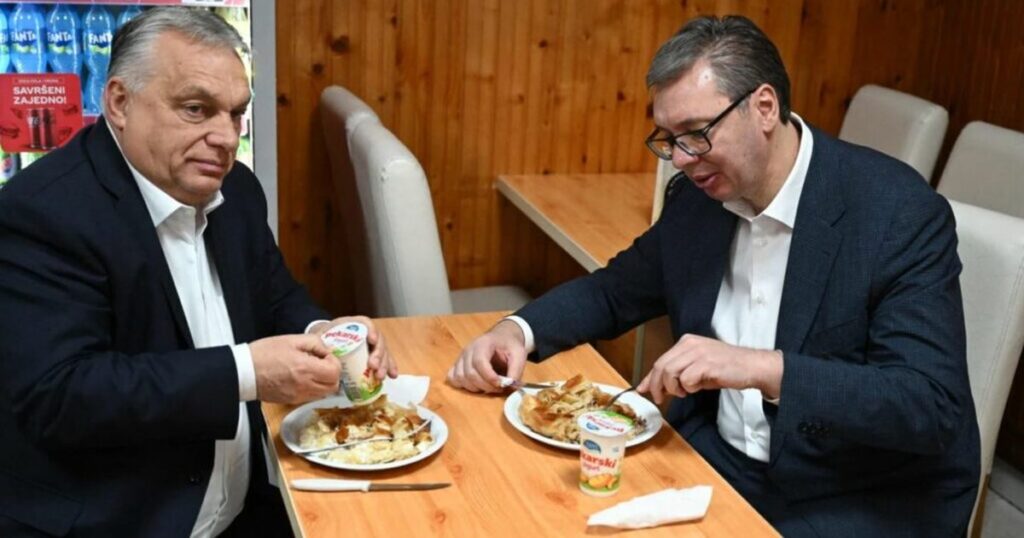
The main beneficiary of this new energy order is a neighbor of Vu?i?: Hungarian Prime Minister Viktor Orbán. The Budapest-based energy company MOL, under his influence, is expected to become the majority shareholder of NIS, provided that the Americans give their approval, which currently seems likely. MOL will continue to be supplied with cheap gas and oil from Russia. With NIS in its portfolio, Hungary will dominate the oil market in the Western Balkans. Investors have high expectations: Since the first rumors of a takeover emerged, MOL shares have risen by about a third.
Meanwhile, the “illiberal” Orbán maintains good relations with both Trump and Vladimir Putin. Within the EU, he votes against any attempt to weaken Russia, which has been attacking Ukraine for four years. His close ties to Moscow are viewed with suspicion by many EU countries. For this reason, Spain and Romania have refused to allow Hungarian investors to buy shares in railway and energy companies. The company Eon has been forced to postpone the sale of a Romanian subsidiary.
Orbán’s strategic strike
Still, Orbán’s investment in NIS was a strategic coup. Thanks to it, Russia remains in the game as a supplier of oil and gas. Hungary also intends to challenge the EU’s plan to ban energy imports from Putin’s Russia in the European Court of Justice. Before the court makes a decision, Hungary will hold elections. It is possible that the longtime leader will be ousted from power in April. The outcome of the elections will determine how long Central European countries will continue to fill Russia’s war coffers with oil and gas imports.
Despite Orbán’s distance from the EU, it is ironic that Vu?i?’s sheltering in Orbán represents a rapprochement with the European Union, whose rules also apply to Serbia. With a drop of a pen from Washington, the Belgrade leader – who saw himself on the same level as the presidents of Russia and China – was brought back to reality: Vu?i? is the ruler of a small country, with slow economic growth, a fragile legal system and a population so revolted against him that he was forced to promise early elections.
Serbia has been a candidate for EU membership since 2012. As the largest country in the Western Balkans, it has a key position. Brussels must maintain this perspective, but rely on politicians who are truly committed to making it happen. With Vu?i?, who has dominated the political scene in Belgrade for years, this seems increasingly unlikely. He has long since exhausted the trust not only of broad segments of his own population, but also of any initial support he had from the European Union./ Frankfurter Allgemeine Zeitung