
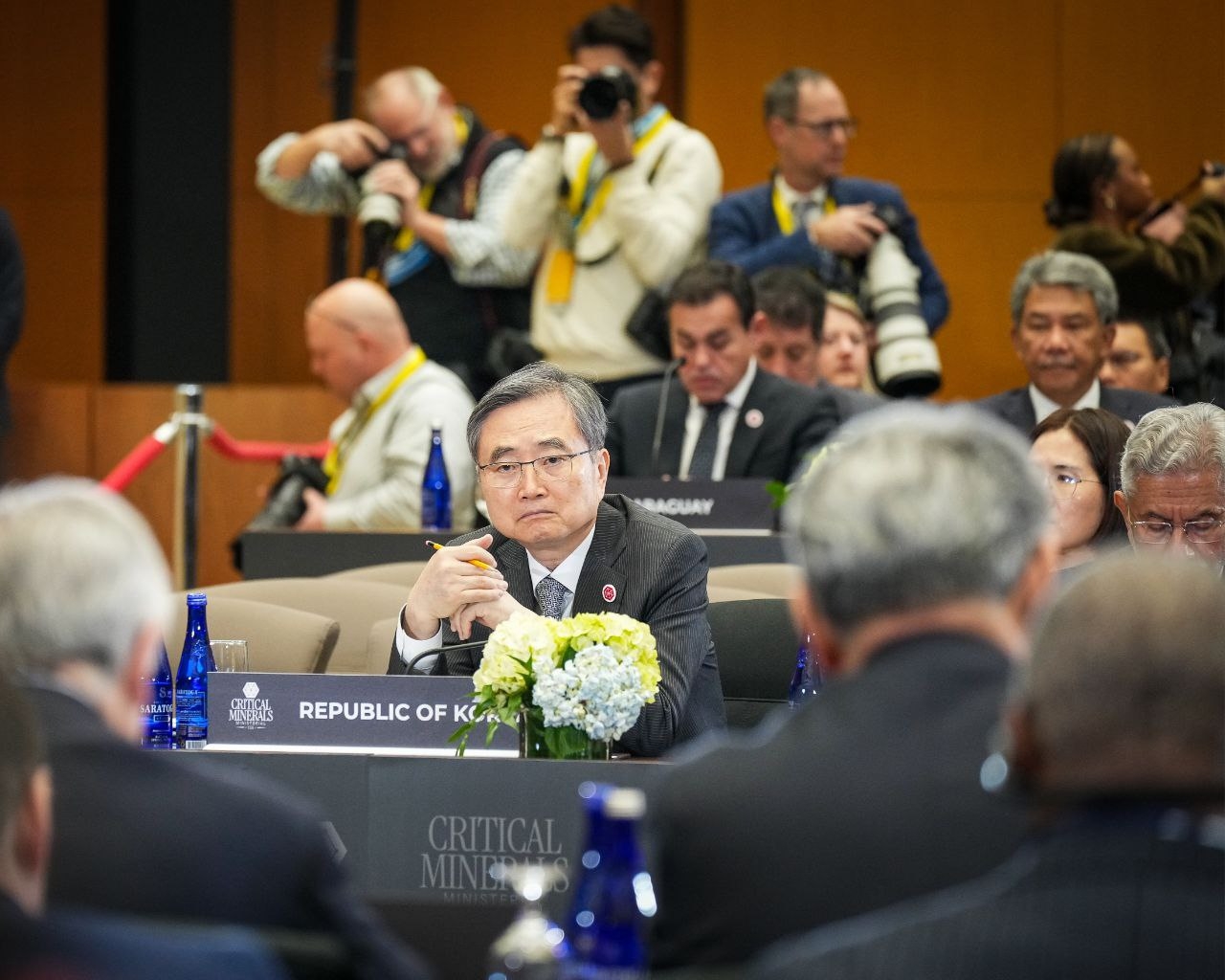
 Foreign Minister Cho Hyun attends the Critical Minerals Ministerial meeting in Washington on Wednesday (local time) in this photo provided by the South Korean Foreign Ministry on Thursday. (Ministry of Foreign Affairs, Republic of Korea)
 Seoul and Washington reaffirmed the need to accelerate progress on civilian uranium enrichment, spent nuclear fuel reprocessing and nuclear-powered submarines during talks between Foreign Minister Cho Hyun and US Energy Secretary Chris Wright in Washington, even as unresolved trade tensions cast uncertainty over the pace of broader strategic cooperation.
Recent high-level diplomatic talks have yielded little progress on trade issues, while Seoul officials say Washington is reviewing steps to formally reinstate higher duties on Korean goods — a move that could complicate momentum on sensitive security initiatives, including South Korea’s pursuit of nuclear-powered submarines.
According to South Korea’s Foreign Ministry on Thursday, the two sides agreed on the need to move quickly toward concrete outcomes tied to the bilateral joint fact sheet released last November following summits between President Lee Jae Myung and US President Donald Trump.
“The two sides reaffirmed a shared understanding of the need to swiftly make concrete progress vis-a-vis the enrichment and reprocessing segment and cooperation over nuclear-powered submarines, which are part of the joint fact sheet,” the ministry said in a press release. “For this, (they) agreed to promptly seek earnest working-level consultations.”
Cho expressed expectations that bilateral nuclear energy cooperation would deepen through expanded collaboration in enrichment and reprocessing, while Wright agreed to actively support efforts aimed at producing tangible results, the ministry said.
The two sides agreed to maintain close coordination to advance broader civilian nuclear cooperation, including exploring joint business opportunities in third countries.
South Korea’s push to acquire nuclear-powered submarines remains one of the alliance’s most sensitive security issues. US backing signaled in last year’s joint fact sheet marked a notable shift from earlier hesitation tied to nuclear nonproliferation concerns.
Still, the path forward is expected to be neither quick nor straightforward, given domestic US procedures and regulatory requirements, as well as the broader strategic implications of such cooperation, observers say.
Cho also attended a US-led multilateral ministerial meeting on critical minerals in Washington, where partner countries discussed strengthening supply chains amid geopolitical uncertainty and shifting global resource dynamics.
The meeting marked the launch of the Forum on Resource Geostrategic Engagement, or Forge, a new initiative building on the Minerals Security Partnership framework. South Korea is set to chair the mechanism through June.
The US State Department said, “FORGE, which will be chaired by the Republic of Korea through June, will lead with bold and decisive action to address ongoing challenges in the global critical minerals marketplace.”
“Understanding the benefits of working together and building on the MSP, FORGE partners will collaborate at the policy and project levels to advance initiatives that strengthen diversified, resilient and secure critical minerals supply chains,” it said.
While cooperation on nuclear energy and supply chains continues to advance, officials acknowledge that the trajectory of future talks — particularly on nuclear-powered submarines — may hinge on whether the two sides can stabilize trade relations in the weeks ahead.
Amid growing debate over South Korea’s pursuit of a nuclear-powered submarine, experts warn that a national-level management system and legal framework must be established first, stressing that the project extends far beyond a conventional defense acquisition.
Retired Capt. Moon Keun-sik, a professor at Hanyang University’s Graduate School of Public Policy and a former submarine captain in South Korea’s Navy, said that while a reversal of US approval is unlikely, Seoul must move quickly on legislative action and institutional support.
“Because there has already been approval from President Trump, the chances of the project being overturned are slim. But that does not mean we can afford to sit idle,” Moon said. “The government needs to quickly establish a dedicated organization, foster specialized personnel and prepare institutional support.”
Speaking at a National Assembly forum on legislation for a Korean-style nuclear-powered submarine on Jan. 28, Moon said that once a nuclear reactor is involved, the project becomes a national strategic undertaking requiring interagency coordination, stable funding and alignment with international rules.
He called for the creation of a presidential-level integrated management body and special legislation to ensure long-term policy continuity and budget stability, warning that without a legal foundation, the project could face delays, funding uncertainty and setbacks in international cooperation.
“Without urgent legislative action by the South Korean National Assembly and legal institutionalization of a national management system, it will be impossible to advance the nuclear-powered submarine project,” Moon said.
mkjung@heraldcorp.com