
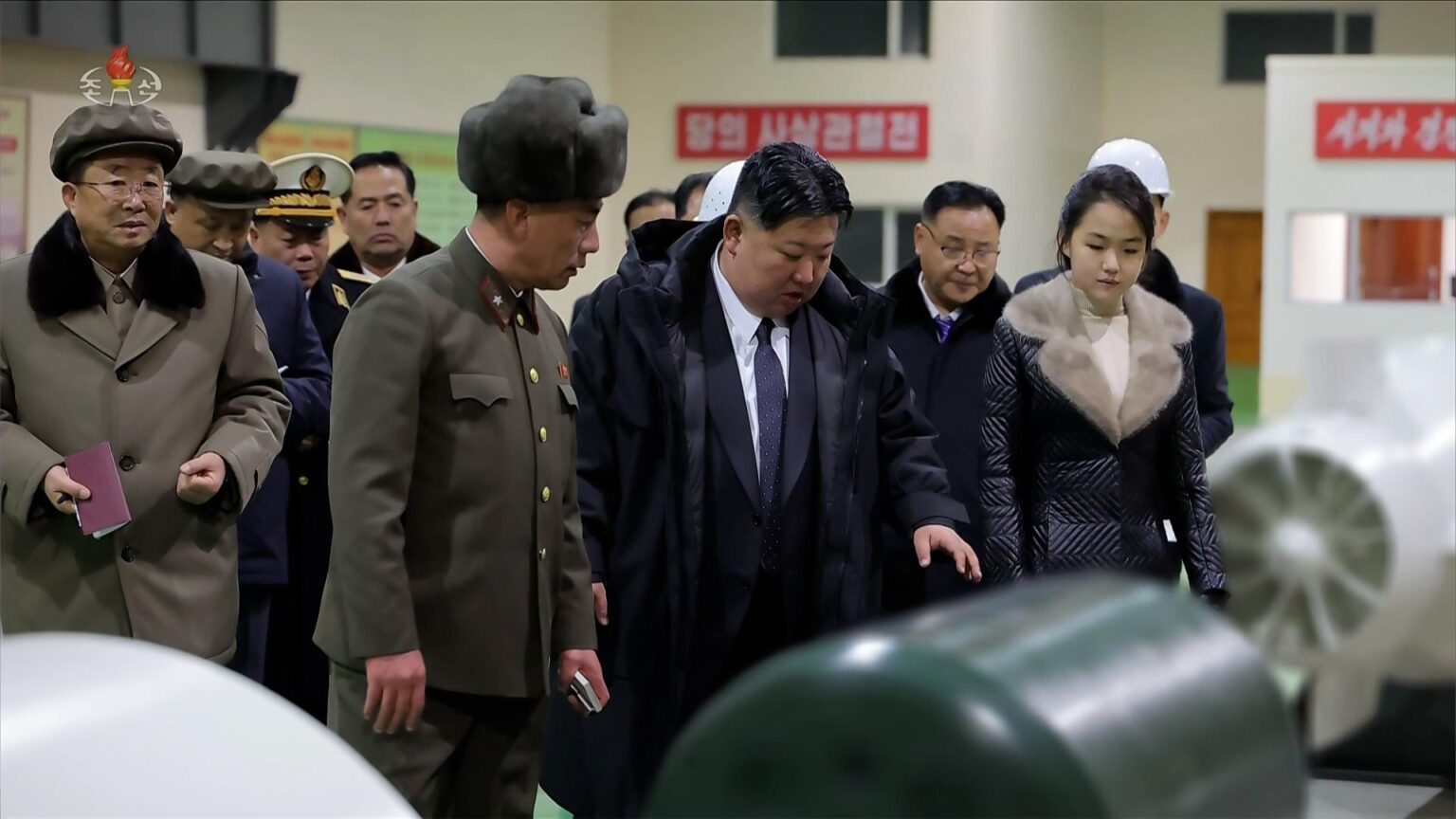
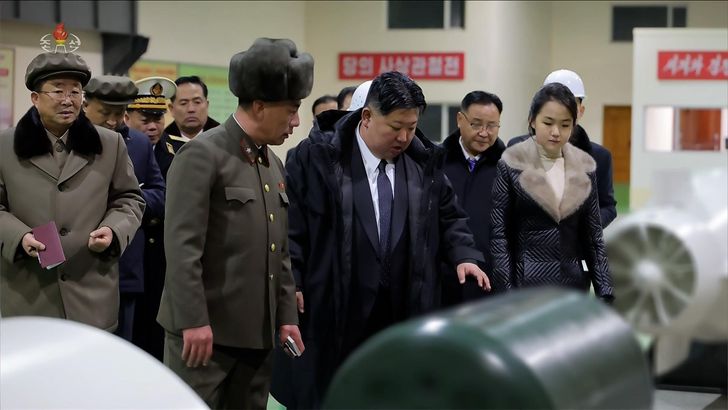
North Korean leader Kim Jong-un, front row second from right, conducts an on-site inspection of what the North claims is an 8,700-ton nuclear-powered strategic guided missile submarine under construction, in this photo released by Pyongyang’s state-run Korean Central News Agency, Dec. 25, 2025. Yonhap
The expiration of the last remaining nuclear arms control treaty between the United States and Russia is heightening concerns that a renewed arms race among major powers could embolden North Korea to expand its nuclear ambitions, analysts said.
Experts said that the erosion of arms control among global nuclear powers could reinforce Pyongyang’s belief that nuclear weapons remain its most reliable guarantee of national security.
The Treaty on Measures for the Further Reduction and Limitation of Strategic Offensive Arms, known as New START, effectively expired Thursday. Signed in 2010, the treaty was designed to reduce the risk of a catastrophic nuclear confrontation by capping the two largest nuclear powers’ deployed strategic nuclear warheads at 1,550.
While the agreement had served as a key pillar of global nuclear arms control, it began to unravel after Russia began its invasion of Ukraine in 2022, when U.S.-Russia relations deteriorated and on-site inspections were suspended.
With the treaty’s expiration, arms control cooperation between Washington and Moscow in the post-Cold War era has effectively come to an end.
As the prospect of a new arms race grows, experts say North Korea may see greater justification to expand its nuclear arsenal. North Korea has long endured international sanctions while pressing ahead with nuclear weapons development, a strategy widely viewed as aimed at securing leverage in negotiations with Washington.
Cho Han-bum, a senior research fellow at the state-run Korea Institute for National Unification, described the situation as a double-edged sword for Pyongyang.
“With the expiration of the New START treaty, Pyongyang would more closely watch the shifts in U.S. posture under President Donald Trump on nuclear arms and use the weakening of global arms control norms to further justify its own nuclear program,” Cho said.
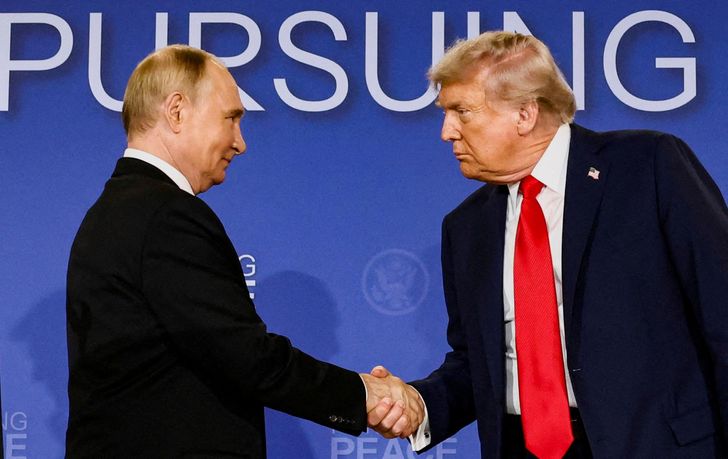
Russian President Vladimir Putin, left, and U.S. President Donald Trump shake hands during a press conference at Joint Base Elmendorf-Richardson in Anchorage, Alaska, Aug. 15, 2025, following their meeting to negotiate an end to the war in Ukraine. Reuters-Yonhap
“At the same time, the erosion of nuclear restraint could fuel debates over nuclear armament in countries that do not currently possess nuclear weapons, raising concerns about a global ‘nuclear domino effect,'” he added. “Such developments could ultimately complicate North Korea’s strategic environment, given that nuclear weapons are its primary source of diplomatic leverage in dealings with the United States and other major powers.”
South Korea’s options in response to the treaty’s expiration seem limited. Still, experts stress the importance of sustaining efforts to preserve the Non-Proliferation Treaty regime, especially as divisions among the five recognized nuclear-weapon states deepen.
In a recent paper, researchers Lee Sung-hoon and Paek Sun-woo of the Institute for National Security Strategy argued that the evolving arms control landscape could warrant a reassessment of South Korea’s approach to North Korea’s denuclearization.
“North Korea could be gradually incorporated into multilateral arms control discussions formed in the wake of New START’s expiration, and South Korea should increase diplomatic efforts to use participation in such frameworks as leverage to advance denuclearization of the Korean Peninsula,” the researchers wrote.
As one possible model, the researchers proposed granting North Korea a form of observer or “special inspection” status in multilateral arms control talks. Such an arrangement, they said, could allow Pyongyang to claim participation in arms control discussions while institutionalizing a freeze on its nuclear program.