
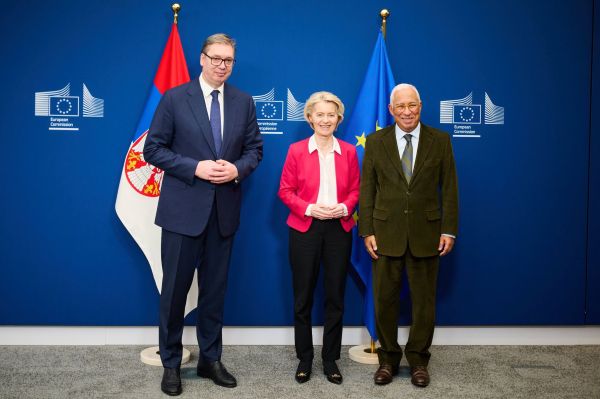
Serbia announced a push to diversify its energy supply, stepping away from its over-reliance on Russia and moving closer to the European Union.
The decision was unveiled by Serbian President Aleksandar Vucic in an interview with Reuters. The Balkan country is already in talks to buy natural gas as part of the EU communal gas-buying (AggregateEU mechanism). Serbia entered into this mechanism last year. It will cover around one-fifth of the country’s gas needs, currently totalling 500 million cubic metres.
During the interview, Vucic stressed that Serbia is moving to diversify its suppliers. Belgrade has already begun buying gas from Azerbaijan and is currently building two new pipelines to further diversify its supply. One that should be ready in 2026 from North Macedonia will allow Serbia access to liquefied natural gas from Greece, while an oil pipeline linking with Romania is set to be completed in 2027.
The effort is meaningful, considering that Serbia was one of the few remaining countries still buying Russian natural gas. In recent years, it reached over 80% of its supplies. Last year, Belgrade failed to secure a new long-term deal with Russia’s Gazprom, settling instead on a stopgap agreement in December that will end in March.
Vucic told Reuters that “still we will have big quantities of Russian gas, but we are taking more and more from Europeans.” The EU has warned Serbia about its reliance on Russia for natural resources, and Vucic has begun to understand the demand, saying, “We have to adjust our energy policies to certain demands and requests.”
Traditionally, Russia has been a close ally of Serbia, supporting the country over its opposition to Kosovo’s independence. The populist Vucic sought to balance the country’s historical closeness with Russia with a push to join the EU, but after Russia’s invasion of Ukraine, it became harder for him to keep the line. He reiterated that “since I am president, Serbia will be on its EU path.”
The long-standing issue with Kosovo remains a roadblock to Serbia’s accession. Still, the EU is also asking for more commitments to reduce corruption, strengthen the rule of law, ensure media independence, and tackle organised crime more robustly. Brussels has also criticised a recent reform of the judiciary as a step in the wrong direction.