
Years later, it’s still a talking point in my life, and, crucially, something I wouldn’t willingly give up.
That experience set a tone. When it comes to wellness tech, especially anything promising better rest or deeper relaxation, there’s a willingness here to suspend disbelief.
If something claims it can calm the nervous system, melt stress or improve sleep, it gets more than a fair shot. Even — or perhaps especially — when it sounds strange.
Speaking of which, enter the Woojer Mat.
Sound-therapy beds (I’m sticking with this simple description of it — but it’s much more) aren’t new. In fact, they’re usually the preserve of luxury spas, wellness retreats and specialist clinics — enormous, immovable things that cost thousands and look like they should come with a waiver. In fact, just last year, I experienced one in one of Northern Ireland’s most famous spas.
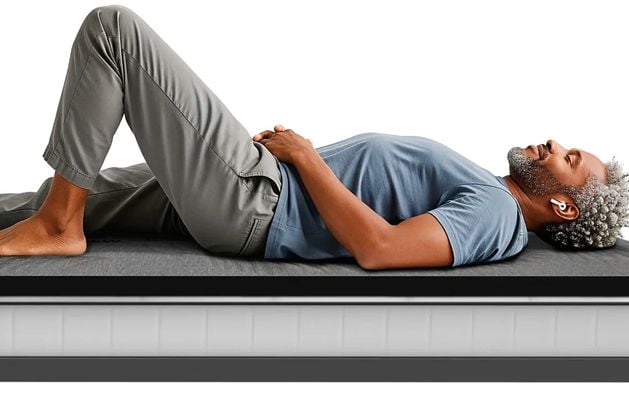
The Woojer Mat takes that same idea — high-fidelity haptic technology that lets you feel sound rather than simply hear it — and shrinks it down into something you can roll out in your living room. That alone is its biggest trick.
At first glance, the Woojer Mat feels like an indulgence. I will stress this now, however: it’s not cheap, and it doesn’t try to be.
This is a premium wellness product that sits firmly in the “considered purchase” category rather than impulse buy.
It’s also undeniably odd. The idea of lying on a mat while low-frequency vibrations travel through your body can sound somewhere between sci-fi experiment and spa gimmick. And yet, once set up, the experience is unexpectedly refined.
The mat pairs with your phone and works with music, soundscapes or guided audio, translating bass frequencies into precise physical vibrations that move through your back, shoulders and core. This isn’t aggressive or rattling, it’s controlled, and deliberate, almost like a deep-tissue massage delivered through sound rather than pressure. The effect is subtle at first, then quietly absorbing.
What makes the Woojer Mat work is restraint, as this isn’t about overwhelming your senses or shaking you into submission. Instead, it leans into slow, grounding frequencies, the kind that encourage your body to unclench without you consciously telling it to. Paired with ambient music or breathwork tracks, the vibrations seem to nudge the nervous system out of fight-or-flight and into something calmer. Less doing, more being.
(Note: I am a notoriously terrible sleeper with a bedtime routine that would make anyone wince, so anything that promises even marginal relaxation is entering a very competitive personal marketplace.)
Unlike spa-based sound beds, which are often one-note experiences, the Woojer Mat is flexible, as it can be used for short decompression sessions during the day, longer wind-down routines at night, or even as a background layer during meditation or stretching.
It rolls away when not in use, doesn’t dominate a room, and doesn’t demand a dedicated “wellness space” — a surprisingly important detail for something designed to be used regularly rather than occasionally admired.
There’s also something quietly convincing about how physical the experience feels. Wellness tech often relies on metrics, dashboards and graphs to prove it’s doing something. The Woojer Mat doesn’t bother.
You feel it working in real time. Your breathing slows. Your shoulders drop. The world gets a little quieter.
However, that said, this isn’t a miracle cure, and it won’t be for everyone. If you’re deeply sceptical of alternative wellness approaches, or if the idea of vibrational therapy makes you uncomfortable, the Mat won’t magically convert you.
It also asks you to meet it halfway: you need to carve out time, lie still and allow the experience to happen. This is not passive tech in the way scrolling a phone is passive.
It’s also expensive enough that the question of value matters. The Woojer Mat sits in that familiar wellness-tech territory where the price initially raises an eyebrow, followed by a longer pause once you start using it.
Like the Eight Sleep, laser masks and blue-light therapy tech before it, this is less about instant justification and more about accumulation.
Over time, it becomes part of a routine. Something you reach for when your head is too busy, your body too tense, or sleep feels annoyingly out of reach. And that’s where it earns its place.
The Woojer Mat is strange. It’s indulgent. It’s absolutely not essential. But it’s also one of those products that quietly embeds itself into daily life, becoming harder to explain than to live without.
In a world saturated with wellness promises, it does something refreshingly simple: it helps you slow down — physically, not just mentally.
To sum it up simply… Expensive? Yes. A bit weird? Definitely. Worth it? For anyone who treats relaxation as something worth investing in — and who knows how rare genuine calm can be — probably.
4/5. From £670