
 TIL Creatives
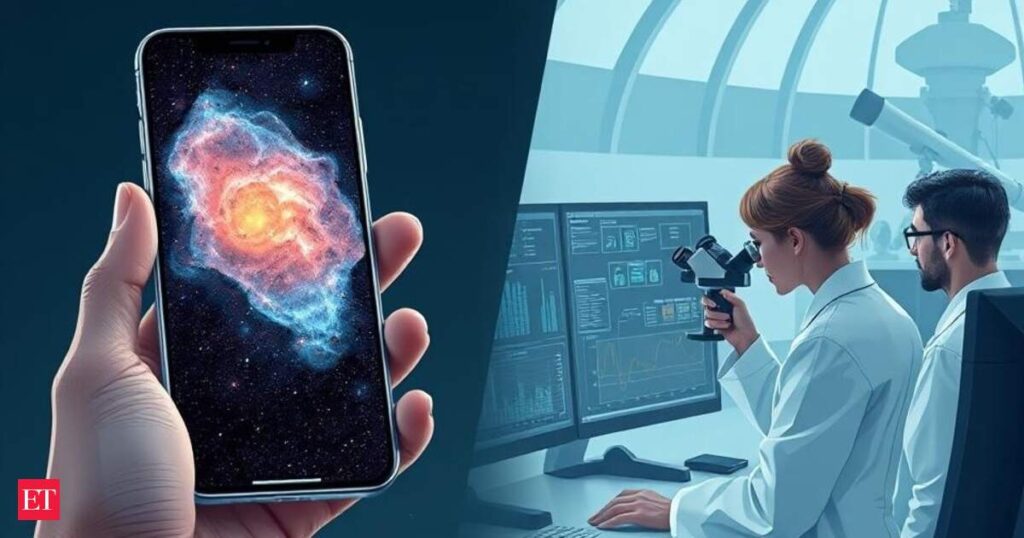
I contrast a digitally manipulated nebula with scientists rigorously verifying real data, highlighting the need for critical thinking.
From centuries-old “fairy” photographs to today’s AI-generated microscopy fakes, not all science pictures are what they seem. Thankfully, scientists and journalists have developed rigorous ways to distinguish real data from visual trickery, and the real proof can be far more remarkable than the fakes it replaces.
Why Images Fool UsHumans instinctively trust what they see. For decades, people have assumed that a photograph provides objective evidence of what happened. But that was not always true, even in the early 1900s. One of the most infamous early image hoaxes was the Cottingley Fairies photographs, taken by two cousins in England in 1917, which were widely believed to show real fairies until they were revealed as staged decades later.
Today’s image manipulation is less quaint, more sophisticated, and far harder to detect. Advances in digital editing tools and artificial intelligence mean that even experts sometimes struggle to distinguish real images from fakes. A National Geographic guide to spotting manipulated photos notes that fake images shared after extreme weather events can spread widely even when they are entirely AI-generated, and that careful analysis of lighting, context, and source is often needed just to begin sorting truth from fiction.
In science communication, image editing isn’t always malicious. Astronomers often enhance color in space telescope images to make invisible wavelengths visible to the human eye, a scientifically meaningful process but one that can confuse audiences who expect “raw” photographs. But there is a sharp difference between enhancing data for comprehension and creating images that misrepresent scientific reality.

When the Image Isn’t InnocentScientific communities have struggled with manipulated imagery for years. In biomedical research, for example, inappropriate handling of photos of gels, blots, or microscopy results can distort the meaning of a study. Editors interpret image misuse as scientific misconduct because it alters the representation of data, undermining the credibility of conclusions drawn from those images.
In some cases, deliberate falsification has misled scientists and delayed progress. A notorious example outside images but related to visual evidence is Piltdown Man, an early 20th-century fossil discovery that was widely accepted as a human ancestor for decades before it was exposed as a hoax. The case illustrates how even professional scientists can be misled when the evidence appears to “look right” but is not tested rigorously.Real Scientific Field Proof Comes With ContextTrue scientific imagery is rarely about dramatic visual flair alone. In the sciences, images accompany rigorous fieldwork, replicable methods, and peer review, which together allow scientists to evaluate what visuals represent.
Take, for example, the iconic Hubble Deep Field images captured by the Hubble Space Telescope. These images represent thousands of separate exposures combined over long observing periods to reveal distant galaxies, many billions of light-years away. Their authenticity isn’t taken on face value; the data has been reproduced in follow-up fields such as the Ultra-Deep Field, and the scientific interpretations of galaxy formation have been validated by multiple teams.
Or consider the “Blue Marble” photo of Earth taken by Apollo 17 astronauts, a real photograph with global significance because it was taken from a known vehicle in space, verified by instrument logs, and corroborated by satellite data over the following decades.
In fields like microscopy, images from tools such as scanning electron microscopes are anchored in physical processes and instrumentation that generate real data, electrons interacting with a specimen, not artistic creation. These images help researchers understand the morphology of cells, materials, and surfaces in precise detail.
How Scientists and Journalists Validate ImagesScientists use multiple safeguards to ensure image integrity. Peer review, metadata analysis, and specialized software tools help detect manipulation. Systems like SILA assist journal editors and reviewers in analyzing image authenticity before publication. These tools, along with expert judgment, help distinguish legitimate images from altered or fabricated ones.
In astronomy, projects like the Event Horizon Telescope (EHT) combine data from multiple observatories worldwide to reconstruct images of black holes using complex interferometry techniques. These images are validated through repeated observations, independent reconstructions, and rigorous calibration procedures, not simplistic camera snapshots.
Seeing More Than ImagesThe takeaway is this: a powerful image is only as strong as the science that supports it. A beautiful but unverified photo of a “new species” or “mystery structure” on Mars might go viral, but without context, raw data, reproducibility, and expert analysis, it’s not scientific proof. In contrast, the breathtaking real photos from deep space or high-resolution microscopes reflect instruments, data, and interpretation that scientists have spent years building and validating.
In a world filled with visuals, learning what real scientific proof looks like and where it comes from matters more than ever. That understanding protects not only the integrity of science but also the public’s trust in visual evidence.