
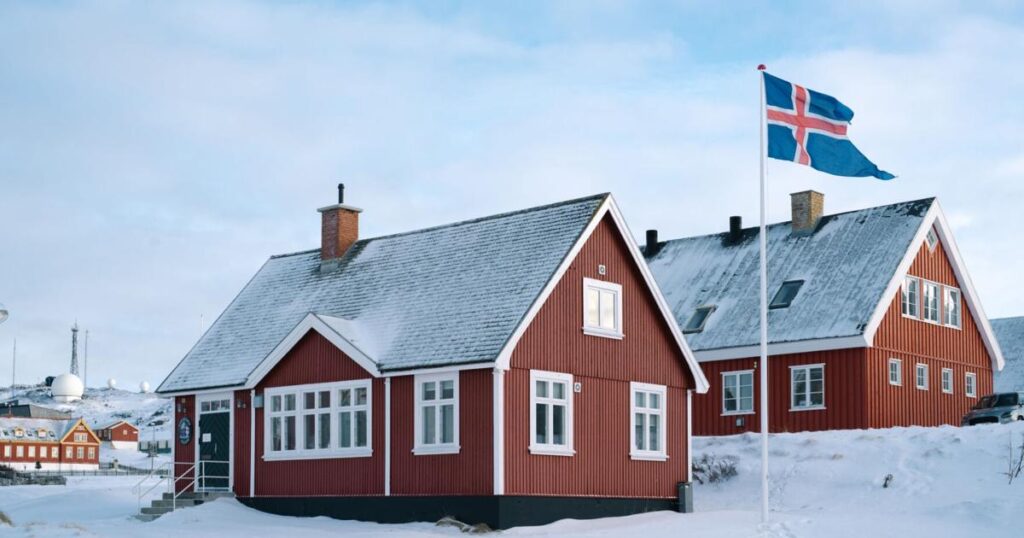
Canada’s new consulate in Greenland is a tiny, terracotta-red house co-occupied with the Icelandic government, staffed by a small team serving an expat community of about 19 Canadians and the occasional stranded tourist.
But amid renewed U.S. expansionism, the outpost’s symbolic value far outweighs its footprint. It signals Canada’s bid for a larger role in a fast-globalizing Arctic — a point underscored by a delegation of senior officials who traveled from Canada to Nuuk for Friday’s opening.
The security of the region is a top priority for Prime Minister Mark Carney’s government, Foreign Minister Anita Anand said in an interview. “This is a milestone that directly responds to our Arctic foreign policy and our goal to advance pragmatic diplomacy,” she said of the new consulate. “It will also underline the importance that Canada places on cooperation in Arctic security.”
France also opened a consulate on Friday. Jean-Noel Poirier, the new consul, said his presence underscores and confirms President Emmanuel Macron’s commitment to the sovereignty and territorial integrity of Denmark and Greenland.
“We have a clear red line: we will not do anything that is not fully aligned with what our Danish friends want,” he said.
Canada and France both moved quickly in recent weeks to voice support for Greenland. For Canada, the stakes are especially high. Its push to reassert its Arctic interests follows decades of neglect of the region. As Russia and China expand their presence in the far north – and after President Donald Trump declared the US “needs” Greenland for security reasons – Ottawa is responding with a defense buildup and a sharper diplomatic presence.
Anand was joined by Governor General Mary Simon, who represents King Charles III in Canada, for the outpost’s opening on Friday.
The Canadian government also plans to open a diplomatic mission in Anchorage, Alaska. Bracketing Canada, the two consulates neatly capture both its geographic opportunity and its quandary: sitting between two longstanding Arctic allies whose relationship under Trump has become highly charged.
Canada and Greenland have much in common, including the intermittent but persistent challenges to their sovereignty posed by the mercurial US president. While both are experiencing somewhat of a lull, Trump’s penchant for policy 180s means it’s too soon to relax.
“It’s a matter of when, and not if” Trump resumes his expansionist rhetoric, said Andreas Osthagen, research director for Arctic and ocean politics at Norway’s Fridtjof Nansen Institute.
When the planet is viewed from the top, it seems obvious that Canada and Greenland should strengthen their security ties, said Osthagen. But policy is also shaped by population distribution and most Canadians live within 100 kilometers (62 miles) of the U.S. border.
There’s also the sheer size of Canada’s Arctic, and the fact that its needs are vastly different depending where you are. The Carney government is moving to rectify Canada’s underinvestment in northern security and communities with a ramp-up in defense and infrastructure projects. It agreed to hit the North Atlantic Treaty Organization’s target of spending 5% of gross domestic product on defense and security by 2035.
And while little is known about the framework for a future arrangement around Greenland and broader Arctic security that Trump said he and NATO Secretary General Mark Rutte reached in January, Osthagen said he would expect Canada is involved in those discussions.
“I’m hoping, and assuming, that Canadian authorities are working quite actively behind the scenes,” he said.
Carney has also said Canada is considering investments in Trump’s proposed Golden Dome missile shield. If Trump’s intention is to create an umbrella capable of stopping every kind of ballistic or hypersonic threat, then extending that over Greenland would be relevant, Osthagen said, though the costs would be astronomical.
The U.S. president has been lobbing new tariff threats and insults at Canada in recent weeks. Hours before Carney delivered a speech in Davos urging mid-sized nations to resist coercion by aggressive superpowers, Trump posted a doctored photo on his Truth Social platform showing a map of Canada and Greenland covered by an American flag.
The question is whether increasing ties between Canada, Denmark and Greenland — perhaps fostered by a common threat against sovereignty — will rankle Trump. Canada has not had a proper consulate in Greenland since 1946, although it has posted honorary consuls to the territory in recent decades, according to the Canadian government.
Changing that is part of a broader move by Canada to underpin its own Arctic sovereignty, said Gerald Butts, vice chairman of Eurasia Group, who helped run Carney’s 2025 bid to become prime minister.
“You could drive yourself crazy in the Canadian government thinking of the various ways Donald Trump could react to whatever it is you happen to be doing on any given day,” he said of the consulate opening. “I do think it’s inevitably going to be seen as support for Greenland but the prime minister has already said, in no uncertain terms, that Canada supports Greenland’s right to determine its future for its own people.”Carney has not shown his support as vehemently as many European countries, including France, which rushed to provide symbolic troops as Trump escalated his rhetoric last month. Instead, Canada said it would continue long-planned North American Aerospace Defense Command exercises with U.S. forces out of the Pituffik Space Base on Greenland’s northwest coast.The diplomacy required by the leaders of Denmark, Greenland and Canada is of an entirely different order.
Greenland’s Prime Minister, Jens-Frederik Nielsen, has been balancing the relationship with Denmark – Greenland’s staunchest defender, from which the island nevertheless may eventually become fully independent — against the immediate U.S. threat. Denmark is seeking to defend Greenland’s sovereignty without scratching open colonial wounds. And Canada is walking a fine line between its Arctic neighbors, one of which has the capacity to cause it great harm, economically and militarily.
An admission of that vulnerability was woven through Carney’s now-famous speech in Switzerland on middle-power cooperation.
As the leader of such a power, Carney needed to wait for the right platform to ensure his views had impact, Butts said. “I think he was just keeping his powder dry until he had a theater where he could use it for maximum effect. And he found it.”
The key will be how Carney follows up, Osthagen said. Canada needs to find more ways to leverage its middle-power position to become more engaged in the global Arctic.
“A consulate that consists of three or four, at most, diplomats is not going to change the whole dynamic in the relations here — especially if Trump keeps up with these demands.”