
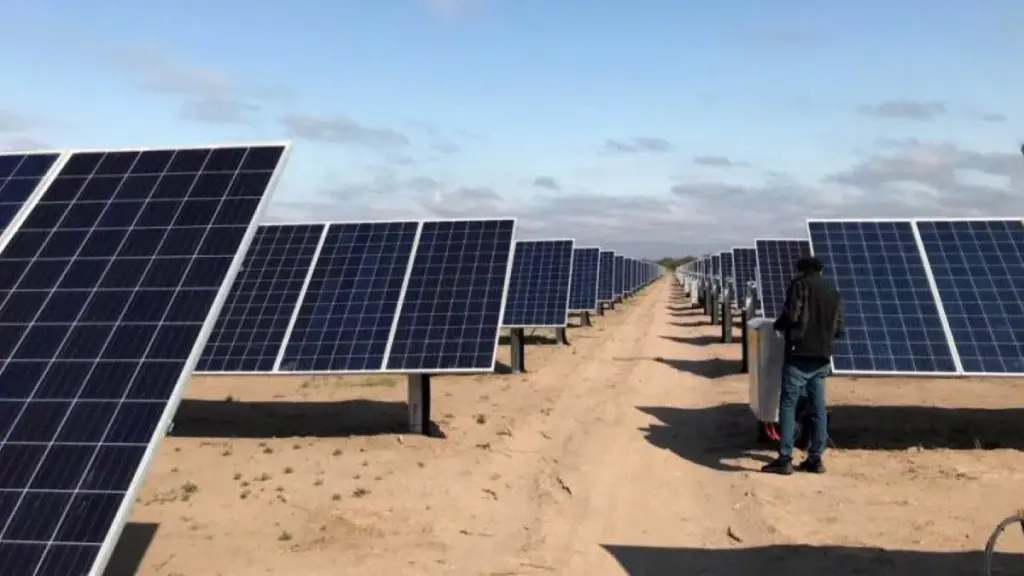
The Ingeniero Juárez photovoltaic solar park is now fully operational and marks a turning point for the electrical system with the expansion of solar energy in Formosa. Driven by private capital from MSU Green Energy, the project is integrated into the grid and strengthens the regional supply.
In this way, the province adds clean generation and diversifies its energy matrix. Additionally, the incorporation of solar energy improves service stability and reduces pressure on traditional infrastructures. Thus, the energy transition ceases to be a long-term goal and becomes a concrete reality.
Clean energy for a historically vulnerable region
The plant has an installed capacity of 15 megawatts and operates with 23,800 solar panels distributed over 30 hectares. This infrastructure allows for the production of sustainable energy consistently throughout much of the year.
Thanks to this generation, the Mataco department managed to cover its electricity demand and even provide surpluses. In turn, localities in the Ramón Lista department and nearby rural areas receive direct benefits.
Therefore, solar energy is consolidated as a key tool to reduce territorial inequalities.
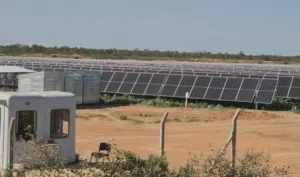 Solar energy in Formosa: Ingeniero Juárez Photovoltaic Solar Park. Photo: La Mañana.
Direct impact on service quality
Although production is marketed through CAMMESA, the energy is injected directly into the provincial grid. This improves voltage stability and decreases dependence on national trunk lines.
As a result, the western Formosa electrical system gains predictability and resilience against consumption peaks. Additionally, risks of prolonged outages in areas far from major urban centers are reduced. In this way, distributed generation strengthens regional energy sovereignty.
The environmental benefits of solar parks
The installation of solar parks significantly reduces greenhouse gas emissions. By replacing fossil sources, the carbon footprint of the electrical system is decreased.
At the same time, this type of energy produces no waste or noise pollution. Its operation requires little water, a key aspect in regions with water stress.
Therefore, photovoltaic energy aligns with the goals of climate change mitigation and environmental protection.
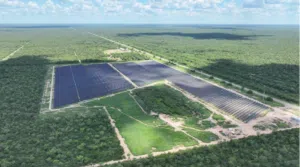 Solar energy in Formosa: Ingeniero Juárez Photovoltaic Solar Park. Photo: La Mañana.
Local development and sustainable economy
In addition to the environmental benefit, solar parks generate employment during their construction and maintenance. This boosts local economies and promotes technical training.
Likewise, the presence of reliable energy infrastructure encourages the establishment of new productive activities. Clean energy thus becomes a factor of territorial development. Consequently, sustainability and growth cease to be opposing concepts.
Alliances and expansion of solar energy
The Ingeniero Juárez project was realized through an agreement between the Government of Formosa, REFSA, and the private sector. This collaboration allowed for the expansion of infrastructure and the connection of the plant to the National Interconnected System.
In parallel, the province is planning new solar parks, such as the one planned in Las Lomitas with 22 megawatts. Initiatives are also being considered in Pirané, Laguna Blanca, Ibarreta, Formosa capital, and Clorinda.
In this way, Formosa moves towards a cleaner energy matrix, resilient and aligned with the environmental challenges of the present.