
Imagine a living room in Soviet-era Belarus, circa 1985. The television is tuned in to—what else?—ice hockey. The Soviet team, in blood red, squares off against the neighboring Finns, in serene white and blue. A six-year-old boy watches, transfixed, his mind drifting to his own stick-wielding escapades on the wild ice outside.
He has two secrets: One is that he doesn’t know how to skate. He’s a decent scorer, but he usually shoots from his knees, having fallen after sliding around in his boots. The other secret is that he’s rooting for the Finns. They seem less angry than Soviet people. The endless vowels of their surnames—Ruuttu, Saarinen, Ruotsalainen—sail through his mind like a song. How can people seem so different in a country a two-hour drive from St. Petersburg?
On-ice dining at Rauhaniemi Folk Spa, in Tampere.
Vesa Laitinen/Travel + Leisure
Forty years later, he’s the father of a six-year-old girl. He still hasn’t learned how to skate, and he still hasn’t seen Finland. Russia’s attack on Ukraine has made a return to his birthplace unimaginable. America, his adopted homeland, struggles with its own hard times. He has been trying to show his daughter the world, so she knows there are options.
Maybe it’s time to see Finland, he thinks. Maybe they can drive northeast from Helsinki, toward the Russian border—as close as he can get now—and learn how to skate on natural ice. It’s one of the few places in the world where the lakes still freeze every winter. It may be 40 years too late for him, but it might be just in time for her.
From left: On the ice in Helsinki; Helsinki restaurant Natura’s snow-inspired frozen yogurt dessert.
Vesa Laitinen/Travel + Leisure
Helsinki was just above freezing when my daughter Agnes and I landed in February. I told myself to keep faith. As one local explained, this is a country where, during winter sporting events, Finns refrigerate the beer to “keep it warm”—that is, to keep it from freezing. We would find our ice.
Can there be any question where we would make our first stop? A hockey game, of course. Russia’s invasion of Ukraine had scrambled the Finnish hockey scene because Jokerit, one of Helsinki’s two teams, had been a member of an international hockey league founded by Russia. Finland has a complicated history with Russia, with which it shares not only an 835-mile border and an obsession with saunas, but also the resourcefulness of people who make their lives in lands shrouded by snow. Stalin invaded in November of 1939, expecting a quick takeover, but the Finns inflicted many times more casualties on the Soviets before eventually ceding 11 percent of their territory and partial control over their foreign affairs. That control ended with the Soviet Union’s collapse, but the territory remains Russia’s.
The hockey drama was relayed to me by Veli-Pekka Karvinen, a mild-mannered senior statistician from the national economics bureau who becomes less mild-mannered when he assumes his role as the chairman of the Jokerit fan club. “There are a lot of cameras here, so I have to watch my gestures,” he said, raising his eyebrows.
Agnes, whom Karvinen had outfitted with a Jokerit flag, shouted along with the many long-bearded men in the stands: “Yaw-keh-REET!” At one point, she turned to me and said, “So, Daddy. When you were a little boy, you went ice-skating in your shoes? That doesn’t make sense.” I agreed.
A painting by Tove Jansson at the Helsinki Art Museum (HAM).
Vesa Laitinen/Travel + Leisure
She seemed well-occupied, so I closed my eyes. I wanted to listen: the scrape of ice by the skates; the players slamming the boards; the plink of the puck. These sounds had been sitting in my subconscious, waiting for this visit, for four decades.
My yard team in Minsk had such meager resources that we played with a green rubber ball instead of a puck. I saw twigs ensnared like splinters in the ice and steam billowing out of red-cheeked faces. I opened my eyes and looked at Agnes, wondering what she would remember. When Karvinen hugged me goodbye, I embraced him as a kind of wizard who had unknowingly guided me back to my childhood.
The next morning, I dragged Agnes to the Allas sea pool. Allas is an embodiment of three Finnish obsessions: the sauna, wintertime bathing in heart-stoppingly cold seawater, and the democratic availability of these pleasures. In Finland, a country of 5.6 million people, there are 3.3 million saunas, more than there are cars. My father took me to my first sauna before I could walk. However, the warmed pools at Allas, with which I meant to ease Agnes into the rituals, were out of order.
From left: Lobster with yellow beets at the Waldorf Astoria Helsinki; gliding on Lake Näsijärvi.
Vesa Laitinen/Travel + Leisure
We trudged back to our hotel, the Maria (it has since become a Waldorf Astoria). There we learned that its gloriously stylish spa prohibited children. I threw myself at the mercy of Sami Joutsenvuo, the head concierge. Within several minutes, some meaningful coughs from him had loosened the rules, and lucky Agnes was piled in a recliner in the spa’s airy, leafy atrium, studying the refreshments menu despite the fact that she couldn’t read it.
Joutsenvuo is the right man for a hotel like Helsinki’s Waldorf. There are many five-star hotels in the world, but only some seem possessed of a magic that makes you wish you could live there, as Eloise did at the Plaza. A former military barracks, the Waldorf is a complex of gorgeous fin de siècle interiors and enough nooks for a child to hide in for hours, as mine did. It has 159 chandeliers, eight and a half miles of decorative molding circling its ceilings, and a lovely employee named Ahn who stole Agnes’s heart by painting a foam teddy bear in the hot chocolate she served her in a cut-crystal glass every morning. “If you stay at this hotel, don’t make too many plans,” Joutsenvuo had said. “This is the destination.”
Alas, Agnes and I had to leave—it was time to skate.
“I don’t know how to ice-skate,” Agnes pointed out.
“Neither do I,” I said.
“Then who’s going to teach us?” she said.
A lovely employee named Ahn stole Agnes’s heart by painting a foam teddy bear in the hot chocolate she served her in a cut-crystal glass every morning.
His name was Tuomas Hannikainen, a part-time conductor who had recorded a symphony of the sounds made by wild ice. A recent storm from the south had broken up the ice near Helsinki, which sits on the country’s south coast, so Hannikainen asked us to meet in Sipoonranta, a nondescript cove defended by several barrier islands 30 minutes northeast of the city. But even nondescript coves take on grandeur in Finland. The sun blazed with piercing light over an infinity of birches and firs, and ice that had frozen in geometric chiaroscuro patches that would have delighted the Cubists.
From left: A staffer transports packages at Rauhaniemi; Rental skates at Järvisydän Nature Hotel & Spa Resort, on Lake Saimaa.
Vesa Laitinen/Travel + Leisure
With his ear for pitch, Hannikainen can ascertain the thickness of wild ice within a half-centimeter by listening to the sound it makes as it settles. At one point, he serenaded Agnes by running a rough violin bow over a saw. She listened raptly, clutching hot black-currant juice and a sausage he had cooked over a charcoal fire.
“When I was a boy, my family had a cottage by a lake,” Hannikainen explained. “It was a full moon, and there was fresh ice. It was so thin and clear that I could see all the stone formations under the water. I thought I was flying over the earth.”
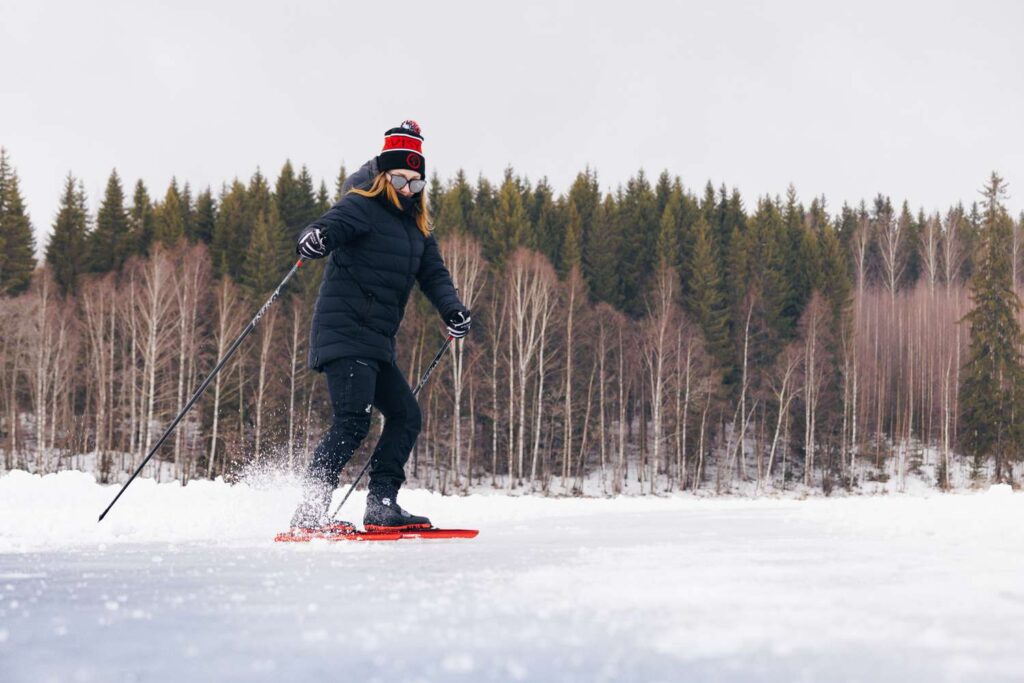
The only flying I was doing was onto my knees as I lost my balance. As soon as I tried to kick one of my skates out for propulsion, as Hannikainen was teaching me to, my body lost its balance. Meanwhile, Agnes submitted to Hannikainen’s kick-sled and hollered with pleasure as he dragged her around. By the end, her jacket had cleaned a good portion of the Gulf of Finland.
Eucalyptus at the sauna at Rauhaniemi Folk Spa, in Tampere.
Vesa Laitinen/Travel + Leisure
Afterward, Agnes and I were felled by the kind of hunger that overtakes only those who have exerted themselves in cold weather. Helsinki teems with Michelin restaurants, but few had met a critic like Agnes: she eats only bread, pasta, oatmeal, and french fries. At Kuurna, which remains one of the city’s best restaurants two decades after opening, I had chestnut tortellini in a coriander-seed butter sauce and pike perch in blood-orange sauce with a beet terrine, accompanied by a crystalline Chardonnay from the Pfalz that Agnes correctly declared smelled like “white flowers.” But she wouldn’t eat anything herself until our kind server brought her a pasta casserole from the staff meal.
It was time for Tampere, Finland’s second city, two hours to the northwest. An affordable, rapidly developing tech and entrepreneurial hub that anchors a lake district of endless outdoor diversions, Tampere is regularly voted by Finns as the country’s prettiest city. “This place is in a sweet spot,” Katja Villemonteix, a local guide, said of Tampere’s recent evolution from a large town into a small city with a new grid of tram tracks, restaurants of renown, and converted industrial spaces. “You will see people with prams, and people with mohawks, and everyone fits.”
She articulated something I’d been feeling since arriving in Finland, a kind of quietness that I’d initially ascribed to the muffling effects of winter and jet lag. But in fact it was the quietness of things working as they should, and people getting along. Finns are often celebrated as the happiest people on earth, but that doesn’t feel right. What they might be instead is the most secure-feeling—the most content.
Back in Helsinki, Agnes and I had wandered into the swooping architectural marvel of Oodi, the city library and Helsinki’s gift to itself for Finland’s independence centennial in 2017. Locals call it “Helsinki’s living room”—it’s where everyone goes after school and work. “I need some peaceful time,” Agnes had declared, and set herself up with a Peppa Pig book, possibly in Finnish, on a faraway bench. “This is what I would call happiness also,” an acquaintance named Heidi Johansson, who had met us there, said. “She’s not laughing. But she’s happy. It’s about being part of a trust-based society. If you don’t feel physically safe, then no amount of meditation classes will help.”
From left: A stained-glass window at Tampere Cathedral; Helsinki’s Jokerit hockey team at a game.
Vesa Laitinen/Travel + Leisure
But in a place like Finland, serenity never means lack of edge. Even the Tampere Cathedral is a Modernist provocation, with a treatment of the Resurrection by Finnish symbolist Magnus Enckell; a serpent painted into the ceiling; and another painting that depicts death as a kind of caring angel.
“Why do people come here, Daddy?” Agnes wanted to know.
“To talk to God,” I said.
“Where is God?” she said.
“Everywhere,” I said.
She nodded, understanding something.
Due to its working-class roots, and the cold-water flats that go with them, Tampere has more public saunas than any other city in Finland. Our destination was the Rauhaniemi Folk Spa, a stalwart on Lake Näsijärvi, a body of water so vast that locals endearingly call it a sea. “It’s part of every resident’s soulscape,” an acquaintance in Tampere told me. “We ski on it, ice-swim, skate—but always respecting its power. Tampere is less a city than a strip of land between multiple lakes.” At the Rauhaniemi spa, a heated walkway connects the sauna to a small patch of water kept from freezing over by a pump.
From left: Natura restaurant, in Helsinki; kick-sledding on Lake Saimaa.
Vesa Laitinen/Travel + Leisure
For Finns, the sauna is sacred. “It’s where children were baptized, and the dead washed for burial,” Alexander Lembke, our guide, said. Lembke holds a degree in sauna studies and has the honor of feeding the furnace at Rajaportti, the oldest public sauna in Finland, which is also in Tampere. “It’s at every part of the cycle.”
Indeed, my daughter, who had refused the saunas in Helsinki, was sitting, with about 40 other Tampereans, right near the massive rock stove. Then, the girl who wouldn’t touch the frigid seawater at the Allas sea pool in Helsinki waded into the swimming hole. Though Agnes had also refused a skating lesson earlier, it was bewitching to watch her acclimate. That morning, as I tried to bundle her into a jacket, she had resisted: “Daddy, I’m a snow baby! The cold makes me warm!”
On the lake, Agnes had missed her daddy rocking it on the ice. My guide had been Tuire Tyllilä, whose family runs a local adventure company. As we skated, she admonished several pedestrians for straying onto a special path reserved for wheelchair users. “We act as a gate to nature,” she said. “There aren’t many opportunities in nature for people who are disabled.”
We were so busy talking that I’d failed to notice I was… skating. I had trouble stopping, which wasn’t ideal, but I was successfully propelling myself by kicking out my skates. Having watched thousands of hockey players do it, my body was “remembering” how to do something it had never done.
From left: Grilling sausages on the ice at Rauhaniemi Folk Spa; braised pork with pickled cucumber and marinated cabbage at Villit ja Viinit, a restaurant in Tampere.
Vesa Laitinen/Travel + Leisure
Later, Agnes and I warmed up at Villit ja Viinit, the casual sibling of Kajo, Tampere’s best tasting-menu restaurant. “Kajo is classical, and we are jazz,” Anas Battah, the chef, explained. That means, among other things, a list of natural wines from places with terroirs usually too valuable to bother with nontraditional winemaking, like Piedmont and Burgundy. There’s even a fortified Riesling. Agnes got a juice of sea buckthorn, cloudberries, and marigolds.
Battah and I became partners in a subterfuge. With a generosity rare for chefs of his level, he stripped a roasted beet risotto made with a mild, creamy blue cheese called Peltolan, pickled beets, and rosemary oil, of everything but the rice, Parmesan, and butter. “It’s oatmeal,” I pretended to Agnes. She plowed through it all. Battah and I shared a silent fist pump.
From Left: A skater on Lake Näsijärvi in Tampere, Finland; guest-room balcony at Sahanlahti Resort.
Vesa Laitinen
As Agnes and I approached our last destination, the Lake Saimaa region, near the now-closed Russian border, the roads began to drift over with snow and the landscapes turned into screen savers—endless expanses of white punctuated by stands of soft-edged birch and pine. Saimaa epitomizes the glories of rural Finland: it has 188,000 (!) lakes, and the bounty of the local fields, forests, and water is so mind-bending that the region was recently awarded Finland’s only Designation of Origin, a guarantee of quality more common in the wine world.
Agnes and I were entering the Finland of my childhood imagination. In fantasizing about Finland, I realized, I had longed for a homeland that was also snowbound, also sauna-bound, but less disposed to cruelty than the Soviet Union. Even as a six-year-old boy who understood little, I understood that.
In the backseat, my six-year-old was still dreaming of the spa at the Waldorf. She had outfitted a doll with a robe fashioned from one of my T-shirts, and fitted green cucumber circles over her eyes. I remembered what my acquaintance in Helsinki had said about contentment and safety.
From left: A gallery at the Serlachius foundation, in Mänttä; gnocchi, fried lion’s mane mushrooms, and apple-butter sauce at Kuurna, a restaurant in Helsinki.
Vesa Laitinen/Travel + Leisure
We had one final stop in our mission to learn Nordic skating: Lake Saimaa, the biggest in Finland. This portion bordered a national park, a setting so remote that I felt as if we were setting off on an Arctic expedition a century earlier. Our guide, Meri Koponen, a national bronze medalist in kick-sledding, had swaddled Agnes in reindeer furs. The ice was opaque, which happens when snow becomes trapped between layers of ice—and creaked ominously as we skated under a sky as white as the snow. If a skating rink is a zoo, natural ice is the bush: wild, mysterious, and scary. “The ice is alive,” Koponen said. As we skated, she pointed out lynx and wolverine tracks.
Her family has lived in the area for 500 years. As we took a campfire-and-hot-chocolate rest stop on a patch of wooded ground, snowflakes the size of nickels settled on my gloves. I had the comic realization that they actually looked like, well, snowflakes—perfect hexagons that I’d only seen in Agnes’s book version of Frozen.
If a skating rink is a zoo, natural ice is the bush: wild, mysterious, and scary.
“This is why Finns are the happiest people in the world,” Koponen said. “Fire and ice and nature. It’s our therapy.”
Our last lodging in Finland had nowhere to skate, though it had a buffet worthy of a Russian noble. That was the reason I wanted to stop there. Its original owner had traded with Russia, eventually constructing a pink country manor in 1810 in the style of a Russian nobleman’s home: endless double doors, parlors, and grand drawing rooms. “It’s not a very easy house to live in,” Matti Pylkkänen, whose family has owned the property since the late 19th century, said. There are many such manors in eastern Finland, but Tertti Manor, a regional institution, is rare in that it opens its doors to lodgers.
From left: Matti Pylkkänen, the owner, in Tertti Manor’s dining room; a sauna at Sahanlahti Resort.
Vesa Laitinen/Travel + Leisure
Tertti is a fantasy of rural Nordic self-sufficiency. Our morning porridge, served with lingonberry sugar, came from estate-grown barley cooked in a massive hearth oven in the dining room. The staff had bored holes in the nearby ice to set nets for whitefish and turbot. Pylkkänen, who hunts for pheasant, roe deer, and much else, served me grouse carpaccio with wild rowan berries. Even at 4 degrees below zero, waxwings flitted outside our room, which had a sauna large enough to be its own hotel room.
On our final morning at Tertti, the crust of ice that had formed overnight was nearly blue. The sun-blitzed morning was silent and still, the cold head-crackingly pure. The snow under my feet squeaked with a sound I had last heard as a boy. Agnes shielded her eyes and laughed at the obscene majesty of it all. I did, too. Like a winter seawater swim, the vision made me ecstatic. We could have been in a Pushkin short story; we could have heard sleigh bells. My homeland had gone astray, but its beauty was not only its own. Beauty will always be free.
A version of this story first appeared in the March 2026 issue of Travel + Leisure under the headline “The Finnish Line.”