
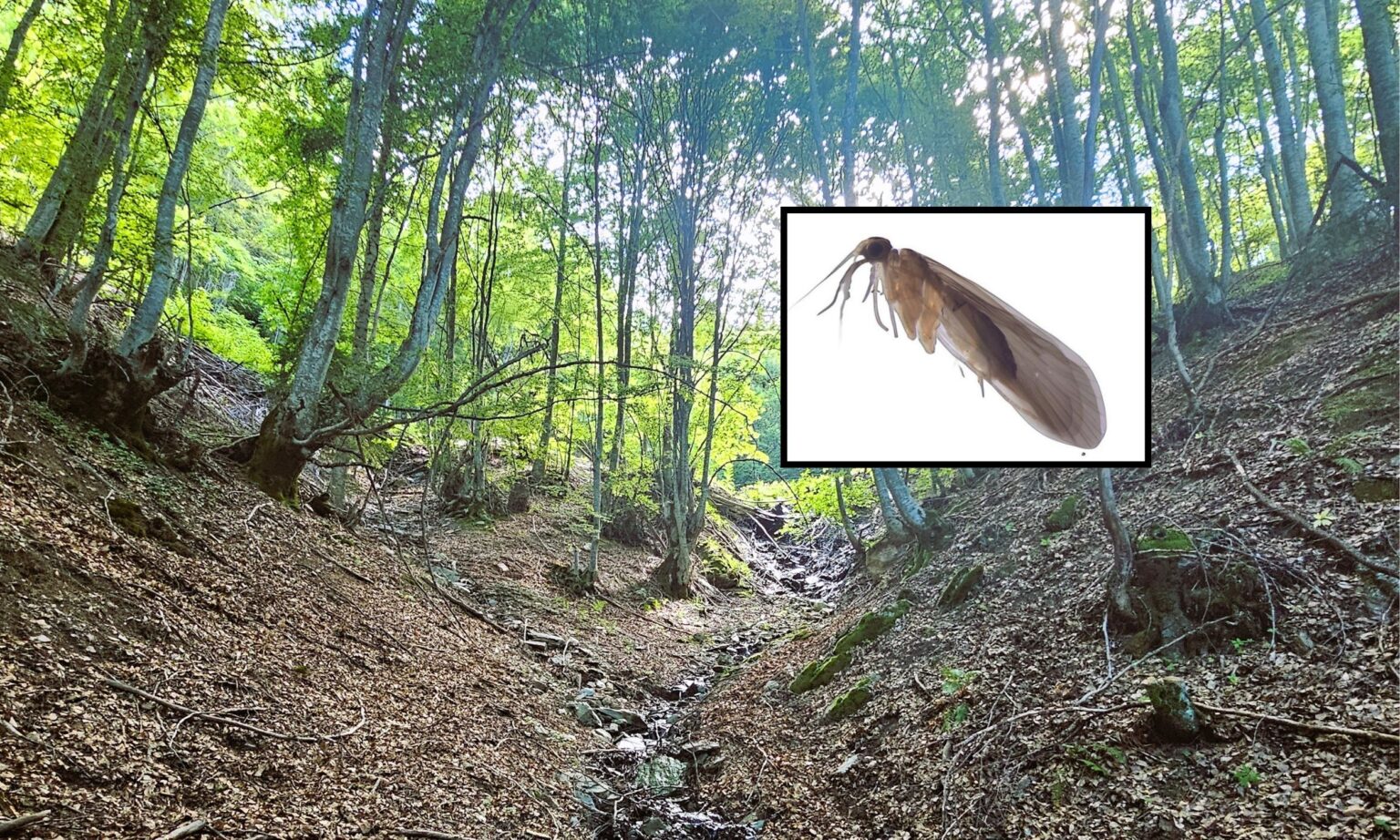
Scientists have documented a previously unknown insect species, named Tinodes lumbardhi, confined to a single, shrinking pocket of freshwater.
Its survival depends on a fragment of habitat that now defines the outer limit of what remains intact in the region’s freshwater systems.

Tinodes lumbardhi was found in a narrow side stream of a mountain river in Kosovo, a small landlocked country in Southeast Europe. The insect was located where cold, fast-moving water still persists amid widespread ecological damage.
Working in that setting, Prof. Halil Ibrahimi of the University of Prishtina documented the insect as a distinct species of caddisfly after tracing its presence to this isolated stretch of stream.
The population appears restricted to this refuge, with no evidence that it persists in the river’s altered main channel or nearby tributaries.
That extreme confinement places the discovery on a knife edge, creating the need to examine how such refuges function and why they have become the last holdouts for rare species.
Tinodes lumbardhi description
In a peer-reviewed paper the team documented the caddisfly’s shape in enough detail to name it.
They compared the males to close relatives and found key differences in parts that lock together during mating.
Adult wings measured under 0.2 inches (5 millimeters) long, a size that let the insect slip past unnoticed in larger surveys.
The researchers named the insect Tinodes lumbardhi, linking it directly to the Albanian name for the river where it was found (Lumbardhi). This anchors the discovery to a place rather than to a classification tally.
Caddisflies reveal river health
A caddisfly, an insect whose young grow underwater, survives only when streambeds stay cool, stable, and well-oxygenated.
Because the species depends on those conditions, its continued presence signals that parts of the river are still functioning as healthy, freshwater habitat.
Their underwater young breathe through gills, so silt, low flow, or warmer water can quickly push them out.
That makes caddisflies a useful bioindicator, a living signal of water quality, when managers track stream health.
When rivers lose their flow
Hydropower projects reshape streams by pulling water into pipes, leaving long stretches shallower and easier to overheat.
Lower flow also moves less oxygen, so algae and fine sediment can build up and smother insect habitat.
One 2021 review warned that many small hydropower plants can hit mountain wildlife hard when they disrupt river flow.
That matters in this mountainous corner of Kosovo, where streams run short distances and offer few remaining refuges for wildlife.
Insects vanish, food webs crack
Along parts of the Lumbardhi i Deçanit River, the researchers reported stretches with no fish at all.
Hydropower construction and operation drove much of that damage, and insect communities in the main channel became significantly poorer.
Fish need both oxygen and prey, and many depend on river insects as food during key growth periods.
Once fish drop out, bringing them back can take years, because the river must recover its oxygen, food, and habitat structure.
Small refuges carry rare life
Sidestream refuges act as last safe spots when people damage a river’s main flow, because they stay shaded and cooler.
Dense shade keeps the water cool, and leaf litter and stones create surfaces where larvae can feed and hide.
Within the same watershed, the land draining into one river, the team wrote that rare insects now persist only in side channels.
Road construction has already pushed out Rhyacophila siparantum – another endemic species of caddisfly – by blocking flow and turning a stream reach into still water.
Kosovo’s insect biodiversity
Bjeshkët e Nemuna has become a hotspot for stream insects, and researchers keep finding species that live nowhere else.
Steep valleys split water into isolated runs, and that isolation breeds endemic populations that are found nowhere else on Earth.
In earlier surveys, Ibrahimi and colleagues also reported Potamophylax coronavirus, another caddisfly tied to these mountain streams.
Each discovery raises the stakes, because a dam, a road, or a dry season can wipe out an entire local lineage.
Protecting Tinodes lumbardhi
Public coverage carried the discovery beyond academia, and that attention can matter when conservation rules face pressure.
Park staff in the directorate can plan protection measures and stop illegal activities, yet work still depends on public support.
“The discovery of Tinodes lumbardhi is both a celebration of Kosovo’s unique natural heritage and a wake-up call for conservation,” said Ibrahimi.
Targeted action can limit new diversions and reduce pollution, keeping those sidestream habitats cool enough for sensitive insects.
Lessons from Tinodes lumbardhi
Giving a species a formal name turns a hidden insect into something governments and scientists can count and protect.
That process, called taxonomy, the science of classifying living things, links field observations to checklists and laws.
Once officials recognize a named species, monitoring programs can track whether its range shrinks after construction or pollution.
Without that paper trail, a rare insect can vanish quietly, and future surveys cannot prove what was lost.
The new insect ties Kosovo’s river health, energy choices, and conservation capacity into a concrete test inside a protected park.
If agencies protect the sidestream refuges and keep water clean, discoveries like this can guide smarter river management for years.
The study is published in the Biodiversity Data Journal.
—–
Like what you read? Subscribe to our newsletter for engaging articles, exclusive content, and the latest updates.
Check us out on EarthSnap, a free app brought to you by Eric Ralls and Earth.com.
—–