
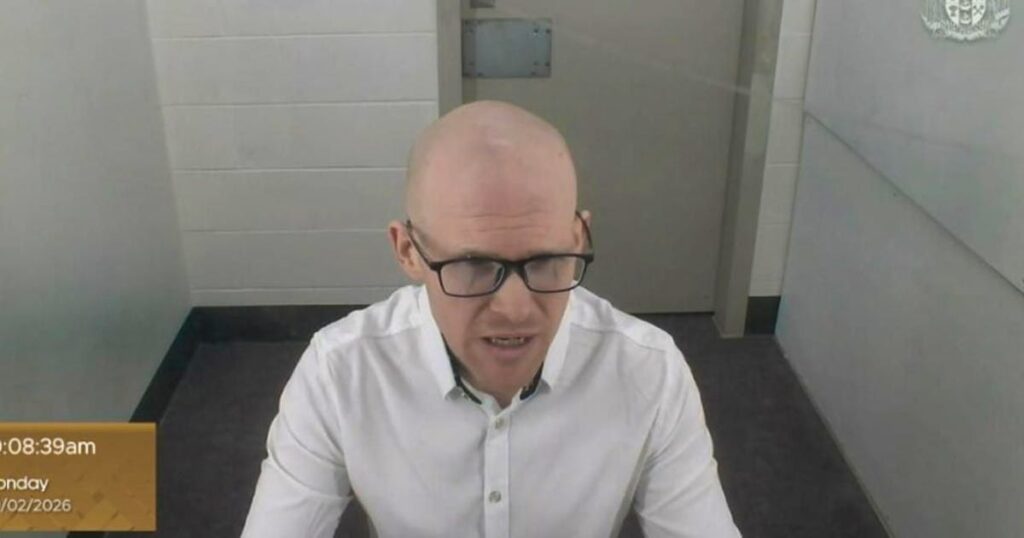
HANDOUT – Brenton Tarrant appears in court via video link from Auckland Prison in Auckland. Photo: New Zealand Court of Appeal/New Zealand Court of Appeal/AP/dpa
Keystone
The assassin convicted of a right-wing extremist terrorist attack in New Zealand that claimed 51 lives has applied to have his guilty plea overturned. Before an appeal court in Wellington, Brenton Tarrant explained that the difficult prison conditions at the time had affected his mental state to such an extent that he had not acted rationally when he confessed.
The Australian, who is now 35 years old, was connected from the high-security prison in Auckland, where he is housed in a special unit for prisoners with extreme security risks. This unit is physically separated from the rest of the prison and is subject to particularly strict security and surveillance measures.
In the most serious attack in the recent history of the Pacific state, Tarrant attacked two mosques in the city of Christchurch on March 15, 2019 and shot 51 people dead. Dozens more were injured, some of them critically. Many survivors still suffer from the consequences to this day, are unable to work or have to live with severe pain. The perpetrator broadcast the massacre live on the internet using a helmet camera.
Severe sentence imposed for the first time in New Zealand
Tarrant had pleaded not guilty in June 2019. In March 2020, he surprisingly pleaded guilty to all charges – including 51 counts of murder and terrorism.
He was sentenced to life imprisonment without the possibility of early release for the crimes at the Al-Noor Mosque and the Linwood Islamic Center. It was the first time such a sentence had been imposed in New Zealand. As a result of the crime, the government tightened gun laws.
Does the case need to be retried?
At the start of the five-day hearing, Tarrant said that he was not sane at the time of his confession. “I would say it was a decision triggered by the conditions. It was a decision I made irrationally,” Radio New Zealand quoted from the courtroom. The assassin spoke of isolation and poor mental health, among other things, which had led him to make his statements at the time.
According to the court, the application will be examined. The central question is whether Tarrant was unable to make rational decisions when he made his confessions due to the conditions of his imprisonment, which he described as “torturous and inhumane”. If the application is granted, the case would have to be retried.