
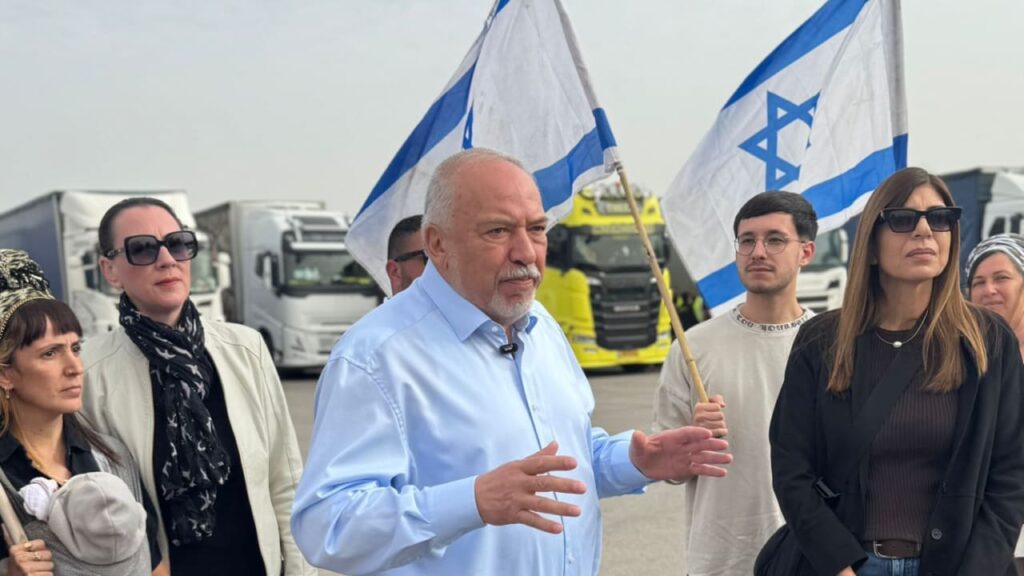
Yisrael Beytenu chairperson Avigdor Liberman visited the Kerem Shalom border crossing on Monday, where he said Israel was funding Hamas and allowing the terror group to rebuild by sending humanitarian aid into the Gaza Strip.
“I look around and see countless trucks, and the truth must be told to the public: these trucks are funding Hamas’s military build-up,” he said.
Footage showed Liberman in front of trucks at the crossing. He was also joined by members of his party, MK Yulia Malinovsky, and MK Sharon Nir, who said they blocked the entry of humanitarian aid trucks.
Activists from Tzav 9, an organization that protests the delivery of humanitarian aid to the Gaza Strip, were at the crossing as well. The group called on all members of Knesset to join them in blocking the entry of aid.
Liberman said that taxpayer money was being used to supply electricity and water in the Strip.

“Reconstruction has already begun in practice. The electricity and water that the State of Israel continues to supply, together with the flow of goods and equipment, are all funded by Israeli citizens and at the expense of the Israeli taxpayer,” he said.
“The October 7 government is returning to exactly the same concept, once again endangering the security of Israel’s citizens.”
He added that what was being seen was a “recipe for the next disaster.”
“Rehabilitating the Gaza Strip before disarming Hamas is simply lawlessness, and it is a return to the very concept that brought us to October 7,” Liberman said while standing at the crossing.
Prime Minister Netanyahu called for the disarmament of Hamas as part of Phase II of the US ceasefire plan after the IDF located the remains of the last hostage held in Hamas captivity in January.
Humanitarian aid has been delivered to the Strip as part of phase I of the ceasefire plan agreed upon in October 2025.
No obligation to maintain the 600-truck pace in Phase II, IDF says
The IDF was obligated to send 600 trucks per day into Gaza as part of Phase I of the deal, partly to restore long-term food security and partly to build goodwill with the Trump administration.
The food aid going into Gaza is provided and funded by third parties and international NGOs. Israel then facilitates its entry into the Strip.
IDF sources contended on January 29 that there was no obligation to maintain the 600-truck pace in Phase II, which is far above the pre-war average of closer to 200 trucks per day. International NGOs have also tired of keeping up to such a pace.
The IDF added that almost all trucks that enter Gaza above the 200 point, and certainly up at levels like 600, are taken by Hamas and used to solidify its control of the Strip.
Before the Hamas attacks on October 7, 2023, goods were transferred into Gaza predominantly through Kerem Shalom, including gas and fuel officially designated for civilian use.
Throughout the war, additional crossings were opened at various times to allow humanitarian aid to enter the enclave, with Kissufim and Zikim among those that later became operational, in addition to Kerem Shalom.
Yonah Jeremy Bob and Sarah Ben-Nun contributed to this report.