
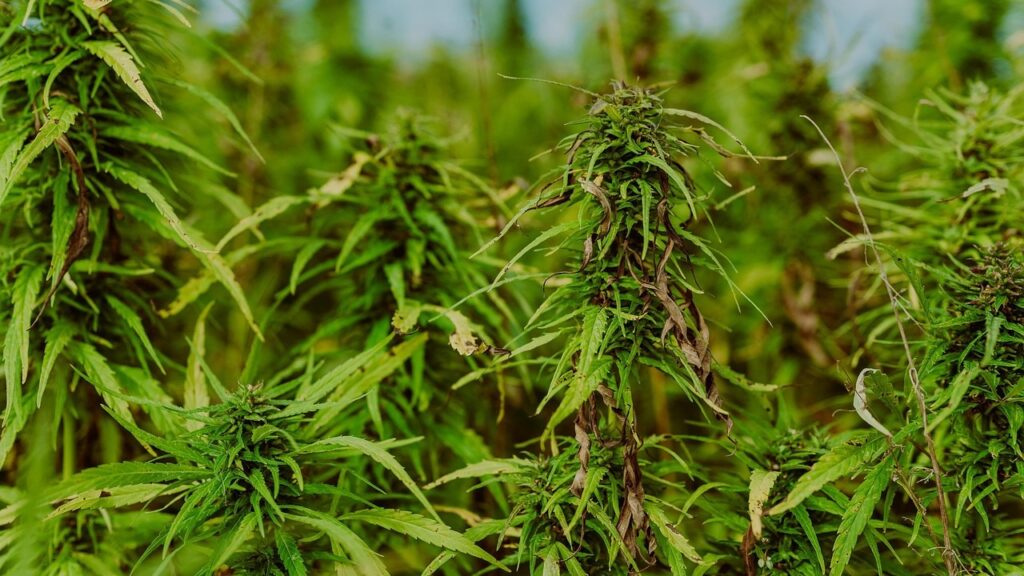
While the names of the suspected companies and people in North Macedonia remain officially undisclosed, media have noted that most of the raids in eastern North Macedonia were conducted in and around the town of Strumica.
Using the drug busts as ammunition for political mudslinging, the ruling centre-right VMRO DPMNE party of Prime Minister Hristijan Mickoski and the main opposition Social Democrats exchanged accusations and counter-accusations over the weekend.
The ruling party focused on former Social Democratic leader Zoran Zaev, the former premier who is also a former mayor of Strumica, urging the prosecution to investigate whether he had any connection to the affair.
VMRO DPMNE legislator Brane Petrushevski on Saturday told a press conference that a large quantity of the seized marijuana came from a firm that he insisted was linked to a former head of the Social Democrats’ local organisation in Novo Selo, near Strumica – who he claimed was a close business partner to Zaev and his brother, Vice Zaev.
Zaev, who resigned as Social Democrat leader and as premier in 2021, following a local election defeat, on Sunday denied the allegations on Facebook. He said he would sue Petrushevski if he did not get an apology, “for all those lies, slander and insults, including the deliberate misuse of my name in that staged drama surrounding the confiscation of tens of tons of medical cannabis, due to alleged improper storage and handling.
“It is a blatant lie that I am in any way connected to the cannabis cases that have been presented to the public,” Zaev wrote. Petrushevski responded that he had no intention of apologising.
The Social Democrats on Sunday insisted that it is the current government, which came to power in 2024, that must be held responsible for such large-scale drugs trafficking.
“Without support from structures high up within the government, the Interior Ministry, the customs and others, one cannot smuggle tons and tons of drugs. The connection of the criminal structures in Macedonia and Serbia is now evident for the public to see, and soon all will be clear,” the Social Democrats said.
So far, however, nothing is clear. The Interior Ministry has promised more concrete information once the busts conclude.
Meanwhile, the affair is prompting calls for a revision of the law allowing the legal growth of medicinal marijuana, with some insisting that a drugs mafia has taken over the business.
“The seized amounts [in Serbia and in Macedonia] exceed the [medicinal cannabis] needs of the entire Balkans, yet alone Macedonia. It is obvious that the original humanitarian intent has been misused and so we need urgent legal changes,” the small Democratic Alliance party said on Friday.
The Konjuh bust has raised eyebrows in Serbia, where the trial is ongoing of Predrag Koluvija in relation to the seizure of 1.6 tons of marijuana on his property in a separate case in 2019.
The case began after police stopped Koluvija on the Belgrade-Nis highway in November 2019 for reckless driving and detained him for possessing a false police identity document.
On the same day, police raided his property near Stara Pazova, where the indictment stated they found 1.6 tons of marijuana.
Serbia’s interior ministry, usually quick to take credit for major drug seizures, kept quiet about the marijuana discovery for several days until the media got wind of it.
Two indictments were raised in the case – the so-called ‘Jovanjica 1’, which deals with illegal marijuana production, and ‘Jovanjica 2’, which deals with alleged Serbian state security links to the marijuana farm. The two indictments were merged and Koluvija went on trial at Belgrade Higher Court.
Both indictments claim Koluvija is the organiser of a criminal group. In November 2025 Koluvija repeated that he is not guilty, and that he has “never been the organizer of any organised criminal group that grows or exports marijuana”,
Soon after his arrest, the opposition started to claim that Koluvija was in contact with Serbian President Aleksandar Vucic’s brother, Andrej. A criminal complaint was filed by a government loyalist against Aleksandar and Andrej Vucic over these claims, aiming to clear the president’s reputation.
The complaint was dismissed in January 2020. The Prosecutor’s Office for Organised Crime said that “there are no grounds for suspicion that Aleksandar and Andrej Vucic committed any criminal offence”.
In October 2021, Koluvija gave a video interview claiming he was urged by police to say that he works for Vucic’s brother Andrej in ordre to be allowed to go free.
In reaction to this, President Vucic called for Koluvija’s release, arguing: “That man spent two years in custody, there is no similar case where a man was in custody for such a crime for two years … You will agree [it is] very strange because he didn’t kill anyone, he didn’t have 10 tons of cocaine or something like that, but as far as I understand, a ton of marijuana, which half of the [European] area, the Germans and others, legalised.”