
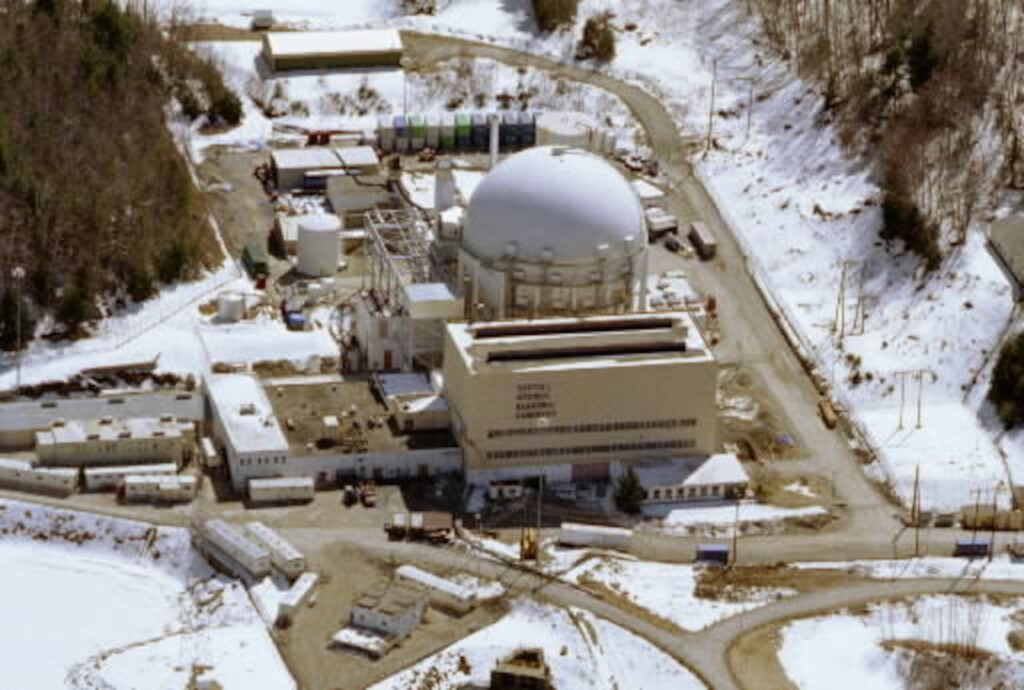
When the wind doesn’t blow, and solar panels are covered in snow, there is another source of carbon-neutral energy to be considered, even if it has a long history of being controversial.
Experts are now taking a second and serious look at expanding nuclear power as part of the push to find more reliable, climate-friendly sources of electrical power.
“It will take many hurdles, but the conversation needs to start today,” said Thomas Barry, chief executive officer of Massachusetts Municipal Wholesale Electric Co. “I don’t think this region can have a serious conversation about power generation without discussing nuclear power.”
Two decades ago, Barry said people would laugh if he even brought up the subject of nuclear power, but that has been changing, especially with concerns about climate change since nuclear power has no emissions.
The Municipal Electric Co., which is made up of some 30 city and town-owned power companies, owns a small part of the Millstone and Seabrook nuclear power plants, which provide about 14% of power to municipal electric companies statewide, said Jason Viadero, director of engineering and generation for the company.
When people think of nuclear energy, they think of past accidents, but years of technological advances make the power source even safer than it has ever been, said Sukesh Aghara, a professor of nuclear engineering and associate dean for research and graduate studies for the college of engineering at the University of Massachusetts Lowell.
“You have to have reliability and resiliency, and the grid has to have the capacity that meets peak demand,” said Aghara, who is also the lead author for the state’s Roadmap for Advance Nuclear and Fusion Energy.
The federal Nuclear Regulatory Commission is considered the gold standard of setting high expectations and following safety parameters. In addition, new technologies automated a lot of the plant operations and prevent core meltdowns without needing an operator to step in. When people bring up the Chernobyl nuclear disaster in Russia that took place in 1986, Aghara explains a different technology was used.
There is always the issue of storing spent fuel rods, which remain radioactive for thousands of years, but he said the solution of sealing them in casks has worked.
Building a nuclear plant costs at least $10 billion, but that capital investment can be recovered in 10 years. Now, plants are continuing to operate for decades and will be guaranteed to make money for another 20 or 30 years or even longer, Aghara said.
Currently, there are three operating power plants in New England, two in Connecticut and a third in New Hampshire. Aghara said once a plant is decommissioned, it cannot be restarted, but building a new plant at the location of one which has been closed is a workable solution.
“What we do have is several sites that have the infrastructure with the grid connection. That is a significant cost to put transmission lines in,” he said.
Adding nuclear power plants is also vital to the New England economy, experts said. If power companies cannot provide electricity needed or cannot provide it at a reasonable cost, that will drive businesses out of state or dissuade them from investing here in the first place, Aghara said.
Thomas Flaherty, executive director of Westfield Gas & Electric, said he feels it is time to consider investing in nuclear power, especially since with the advent of mini-plants — those which would cost $1 billion to $2 billion instead of $17 billion — that are in the testing phase.
The plants could help reduce the shortage of power that New England faces, especially in peak periods when the weather is very cold or hot, and save companies from having to fire up older oil-fueled plants needed to fill the gap in production. They also will provide additional electricity needs for business growth, especially for things like AI data centers, which are huge power hogs.
Wind is available 30% to 40% of the time, and solar is available 13% to 15% of the time. Renewable energy overall provides about 9% of the overall mix of the energy used by Westfield Gas & Electric, Flaherty said.
Adding to the difficulty is natural gas pipeline expansion has been blocked, so that resource, which is cleaner burning than oil, is limited, especially during a prolonged cold snap like this one.
“You have to start taking the politics out of power generation to ensure we have safe, reliable power,” Flaherty said.