
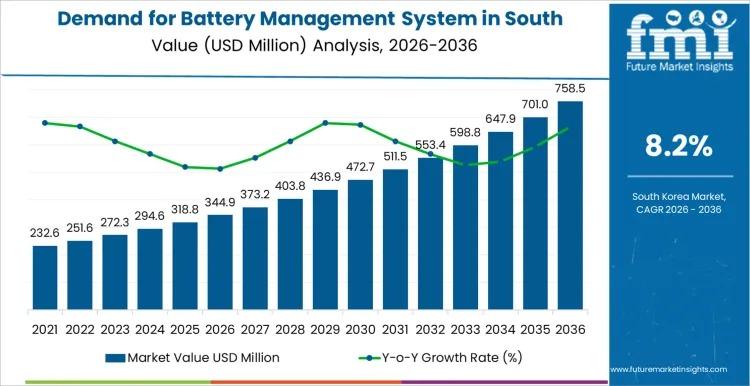
Demand for Battery Management System in South Korea
Sales of battery management system (BMS) units in South Korea are entering a sustained growth phase, reflecting the country’s strategic position at the center of the global secondary battery value chain. The market is projected to be valued at USD 344.9 million in 2026 and is forecast to reach USD 756.3 million by 2036, advancing at a compound annual growth rate (CAGR) of 8.2% over the ten-year period. This expansion underscores the rising importance of intelligent control systems as electric vehicles (EVs), grid-scale energy storage systems (ESS), and digital infrastructure place increasing demands on battery safety, efficiency, and lifecycle optimization.
South Korea’s dominance in advanced battery manufacturing-anchored by global leaders such as LG Energy Solution, SK On, and Samsung SDI-has created a highly sophisticated domestic ecosystem for battery control and monitoring technologies. As battery pack capacities increase and system architectures become more complex, the role of BMS has evolved from basic monitoring to a mission-critical component that directly impacts performance, safety, and regulatory compliance across automotive and stationary storage applications.
Request For Sample Report | Customize Report | Purchase Full Report
https://www.futuremarketinsights.com/reports/sample/rep-gb-31560
Policy Alignment and Safety Regulations Drive Value Growth
Market momentum is strongly reinforced by government-backed initiatives, particularly the “K-Battery” strategy, which aims to secure South Korea’s global leadership in next-generation battery technologies. This policy framework prioritizes innovation across materials, cell design, and system-level integration, creating a favorable environment for advanced BMS adoption.
At the same time, heightened safety scrutiny following high-profile energy storage system fire incidents has reshaped industry requirements. Regulators now mandate more rigorous testing, inspection, and certification protocols, compelling manufacturers and operators to deploy BMS solutions with high-precision thermal management, fault detection, and real-time diagnostics. As a result, value growth is occurring across both hardware components-such as battery monitoring ICs and sensors-and software layers responsible for analytics, safety algorithms, and system intelligence.
Electrification and Renewable Integration Sustain Demand
A core growth catalyst remains the rapid electrification of South Korea’s automotive sector. Domestic automakers are accelerating their transition to dedicated EV platforms, each requiring sophisticated BMS architectures capable of managing high-voltage battery packs with accuracy and reliability. These systems are essential for ensuring range prediction, cell balancing, thermal stability, and long-term battery health-key factors influencing consumer confidence and vehicle lifecycle costs.
Beyond mobility, national energy policy is also playing a decisive role. The “Renewable Energy 3020” plan is driving large-scale deployment of ESS infrastructure to stabilize the power grid amid rising penetration of wind and solar generation. Lithium-ion batteries, while energy-dense, require continuous monitoring to mitigate thermal runaway risks, making advanced BMS solutions indispensable for utilities and industrial operators. The country’s broader push toward carbon neutrality further guarantees baseline demand for efficient power management technologies across residential, commercial, and industrial sectors.
Lithium-Ion and Automotive Segments Anchor Market Structure
By battery type, lithium-ion BMS units account for approximately 42.0% of market share, reflecting the overwhelming dominance of lithium-ion chemistry in EVs and energy storage applications. These batteries demand precise voltage, current, and temperature control to prevent degradation and safety incidents, ensuring that BMS remains tightly coupled with lithium-ion production volumes.
From a system architecture perspective, centralized topologies hold around 45.0% share, favored for their cost-effectiveness in compact applications such as e-bikes and small appliances. However, modular and distributed topologies are gaining traction as battery packs grow larger and more complex, particularly in long-range EVs and grid-scale ESS installations. These architectures improve scalability, fault isolation, and maintenance efficiency, aligning with the industry’s shift toward higher-capacity systems.
The automotive application segment dominates with roughly 55.0% of total demand, underscoring EV production as the primary engine of growth. Integration of BMS with vehicle thermal management systems and powertrain controllers is becoming standard practice, creating higher-value opportunities for suppliers capable of delivering system-level solutions rather than discrete components.
Technology Trends Reshape Competitive Differentiation
Technological adoption within South Korea’s BMS market is increasingly pivoting toward wireless architectures and artificial intelligence. Wireless battery management systems eliminate heavy wiring harnesses inside battery packs, reducing weight, improving energy density, and simplifying manufacturing. Several South Korean battery and automotive manufacturers are actively piloting these solutions in next-generation EV platforms, signaling a structural shift in pack design philosophy.
In parallel, research institutions and private enterprises are collaborating on AI-driven state-of-health (SOH) and remaining useful life (RUL) estimation algorithms. These capabilities enable predictive maintenance, extend battery lifespan, and are particularly valuable for fleet operators and stationary storage providers seeking to optimize total cost of ownership. The emergence of second-life battery applications-repurposing retired EV batteries for stationary storage-further amplifies demand for adaptive BMS software capable of managing mixed-health cell configurations.
Regional Hotspots Reflect Policy and Industrial Strengths
Regional dynamics within South Korea reveal differentiated growth patterns. Jeju leads with a projected 9.8% CAGR, driven by its role as a testbed for smart grids, EV penetration, and Vehicle-to-Grid (V2G) technologies under the island’s carbon-free policy goals. South Gyeongsang follows at 8.6% CAGR, supported by dense manufacturing activity across automotive, shipbuilding, and industrial machinery. South Jeolla benefits from renewable energy projects under the Energy Valley initiative, while North Jeolla is emerging as a hub for commercial electric vehicles and agricultural electrification.
Drive Your Business Growth Strategy: Checkout the Report for Key Insights
https://www.futuremarketinsights.com/checkout/31560
Competitive Landscape: Semiconductor Expertise as a Strategic Advantage
Competition in South Korea’s BMS market is heavily influenced by semiconductor capability and functional safety expertise. Texas Instruments commands a leading position, leveraging high-accuracy battery monitoring and balancing solutions tailored for automotive and ESS applications. Infineon Technologies and NXP Semiconductors follow closely, offering ISO 26262-compliant chipsets that integrate seamlessly with vehicle electronics architectures. Companies such as STMicroelectronics and Toshiba are increasingly delivering reference designs and system-level solutions, reducing development cycles for battery pack manufacturers.
Strategic collaboration is intensifying, with chipmakers co-developing custom ASICs alongside South Korean battery giants to optimize performance for specific chemistries and applications. These deep partnerships are reshaping the competitive hierarchy and locking in long-term supply relationships in a high-stakes, safety-critical market.
Outlook: Intelligent Control as a Cornerstone of Energy Transition
As South Korea advances its leadership in EVs, renewable energy, and digital infrastructure, battery management systems are becoming a cornerstone technology enabling safe, efficient, and scalable electrification. With strong policy alignment, accelerating innovation, and expanding end-use applications, the BMS market is positioned for sustained value growth through 2036. Stakeholders seeking deeper insight into segment-level opportunities, regional dynamics, and competitive strategies can explore the full market report, which provides comprehensive analysis of South Korea’s rapidly evolving battery management ecosystem.
Similar Industry Reports
Korea Battery Management System Market
https://www.futuremarketinsights.com/reports/battery-management-system-industry-analysis-in-korea
Battery Management System Market
https://www.futuremarketinsights.com/reports/battery-management-system-market
Battery Management System Market Share Analysis
https://www.futuremarketinsights.com/reports/battery-management-system-market-share-analysis
Future Market Insights Inc.
Christiana Corporate, 200 Continental Drive,
Suite 401, Newark, Delaware – 19713, USA
T: +1-845-579-5705
For Sales Enquiries: sales@futuremarketinsights.com
Website: https://www.futuremarketinsights.com
Future Market Insights, Inc. (FMI) is an ESOMAR-certified, ISO 9001:2015 market research and consulting organization, trusted by Fortune 500 clients and global enterprises. With operations in the U.S., UK, India, and Dubai, FMI provides data-backed insights and strategic intelligence across 30+ industries and 1200 markets worldwide.
This release was published on openPR.