
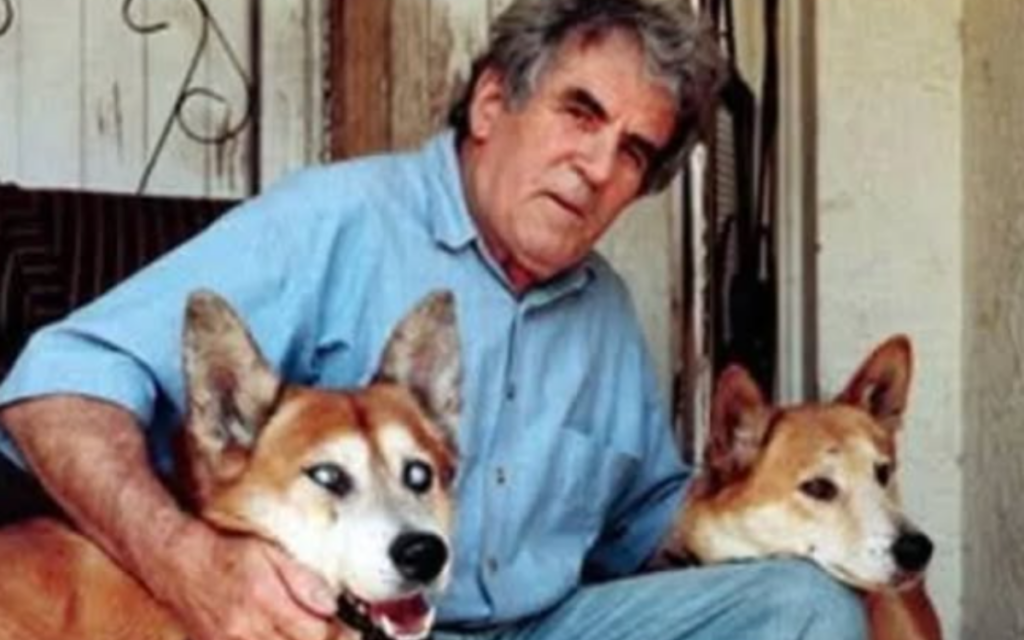
The greatest protector of Aborigines, a great writer, an unrealized Nobel Prize laureate, a man who was banned from practicing journalism in Yugoslavia, who then moved to Australia and reached the Aborigines by camel through the Tanami Desert, Cyclone Tracy took his wife and two children from him, he was deported from Australia, he condemned white colonizers from Britain and America, wrote about depleted uranium, wrote a novel about an Aboriginal boy who grew up in Serbia that was confiscated, after which 200 writers wrote to the Prime Minister of Victoria demanding that his manuscript be returned. Later, from memory, he wrote the novel “Raki,” for which he received the highest Australian literary award, after which, according to the rulebook, he was supposed to be a candidate for the Nobel Prize, but thanks to politics and a change in the rules, that right was denied to him. One and only B. Vongar (Sreten Božić).
Sreten Božić, known by the literary name B. Vongar, was born in 1932 in Gornja Trešnjevica near Aranđelovac into the large family of Stevan and Darinka Božić. He interrupted his education after being denied a scholarship due to the political views of his father, who had been declared a kulak and imprisoned after the war in Yugoslavia.
In Yugoslavia, Božić worked as a journalist, but because of one article, allegedly at the request of Slobodan Penezić Krcun, he was fired and banned from working in journalism. He defected to Italy and then to France, where he learned the language and socialized with great figures such as Jean-Paul Sartre, Simone de Beauvoir, and Samuel Beckett.
Due to financial problems, he decided to go to Australia in 1960, where his father had previously worked as a gold digger. He lived in the interior of Australia among the Aborigines and received the name Barnumbir Vongar, which means “Messenger from the spirit world.” He owes a large part of his knowledge of indigenous poetry to an indigenous woman named Djumali.
In Australia, he often had conflicts with the authorities due to the strictly regulated access to indigenous territories, and on one occasion the natives hid him from a white policeman by covering him with dust and pretending that he was ill.
Božić also met the celebrated Australian writer and anthropologist Alan Marshall, with whom he wrote the book Aboriginal Myths in 1972. His collection of short stories The Road to Bralgu was published in 1976 in French, and later in English. Because of his portrayal of Aboriginal life, he was criticized by the Australian white community and authorities, and was forced to move to the vicinity of Melbourne with a ban on returning to the north.
Until 1981, it was believed in Australia that he was an Aborigine, because in his works he recorded the life and traditions of the indigenous people. He spoke publicly about his origin only during the 1990s, drawing attention to the suffering of Serbs in the wars.
After a family tragedy and moving to Melbourne, he lives in relative isolation on his estate, where he is accompanied by dingo dogs. Božić is the author of novels, plays, short stories, and poems, and his works have been awarded multiple times and translated into many world languages. For the German edition of the story Babaru from 1987, the foreword was written by Nobel laureate Peter Handke.
MORE TOPICS:
DODIK’S PARTY DECLARED VICTORY: Siniša Karan is the new president of Republika Srpska!
Source: Telegraf, Foto: Printscreen Youtube