
Jack Dorsey, co-founder of the social network that was once called Twitter, announces and publishes on the Internet the first version of Bitchat, an app that allows you to send text and voice messages or photos without Wi-Fi, without Internet, without central servers, without asking for telephone numbers or emails, and in anonymous and encrypted form. You don’t even need to create an account.
…
Bitchat uses a so-called peer-to-peer wireless mesh network, i.e. a wireless mesh network. Translating from the technical jargon, the network that interconnects mobile phones with Bitchat is made up exclusively of the smartphones themselves, which talk to each other via Bluetooth, without needing a central server, Internet connections or anything else.
…
No personal user information appears and there is no profile photo, and this is all intentional. Bitchat is designed to protect people’s privacy and security and to allow the anonymous exchange of ephemeral messages, as explained in the programmatic document published by Jack Dorsey. The messages, in encrypted form, are stored only on individual mobile phones, disappear after sending or delivery and never touch a centralized infrastructure. In case of emergency, tapping the app icon three times in sequence will erase all data.
As can be seen, the main limitation is the radius of the BLE, which in an open field is approximately 20 metres.
This means that if you have no other Bitchat users within this distance, you cannot use Bitchat to exchange messages without using the Internet. And there is also a limit to the number of hops from one cell phone to another that a message can make in an attempt to propagate to its destination without relying on the Internet. This limit is seven, and this means that a Bitchat local network, even under the best conditions, has a maximum range of about half a kilometer. In real conditions the effective range can be around two hundred meters.
However, if some of the telephones that are part of the local network move, for example going back and forth between various places, they become digital “postmen”, who can deliver the messages they contain even over great distances, even if in this case the delivery is obviously not instantaneous.
To compensate for this limitation, Bitchat has evolved since its debut six months ago and now also includes the ability to communicate with users far away, even on other continents. In this case it relies on the Internet in a classic way [tramite Wi-Fi o rete dati cellulare] and communicates through the open protocol Ours.
…
In fact, it must be clarified that Bitchat partially loses its protections when used for long-distance chats via the Internet. Users remain anonymous, their communications are routed, in a very protected and untraceable way, via the Tor system and messages direct to a single user they remain encrypted. However, Bitchat messages destined for distant channels are public by default and by necessity, since they must be readable by anyone participating in a channel.
….
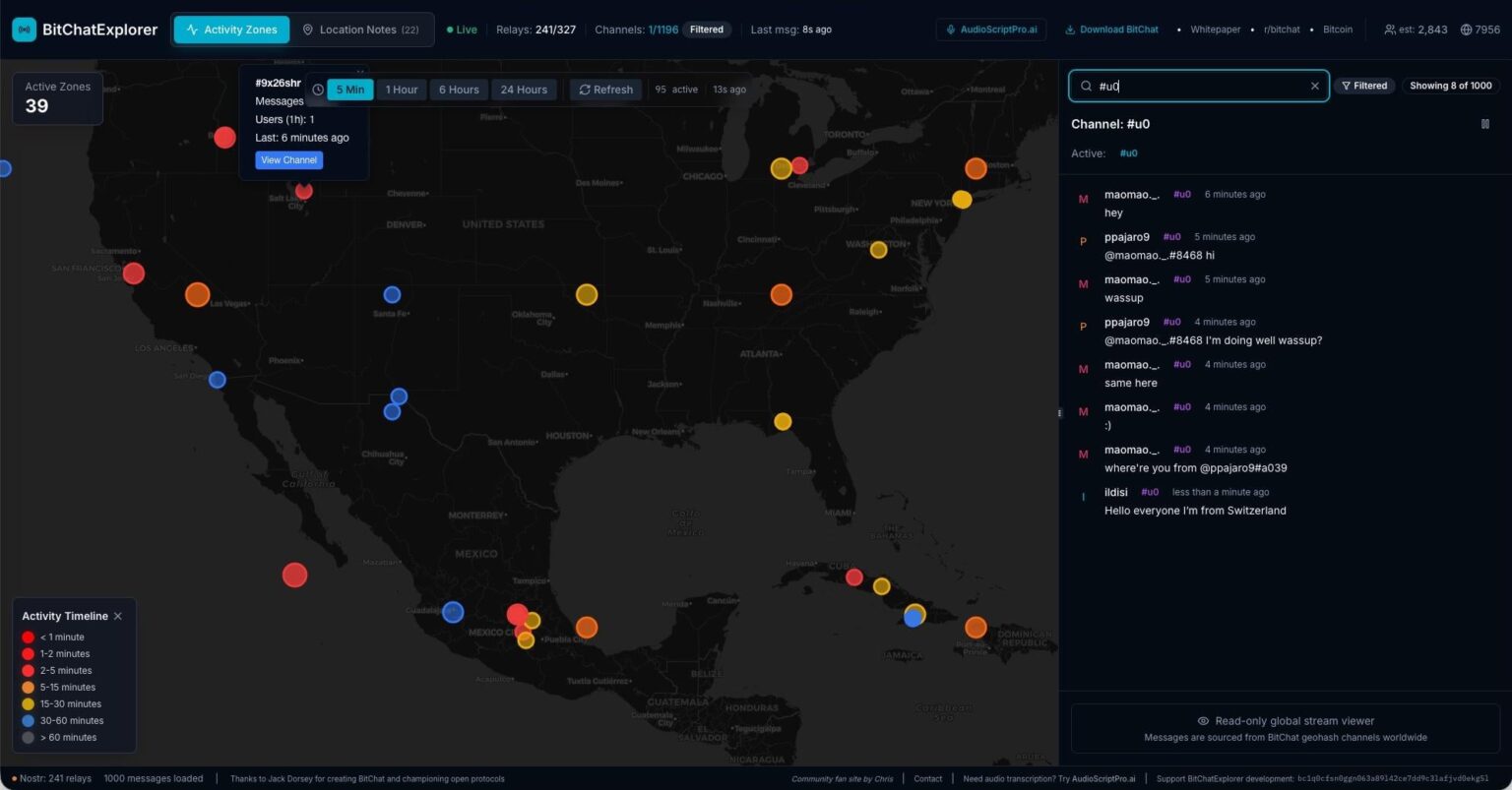
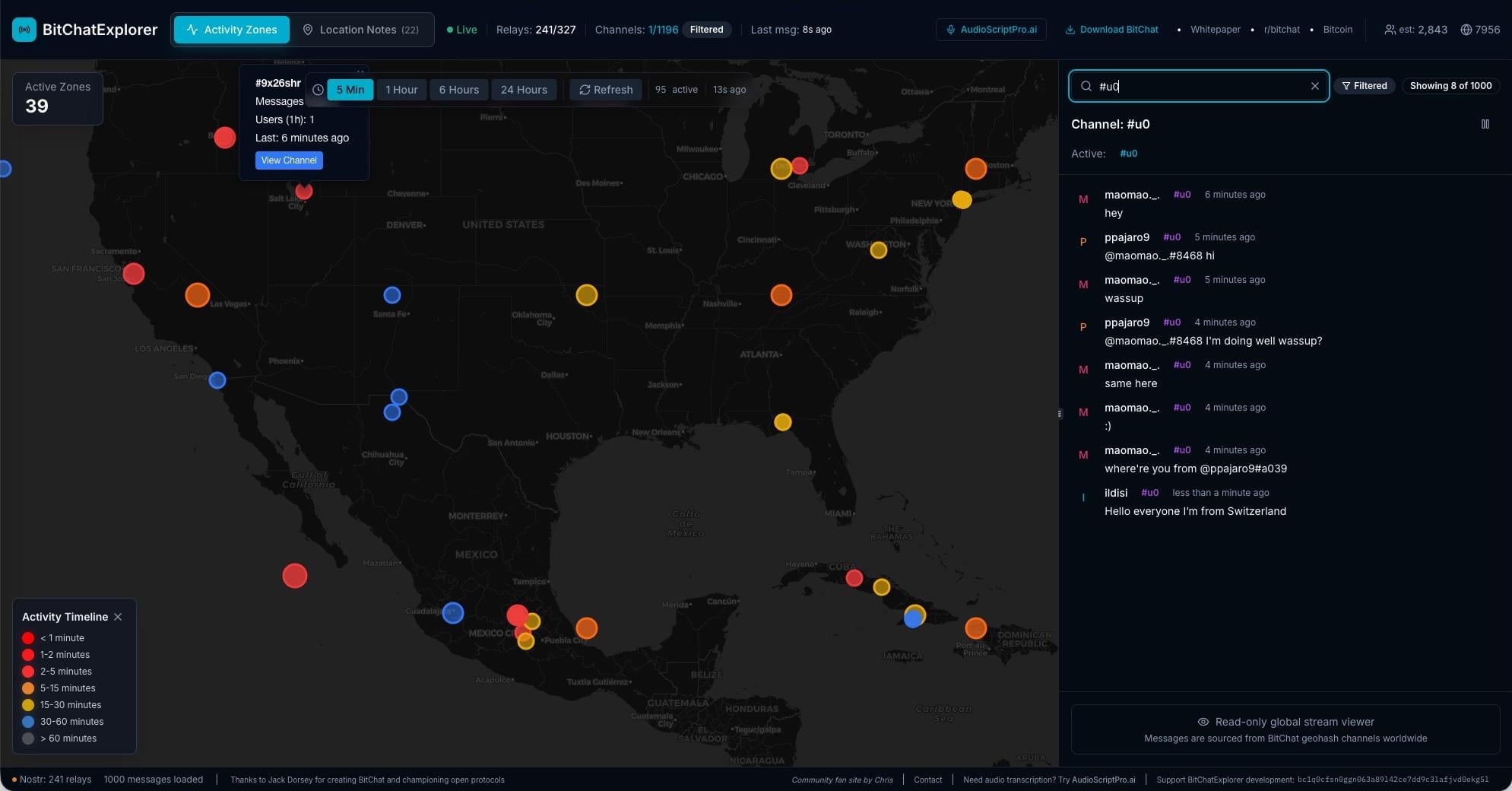
To better understand this important difference between local use and Internet use of Bitchat, you can consult one of the users’ public maps, such as the one available in real-time updated form at Bitchatexplorer.com. There you can see users who are using Bitchat for long-distance communication and you can read their public conversations.
The channels are geolocalized, in the sense that they are associated with a more or less large location or region. For example, every Bitchat user has predefined channels, called block, neighborhood, city, province, regioncovering a radius varying from 200 meters in the case of the block to 1250 kilometers in the case of the region, and the world is mapped with extreme precision via channel names called geohash. The longer the name of the canal, the more precise its location, and eight characters are enough to indicate a single building anywhere on the planet, as explained interactively at geohash.softeng.co.
Podcast RSI – Bitchat: messaggi senza Internet, senza rete cellulare e senza padroni
Posted by MasterPen6
11 Comments
> Traducendo dal gergo tecnico, la rete che interconnette i telefonini fra loro con Bitchat è composta esclusivamente dagli smartphone stessi, che si parlano via Bluetooth, senza aver bisogno di un server centrale, di connessioni a Internet o altro.
grazie per averci riportato nel 2002, Jack.
Molto utile, anche nel caso di paesi dove viene bloccato internet oppure i social network. Come sempre, dipende come si usa uno strumento, nel bene o nel male
Meglio LoRa (Long Range)
Nintendo aveva un’app simile tipo 20 anni fa
Non l’avrei chiamato Bitch-at
Distanza massima tra utenti: 20 m.
Numero massimo di salti: 7
Massima distanza utile: 500 m
*visible confusion*
C’era un’applicazione che usavamo in compagnia, sui Nokia con symbian più di 20’anni fa, per scriverci via BT quando eravamo alle feste o in disco e la rete 2G non prendeva.. purtroppo non riesco a ricordarmi come si chiamasse..
Figata, perfetto per situazioni come la recente serie di proteste in Iran. In quei casi i limiti sono meno impattanti, perché gli scontri importanti si svolgono in grandi città dove la densità di abitanti annulla il problema del raggio limitato e ci sono abbastanza persone che vanno e vengono da riuscire a portare le informazioni anche nelle periferie in non troppo tempo (con quel discorso della staffetta).
Allo stesso tempo aggiri completamente i blocchi governativi a internet, rete cellulare ecc., e permetti ai manifestanti di coordinarsi per evitare le zone dove la repressione è più violenta, o al contrario di fare affluire più gente per sopraffare le forze di sicurezza.
E anche quelli non in piazza potrebbero ricevere informazioni realistiche sull’andamento delle proteste.
Altro vantaggio è che si basa su una tecnologia presente anche sui cellulari più economici, quindi è praticamente già nelle mani dell’intera popolazione, non c’è bisogno di dispositivi dedicati.
Che bella cosa, spero proprio prenda piede!
Come mai c’è questo limite ai salti?
È come gli airtag, potrebbe farlo apple sinceramente
Ma non è uguale a quanto si faceva già 20 anni fa circa?