
Debate over Katama Meadows, a 54-acre development proposed to be built in Edgartown, has surged in recent weeks. While some town officials continue to support the project, other community members and environmental organizations have spoken out against it as the Island gears up for a continued public hearing on the project Thursday night.
The 52-lot, subdivided development — consisting of purchasable parcels for single-family homes and open space — has been bathed in contention from the start, not unlike other large housing projects in the Island’s history. Advocates for affordable housing have warned that one perceived misstep, approval, or denial could set the tone for future developments on the Vineyard for generations to come.
At a recent presentation about the environmental impacts of the project, John Abrams, the former CEO of South Mountain Company, spoke out against it. “This, if it were approved, would take us back 40 years. And we need to go forward, not back,” he said.
For those involved in housing, every case matters. But for some Edgartown officials, the goal is the best result possible while taking into account the reality of these projects. They said the part they grapple with is rather simple: The town doesn’t own the land; the developer does.
And the zoning in the area of Edgartown where the parcel is located, near Meshacket and Division roads, permits a project like Katama Meadows, which consists of single-family homes, to be built over a large swath of land.
“It’s an obligation for the board to get the best deal from the town,” Edgartown town administrator James Hagerty told The Times. “In an ideal world, nothing’s developed. Everything remains open space. But if individuals have a right, the town has to negotiate the best deal for something that’s likely inevitable.”
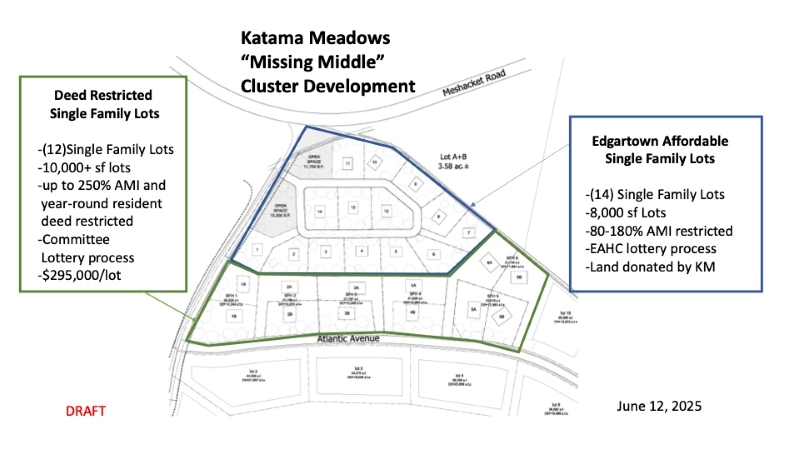
That requires compromise, he said. In the case of Katama Meadows, compromise looks like a donation of 14 lots to the town of Edgartown, and 12 lots restricted for “missing middle” Islanders. The other 26 lots, which will be built on over 23 acres of the property, will go at market rate, with a five-bedroom limit on each home constructed.
Amid the concern about the amount of single family homes that could be built in that area, Robert Moriarty, the attorney for the developers, reiterated that half of the project is geared toward local families.
“I prefer to do my talking in front of the commission, but I look forward to presenting a plan that will provide housing for 26 hard-working Island families who would otherwise not be able to afford it,” Moriarty said in a statement to The Times.
Nearly 50 letters have been submitted from community members to the Martha’s Vineyard Commission (MVC) regarding Katama Meadows, which can be viewed on the commission’s website. Some supported the developer’s mission to engage with the “missing middle,” but most were against the project.
At the same time, the Edgartown select board submitted a letter requesting the MVC not impose income-based deed restrictions on the donated lots. Previous affordable housing projects that the town of Edgartown has been involved with have capped an individual’s annual salary at around $180,000. They want to cater to slightly higher incomes with this one.
Environmental concerns
While some of the concerns from the community have been in relation to the developer’s “missing middle” claims, which they say are not in line with the average salary of Island residents, most of the condemnation of the project has been environmentally driven.
Around 40 people attended a recent presentation on Feb. 5 by the Vineyard Conservation Society and the Great Pond Foundation to tune into conservation efforts in the area that Katama Meadows will be developed close to, namely Edgartown Great Pond.
Emily Reddington, the executive director of the Great Pond Foundation, said she’s immensely worried about the nitrogen load a housing project could introduce to the pond through increased wastewater usage. Although the project is in line with the MVC’s nitrogen limits for development in the area, Reddington said there is still potential for damage. She did a variety of calculations; the group she leads has been studying the health of the pond for years.
Through her research, Reddington found that the health of the pond has greatly improved this year. Eelgrass is slowly growing, the tendrils creeping through the sand, and shellfish are returning. Just a few years prior, images taken of the pond showed murky water and very little life.
“The thing we’re really worried about is toxic algal blooms,” Reddington said. “Any more nitrogen is too much nitrogen … and this development is talking about adding more.”
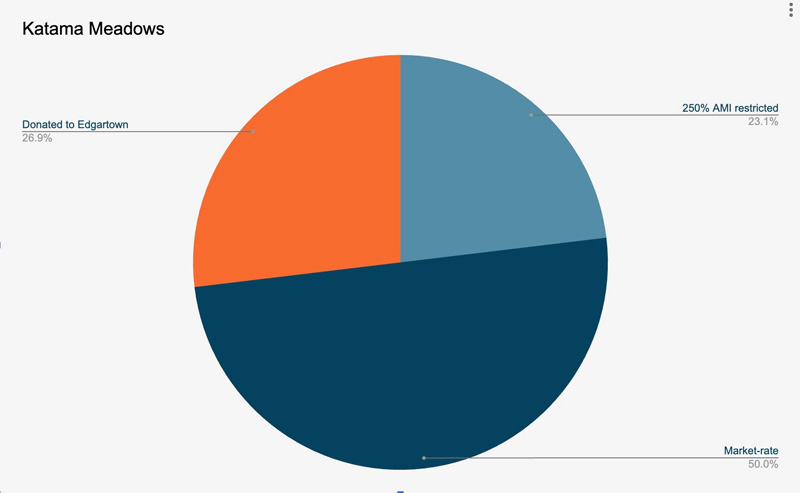 A breakdown of the lots for the Katama Meadows subdivision. —Sarah Shaw Dawson
The executive director of the Vineyard Conservation Society, Sam Look, agreed. She also pointed to the 26 market-rate lots that Katama Meadows proposes. To Look, the benefits of some affordable housing do not make up for the amount of development proposed.
Look, and some other attendees who spoke up, worried that the 26 lots would end up as a “luxury development,” and that with no year-round restrictions, they could also be summer homes.
“Most of us are concerned about housing,” Look said to the crowd at Carnegie Hall in Edgartown. “This is not a question of whether our community can have affordable housing or protect the environment. It’s about how we can balance two critical needs for the community.”
Town asks for income limits increase for donated lots
In a letter to the MVC dated Feb. 9, the select board urged the commission to raise the income limits of the 14 donated lots to reach middle-income municipal employees in the town, who they say have not qualified for recent affordable housing projects.
According to the board, there were no municipal applicants for Meshacket Commons, an Island Housing Trust development that is located across the street from Katama Meadows and is a combination of apartments and single-family homes. The project had an income restriction of up to $126,100 for an individual and up to $208,900 for a family of four.
“This outcome is significant and strongly indicates that even relatively moderate AMI thresholds, when combined with current construction costs, municipal employee salary structures, and financing constraints, are not viable for the very population these units are intended to serve,” the select board stated in the letter. (The AMI, is a calculation of median income by district.)
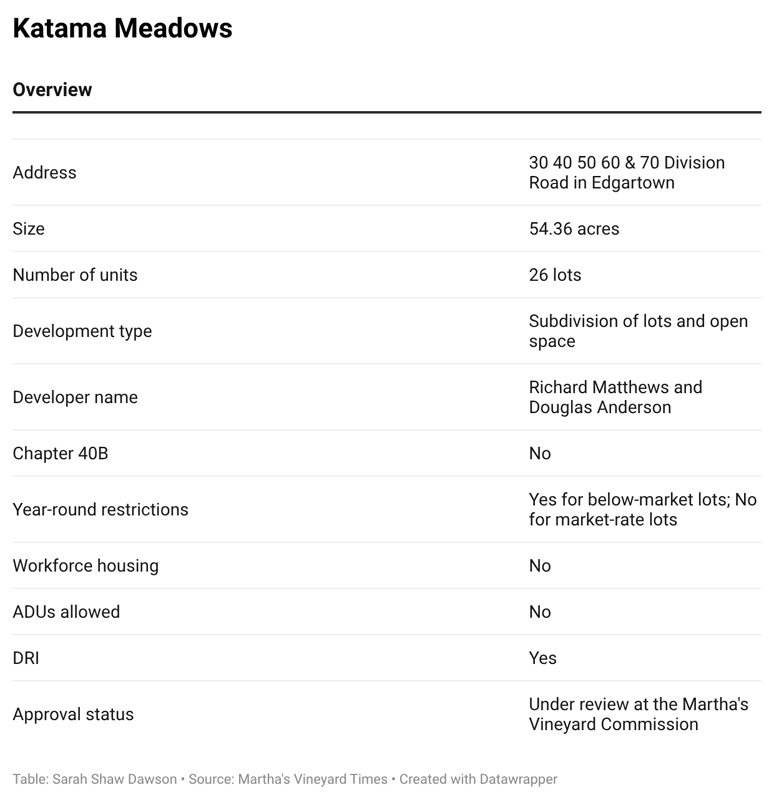 The subdivision plan for Katama Meadows in Edgartown. —Sarah Shaw Dawson
In addition to the donated lots, the Katama Meadows development includes 12 lots that will be sold at $295,000 each. They will be available for purchase to Islanders who make 250 percent of the area median income or less.
In Dukes County, the median income is $105,000 for an individual and $150,100 for a family of four. And so, 250 percent, or 2.5 times the AMI, is $262,750 for an individual and $375,250 for a family of four.
For Edgartown municipal employees, the average annual salary was $43,357 in 2024, and the highest was $217,329. In the new contract for teachers at Island schools, the lowest salary is $77,361, and the highest is $129,988.
There’s one other development — on Jernagen’s Pond Road in Edgartown — that got approved in 2024 for its mission to house “missing middle” Islanders, owned by Jean G. Cohen Trust. Rob McCarron, the trust’s attorney, presented the project to the commission back then. The income restriction is twice the AMI, with the affordable lots priced at $225,000 each.
MVC representative replaced, cites opposition of Katama Meadows
While many Edgartown officials have maintained their support of the Katama Meadows project, others have been against it from the start.
Julia Livingston from the Edgartown Planning Board and Kate Putnam, the former Edgartown representative at the MVC, have come under intense scrutiny for their opposition of the development.
Livingston was asked to recuse herself by the legal representative of Katama Meadows, Robert Moriarty, on two separate occasions. In the first meeting that the recusal request was brought up, Livingston answered “yes” to a question of recusal. Later, she told The Times in an interview that she meant she was abstaining from voting on that day.
As of now, Livingston said she’s not planning to recuse herself and has no reason to. Livingston also attended the event by the Vineyard Conservation Society where presenters were against the development.
As for her opposition to Katama Meadows, Livingston is still advocating for other solutions. She has said in meetings that she’s a proponent of affordable housing for the “missing middle” bracket of Islanders, but that this project doesn’t meet that mark. She also cited environmental concerns due to the development’s proximity to Edgartown Great Pond and another housing project, Meshacket Commons.
Meanwhile, Kate Putnam was quietly removed from her seat at the MVC by the Edgartown Select Board in a meeting on Jan. 5, and claims it was because of her opposition to the Katama Meadows development.
Putnam has worked on various committees at the MVC since being appointed in 2022 and said she’s a proponent of affordable housing, conservation, and the local economy.
Then, last month, a short time after Putnam submitted her catalog of work she had done at the MVC in an effort to be reappointed for another term, she saw her name on a select board meeting agenda.
“I didn’t hear anything, and I finally saw that I was on the agenda in January,” Putman told The Times.
She attended, just to hear she was being replaced by Daniel McGinn, a retired state police major. Putnam said the select board expressed to her that they wanted someone who supported affordable housing to represent the town at the regional level. A member of the board was not immediately available for comment.
“Certainly the cost of housing here is a big issue,” Putnam said. “[But] I think probably the most important thing that’s been said is we haven’t seen a development of [this] scale.”