
Last year, Lauri Cumming and her husband, Jonathan, were both diagnosed with cancer. Lauri, a realtor and church bookkeeper in Bryn Mawr, underwent a lumpectomy and radiation for breast cancer, and Jonathan, who runs a contracting business with their adult son, received treatment for melanoma.
Fortunately, Lauri said, they both caught their cancers with enough time to successfully treat them. Now, however, as Lauri continues to need costly medication and they both will require follow-up oncology appointments, CT scans and MRIs, they are facing soaring health care prices.
Enhanced Affordable Care Act tax credits that have helped tens of millions of Americans purchase health care through their state marketplaces expired at the end of December after the Republican-controlled Congress did not extend them.
Lauri, who spends much of her day caring for her adult daughter who is on the autism spectrum, and Jonathan buy their health insurance through Pennie, the state’s Affordable Care Act marketplace. With the federal tax credit, the couple paid $950 a month in 2025. This year, they have to pay $2,500 a month.
They’re not sure how they’re going to continue paying for their health care — but they also can’t afford to not have insurance, Lauri explained at a health care forum organized by the Pennsylvania Association of Staff Nurses and Allied Professionals, or PA-SNAP, on Jan. 22. They could likely save a couple of hundred dollars by scaling back on television and their cellphones, but they’ll need to come up with another $1,000-plus every month to keep their health insurance.
“But then all that’s left is food and clothing,” Lauri said of possible budget cuts. “Our electric and gas is supposed to be going up, as far as I know, and it’s kind of scary. So it’s not something that is doable for us. So if we can’t pay it, we’ll wind up having to drop it as time goes on. We will see how it goes.”
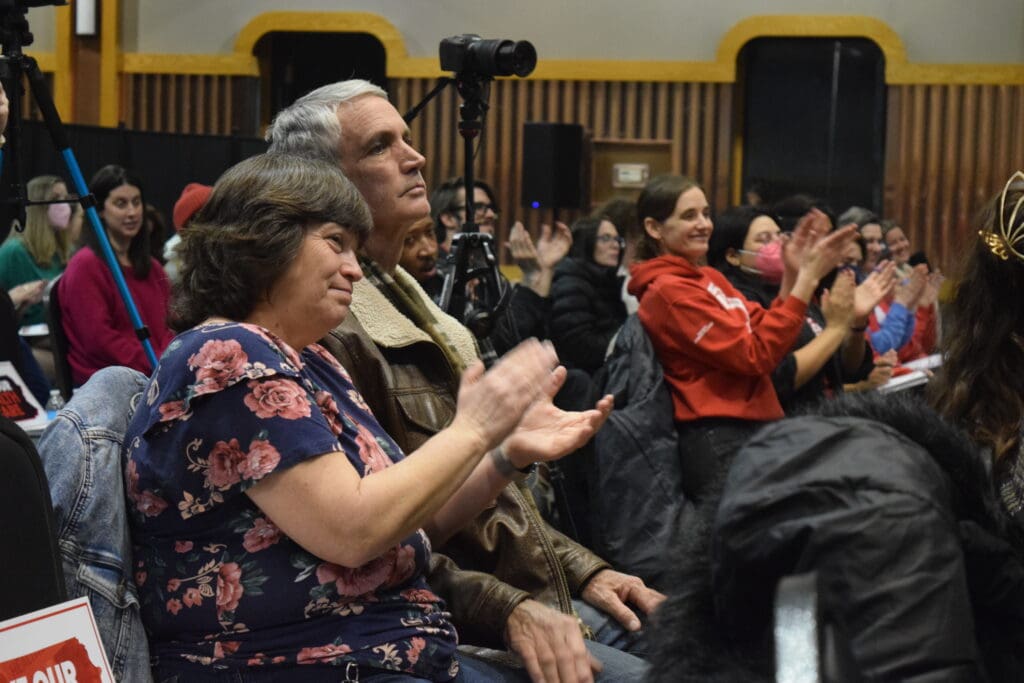 Lauri and Jonathan Cumming, attending a Jan. 22, 2026, health care forum organized by the Pennsylvania Association of Staff Nurses and Allied Professionals, are not sure they’ll be able to keep their health insurance plan after their premium cost rose from $950 to $2,500 a month. (Photo by Anna Gustafson)
If they do have to drop their health insurance, Lauri doesn’t know how they’re going to afford the more than $1,000 they’d have to pay each month for their medication — not to mention the CT scans and MRIs.
“Before the ACA, my husband and I did not have insurance for several years, and we know what it’s like,” Lauri said. “We were lucky this year because we were there early. We went to the doctor and found that we had cancer early, and it was taken care of with no problems. But if we had waited, who knows what we would be doing right now.”
‘It’s devastating. No one can do this. No one can afford this.’
The Cummings are far from alone in being worried about health care costs.
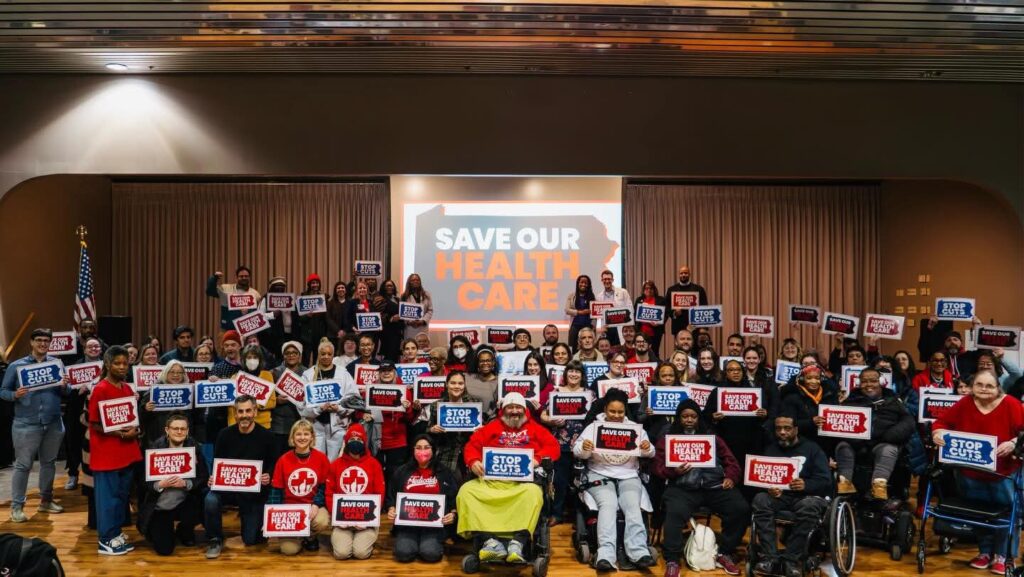
At the Forum to Save Our Healthcare, which PA-SNAP, a union that represents nurses and health care workers, held at the Sheet Metal Workers Local 19 in Philadelphia, health care workers, policy experts and faith leaders described a health care system that is being broken by the loss of ACA coverage and the Medicaid cuts passed in 2025 by Republican lawmakers and signed into law by President Donald Trump. Those cuts, forum participants said, have left people to choose between paying for food or health insurance. They have resulted in the likelihood of hundreds of thousands of Pennsylvanians losing health coverage, dozens of hospitals closing in the commonwealth, and burnout pushing doctors and nurses from their jobs.
“This administration is doing everything possible to roll back our ability to get care, and these decisions have devastating consequences for my patients, for my colleagues and for our communities,” Dr. Michelle Munyikwa, a resident physician in combined internal medicine and pediatrics at the University of Pennsylvania and the Children’s Hospital of Philadelphia, told the crowd of about 100 people gathered for the forum. “Providing access to health care is a necessity. Lives are on the line here in Pennsylvania and across the country.”
After congressional Republicans slashed about $1 trillion over the next decade from Medicaid funding in their One Big Beautiful Bill Act and didn’t renew the ACA tax credits, about 600,000 Pennsylvanians could lose their health coverage in the coming years, 47 hospitals in the commonwealth face closure, and the state could be forced to make drastic health coverage decisions due to financial concerns. These might include eliminating the Medicaid expansion program that covers about 750,000 Pennsylvanians, Joanna Rosenhein of the Pennsylvania Health Access Network said during the forum.
As of January, nearly half a million Pennsylvanians saw their health care premiums increase, with some premiums doubling or even quadrupling, Rosenhein said. Pennie reported on Feb. 9 that rising premium costs caused about 85,000 Pennsylvanians to drop their health coverage, nearly one in five enrollees.
“It’s devastating,” Rosenhein said. “No one can do this. No one can afford this. It’s really an unreasonable increase in premiums.”
‘People will die.’
The Medicaid cuts, rise in premiums and consequent loss of coverage come after Americans had been insured at a level never seen before. At the start of 2025, more Americans were insured due to a record-breaking number of people purchasing ACA marketplace plans, both nationwide and in Pennsylvania, allowing for more people to access a wide range of preventative health care, such as cancer screenings. Then, after Trump entered office and Republicans took control of Congress, those numbers began to decrease and are expected to nosedive in the coming years if lawmakers do not restore funding for Medicaid and the ACA tax credits, forum panelists said.
“We know people will die due to the lack of access to care,” said Maureen May, the president of PA-SNAP and a registered nurse at Temple University Hospital.
Nationwide, ACA marketplace enrollment is down by 1 million people compared to last year, according to an analysis of federal data by KFF, a nonprofit that analyzes and reports on health policy. About 4 million Americans are expected to lose their ACA marketplace coverage because the tax credits weren’t renewed, according to the Congressional Budget Office. More than 8 million people nationwide are expected to lose their Medicaid coverage by 2034 due to the cuts in the One Big Beautiful Bill Act, an analysis from the Congressional Budget Office stated.
“Overall, this bill is the largest cut to health care in U.S. history,” Rosenhein said.
These numbers translate to a country that’s incredibly anxious about health care costs. Polling from KFF found in January that health care costs are the top financial concern for adults and their families, followed by food, utilities and other household expenses.
May said cuts to Medicaid and the loss of ACA coverage doesn’t just affect Medicaid and marketplace policy holders; they will lead to stress on the entire health care system.
May said hospitals may close as Medicaid cuts deprive them of reimbursement for their services and more patients are uninsured; there will be longer transportation times for patients and increased wait times at the emergency rooms that remain open; and health care workers will be increasingly burnt out.
“Even before the proposed cuts, our health system was broken, already under enormous strain,” May said. “Hospitals are closing services. Entire facilities are disappearing. Care is being consolidated farther and farther away from the people who need it the most. Preventative care is harder to get. … Now imagine someone pulling billions of dollars out of that already strained system — frightening. That doesn’t just mean inconvenience; it means fewer services, fewer staff, longer waits, worse outcomes, and, yes, again, people die.”
‘The nurses are dying. They’re dying inside.’
It’s not just people losing coverage who are worried for their future, forum panelists said. Following years of burnout among health care workers that’s largely rooted in burdensome patient loads, stress from working during the COVID pandemic, and a Trump administration that cuts health care funding and regularly promotes misinformation about health care and science, doctors and nurses said their peers are leaving, or considering leaving, their jobs.
“Every day that I go on Facebook or Reddit or Instagram, I see questions posted in forums like, I can’t deal with clinical medicine anymore. I’m so beyond burnt out on all of this. What nonclinical jobs could I potentially do with my degree?” Max Cooper, an emergency physician who worked at Crozer-Chester Medical Center in Delaware County before it closed last year and now works as a physician in southeastern Pennsylvania, told the Pennsylvania Independent.
“I think for myself and for many of my colleagues, we got into this because we love clinical medicine,” Cooper continued. “We want to practice clinical medicine. We just want someone to have our back as we’re trying to help our patients and communities.”
Peggy Malone, a registered nurse for 37 years who recently lost her job at Crozer-Chester Medical Center and now works at Jefferson Einstein Philadelphia Hospital, said it’s not just that she expects more nurses to leave their jobs in the wake of the Medicaid cuts — it’s likely that people will stop wanting to enter the nursing field altogether.
“I don’t know how many people will go into the nursing profession in the future,” Malone, who also serves as an executive board member of PA-SNAP, told the Pennsylvania Independent. “There’s nothing appealing about it anymore.”
As for nurses who are already working, the Medicaid cuts exacerbate already-existing challenges in the health care field and are prompting nurses to leave their jobs, May and Malone said.
“The nurses are dying, they’re dying inside,” Malone said. “We say there’s a nursing shortage in Pennsylvania. There is not. There is a shortage of nurses who are able to do this job at the bedside any longer.”
A ‘Healthcare Bill of Rights’
At the end of the forum, panelists and members of the crowd signed what PA-SNAP calls its Healthcare Bill of Rights, which calls on Congress to restore the ACA tax credits and roll back Medicaid cuts, among other efforts to strengthen health care.
In addition to those attending the event, PA-SNAP and other participating groups are calling on elected officials in the commonwealth to sign the document.
“If the halls of power won’t protect patients and communities, then we have to be honest about how we change that, and that requires all of us, organized, informed and willing to act together,” May said.