
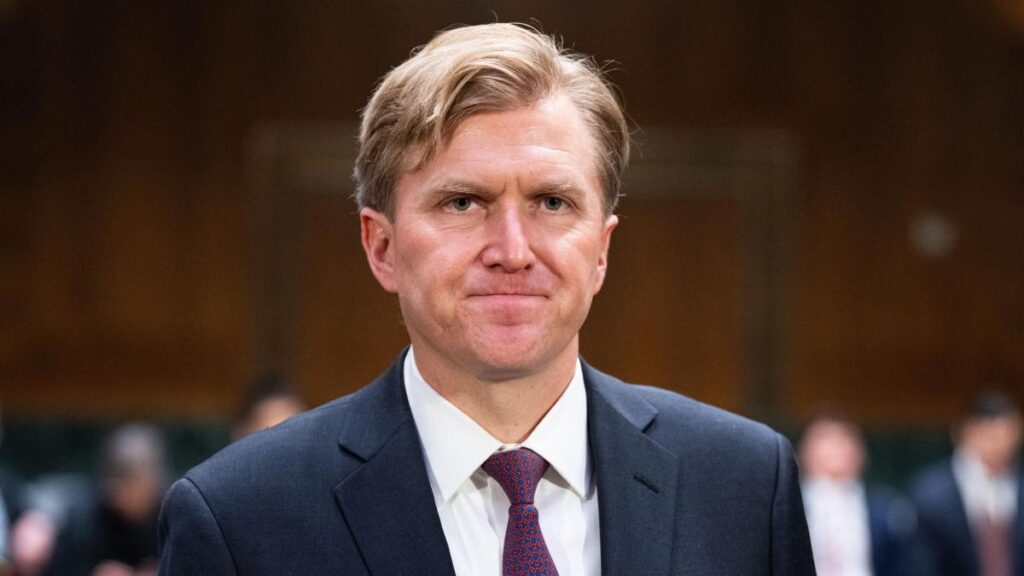
Pete Hegseth, the US war secretary, is snubbing a meeting of Nato defence ministers and sending instead his policy chief, who has advocated reducing the US military presence in Europe.
Elbridge Colby, 46, is a China hawk who believes European members of Nato should do a lot more to provide their own defence and should not rely on American assistance for Ukraine.
His more hardline views on refocusing the US military away from Europe have, however, been tempered by witnessing the support role played by European Nato in refuelling for the B-2 bombing raid on Iran last summer.
All the signals from Washington are that no major draw down of forces will be announced this week, European officials said, because the importance of a stable Europe has been recognised by Colby and others, despite President Trump’s antagonistic attitude towards Nato allies.
Colby is regarded as a man that Nato can do business with, more so than Hegseth, Europe officials said. A senior Nato diplomat described him as one the Trump administration’s conceptual and strategic thinkers with clear and well informed views on what should be the priorities of US armed forces.
• We can’t rely on United States now, says EU justice commissioner
He is nevertheless willing to play hardball as European defence ministers will hear on Thursday. “Colby will press for more European defence expenditure and for a Nato that goes back to factory settings, a more lethal Nato committed to collective defence,” said an ambassador.

Pete Hegseth caused anger at the same Nato meeting last year when he criticised Europe for not spending enough on defence
EVAN VUCCI/AP
As under secretary of defence for policy, Colby is the number three civilian leader in the US Department of War under Hegseth and the deputy secretary, Steve Feinberg.
He served in a similar role in the first Trump administration for a year and was behind the 2018 National Defence Strategy that refocused the department’s approach away from Europe and the Middle East and on to China.
Colby, whose grandfather was head of the CIA in the 1970s, is a graduate of Harvard and Yale Law School. His early government career included stints in the Coalition Provisional Authority in Iraq in 2003 and the Office of the Director of National Intelligence in 2005-06.
“I would have a hard time identifying a single person in my time in Washington who has had a bigger impact in moving the needle of the debate” on Ukraine and China, said Wess Mitchell, an assistant secretary of state in the first Trump administration, who started the Marathon Initiative, a think tank, with Colby.
Summing up his approach in 2023, Colby said: “Our allies must take primary responsibility for Europe’s conventional defence, relying on the United States mainly for its extended nuclear deterrent and select conventional capabilities that do not detract from our ability to deter China.”
His opposition to providing arms and other military assistance to Ukraine heavily influenced the Trump administration’s thinking.
“He’s one of the new right’s ‘realist’ foreign policy champions, America First, limiting US resources to power competition with China, and generally unsupportive of international commitments,” said one Ukrainian source. “He’s also the official who tried to stop weapons transfers to Ukraine in summer 2025.”
According to most European allies, there are three main foreign policy factions in Trump’s Washington, the “primacists”, the “restrainers” and the “prioritisers”.
The first camp, particularly associated with the Republican Neocons, seek a return to a world with the unchallenged primacy of the US, in every military theatre at all times.
In response to this, and sometimes dominant in Trump’s administration are the “restrainers”, arguing that America’s “forever wars” in the Middle East and failed policies of interventionism, including alliances such as Nato, have drained resources and squandered lives fruitlessly.
Colby on the other hand, is in an emerging third camp, the “prioritisers” who, while wanting to shift America’s focus to Asia and China, are pragmatic about keeping the Nato alliance because America needs it.
• Trump weighs bolstering ‘armada’ near Iran before Netanyahu visit
Whereas the “restrainers”, and perhaps Trump himself or Hegseth, might withdraw from Nato, he is pragmatic and something of a convert. His tone changed last June, said one senior diplomat who describes him as “very bright and personable”, when he discovered that “Operation Midnight Hammer” to bomb Iran with US Air Force B-2 Spirit stealth bombers was impossible without using Nato’s network of air bases for refuelling en route.
“He was mugged by reality,” said the diplomat.
That message has been underlined this week with departures of USAF F35As and their air tankers from RAF Lakenheath and Mildenhall to the Middle East.
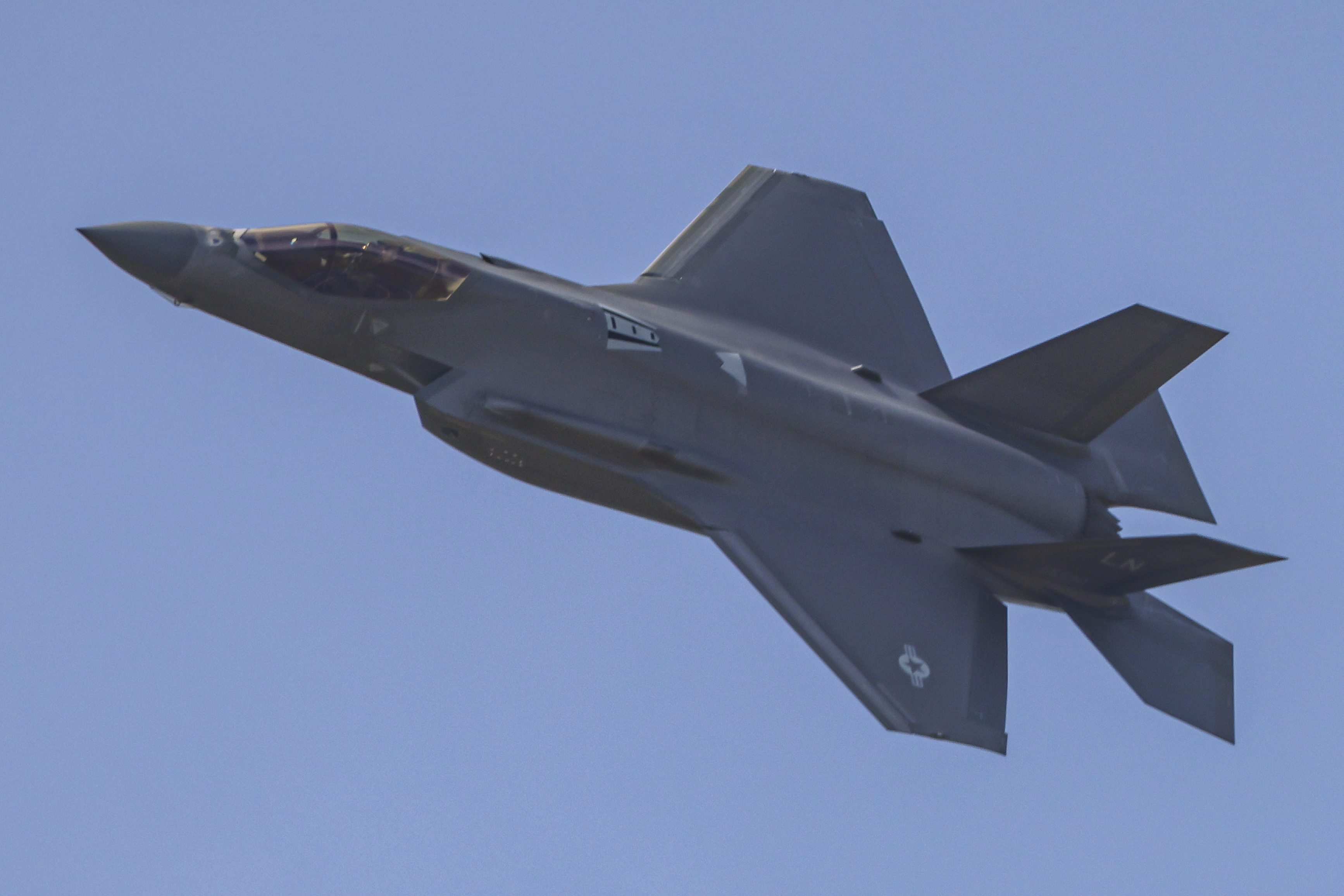
The F-35 Lightning II
NICOLAS ECONOMOU/NURPHOTO/GETTY IMAGES
Colby is expected to be unforgiving when European allies, including Britain, hand in their Strategic Level Reports, explaining how they will hit Nato’s 5 per cent spending target by 2035.
US officials are on high alert for an old European accounting dodge, known as the “hockey stick” which is to backload spending as close to 2035 as possible to avoid difficult budget choices now. He will tell Europeans that Washington will not tolerate the trick, with a warning that unless real military expenditure happens quickly the scene is set for a big showdown with Trump at a Nato summit in Ankara this July.
First comes the Munich security conference this weekend, to be attended by Colby and Marco Rubio, the secretary of state. The annual Munich report warns: “The world has entered a period of wrecking-ball politics. Sweeping destruction — rather than careful reforms and policy corrections — is the order of the day.”
The post-Cold War order, largely organised and upheld by the US, is “under destruction”, the report adds. “For decades, Europe thrived under an American security umbrella that allowed it to prioritise integration and prosperity over hard power. That era has ended.”