
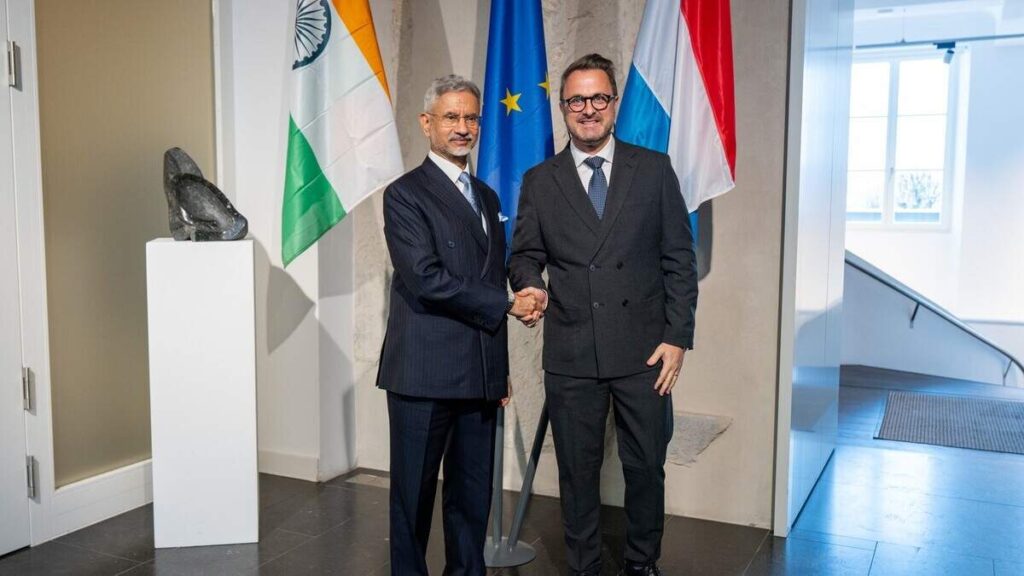
Last month India and the European Union signed a landmark free trade deal after almost two decades of negotiations, strengthening ties between the world’s second- and fourth-largest economies.
Himanshu Upadhyay, from the Indian Business Chamber of Luxembourg, told the Luxemburger Wort what the agreement means in practical terms for the Grand Duchy.
The housing situation in Luxembourg is difficult. If more Indians come to Luxembourg because of the free trade agreement, will that make the situation worse?
If you bring qualified workers from India, who often also have families, and there is not enough affordable housing, then that can indeed become a challenge.
However, I don’t believe that the free trade agreement will flood Luxembourg’s labour market with skilled Indian workers. Companies here have growth plans, but they are also aware of the housing market situation. So of course they will not expand to the extent that they have problems finding resources. On the other hand, it is also clear that there is a great need for qualified labour in Luxembourg.
Himanshu Upadhyay has been chairman of the Indian Business Chamber of Luxembourg (IBCL) since 2024. © Photo credit: IBCL
What I personally believe is that Indian students in particular – who previously tended to go to the USA – will increasingly discover Luxembourg and study here. That’s why we also need to address this issue: Do we have enough resources for these students?
In my opinion, having more students from India is also a very good thing for the economy, because they come at an early stage, they are integrated, they learn the language, they understand the entire economy, and then they can fit in very well to meet the needs of the country.
While the free trade agreement was being finalised, SES and ArcelorMittal said they would reduce staff in Luxembourg and build up the headcount in India. Are we losing jobs in Luxembourg and are they all going to India because of the trade agreement?
I can’t comment on SES and ArcelorMittal. But today, if a company in Luxembourg wants to grow quickly and hire 500 people, it is very difficult to find these skilled workers quickly in Luxembourg and the surrounding area, especially when it comes to IT specialists.
The free trade agreement opens the doors for both sides to work more closely together in various areas. Some specific jobs may be lost, but new ones will also be created. Indian companies will also come and set up here, creating jobs. Of course, Luxembourg companies will also enter the Indian market, which will also create jobs here as well as in India.
About Himanshu Upadhyay
Himanshu Upadhyay was born in India in 1980 and worked for many years in Singapore, Hong Kong and Malaysia, most recently at insurer Munich Re, whose subsidiary Globality Health (now part of Foyer) he joined in Luxembourg in 2021. He has been chairman of the Indian Business Chamber of Luxembourg (IBCL) since 2024.
What are the benefits of the trade agreement specifically for Luxembourg?
As an EU member, Luxembourg benefits from reduced tariffs on over 90% of EU exports to India, saving up to €4 billion in tariffs annually across the EU. This improves market access for Luxembourg’s key industries such as financial services, space technology and green energy.
It positions Luxembourg as a gateway for Indian investment into the EU and promotes predictability, legal certainty and opportunities for SMEs in the services and manufacturing sectors. India’s focus on AI, infrastructure and mobility fits with Luxembourg’s strengths and could lead to new jobs and diversification of supply chains.
What business activities already exist between Luxembourg and India?
Bilateral trade reached a value of around €94.6 million in 2024, with recent exports from India to Luxembourg including electrical machinery. This includes Indian exports to Luxembourg worth around €31.6 million and Indian imports from Luxembourg worth around €63 million.
Since 2000, Luxembourg has invested over $2 billion (€1.68 billion) in India in the software, chemicals, steel and automotive industries. Indian IT companies such as TCS, Tech Mahindra and Wipro are active in Luxembourg and serve the EU market.
Which activities might increase as a result of the agreement?
India has the advantage that its population speaks English and India is strategically located between the eastern hemisphere and the western hemisphere.
For example, customers can be served from Luxembourg during the day and Indian employees can take over when it is night here and morning there. Overall, however, I don’t think the free trade agreement will have a major impact on the labour market in Luxembourg. For IT, digitalisation and artificial intelligence, it could be a very, very big advantage for Luxembourg to have good connections with India, including in the space sector.
Luxembourg needs to find new, specific niches, and I believe that India is a good partner in terms of expertise and qualified resources. Luxembourg’s new ambassador in New Delhi, Christian Biever, is also very active in this area, meeting with many organisations in India and with many institutions to see how Luxembourg can benefit from the strengths that India brings to the table.
Balance of trade
The EU is India’s largest trading partner, with a goods trade volume of €120 billion in 2024, representing 11.5% of total Indian trade. India is the EU’s ninth-largest trading partner, accounting for 2.4% of the EU’s total trade in goods in 2024. Trade in goods between the EU and India has increased by almost 90% over the past decade.
The exchange of services amounted to €59.7 billion in 2023, with EU exports totaling €26 billion. Around 6,000 European companies operate in India. Roughly the same number of people of Indian origin currently live in Luxembourg. Unlike the Mercosur agreement, the agreement with India largely excludes or severely restricts agricultural sectors such as beef, sugar, ethanol, poultry, and dairy products.
According to UN Contrade data, Luxembourg’s goods exports to India amounted to $68.69 million (€57.8 million) in 2024, while India’s goods exports to Luxembourg amounted to $46.78 million (€39.37 million) in 2024.
The free trade agreement could expand relations in the financial services sector – with Luxembourg serving as India’s EU hub – as well as in steel and automotive manufacturing, infrastructure investment, and defence.
In the space sector, cooperation in mining and satellites is possible. Joint projects in renewable energy and sustainable technologies are also envisioned, along with increased skilled worker exchanges and research and development in artificial intelligence and digitalidation. Overall, the agreement supports the doubling of trade between the EU and India and creates jobs and opportunities for innovation.
Do you already know if you want to stay in Luxembourg?
When we moved to Luxembourg in 2021, my youngest son was just starting his first year at school. He is now Luxembourgish and speaks fluent Luxembourgish. We are trying to integrate, my wife has a job here and my eldest is studying here. So it would be very difficult to go back and rebuild everything from scratch, also because we have made friends here. I now consider myself a Luxembourger and am also learning Luxembourgish.
(This article was originally published by the Luxemburger Wort. Machine translated using AI, with editing and adaptation by John Monaghan.)