
Romania has relatively few standout advantages for building offshore wind farms in the Black Sea. Yet, the country possesses offshore wind resources capable of generating far more energy than the nation will ever need. According to the World Bank’s 2024 study, a potential for up to 7 gigawatts (GW) of capacity exists. Despite this, there is currently not a single offshore wind project underway in Romania to harness this potential. This is due to a combination of factors, as a series of regulatory, technical and well-founded environmental challenges have prevented projects from progressing towards the construction phase.
On the one hand, the existing power transmission network requires significant and targeted upgrades to handle large volumes of offshore energy. Furthermore, a critical uncertainty remains regarding environmental impacts, particularly concerning avian migration routes near the Danube Delta. Large coastal areas are already designated as protected zones, necessitating a Strategic Environmental Assessment to identify suitable development areas that do not threaten biodiversity. Furthermore, until recently, Romania lacked a dedicated legal framework for offshore wind. The 2024 legislation established the necessary legal basis for exploration licensing, seabed leasing, and other vital regulatory elements.
The Black Sea’s unique bathymetry plays a central role in determining how Romania will be able to develop its wind farms. The roadmap identifies a maximum technical potential of 76 GW, which is divided between two primary technologies: 22 GW for foundations fixed to the seabed and 54 GW for floating foundations. For the initial phases of development, the focus remains firmly on fixed-bottom technology. The economically most attractive sites — these represent the aforementioned 7 GW of potential capacity — are located approximately 50 kilometres from the shore. These areas are characterised by relatively shallow water, which makes them ideal for conventional foundations like monopiles or jackets. Fixed-bottom projects currently offer a lower Levelised Cost of Energy compared to their floating counterparts, primarily due to the maturity of the technology and the depth of the available Romanian seabed in these zones.
While the majority of immediate potential can be met with fixed foundations, floating wind technology remains a vital component of Romania’s long-term strategy. Currently, floating offshore wind (OSW) is unlikely to be used in commercial projects in Romania until the 2040s. The roadmap suggests that the potential wind energy areas identified could facilitate 6.4 GW of fixed projects and 2.3 GW of floating capacity in the medium term, with even more space available for floating projects thereafter. The roadmap suggests that the cut-off point of 65 metres is an industry expectation, though in practice, the final decision between fixed and floating technology is made on a project-by-project basis.
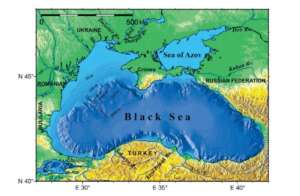
Black Sea morphology, the figures marked with m denote water depth in metres.
Source: Popescu, I. et al.: Submarine canyons of the Black Sea basin with a focus on the Danube Canyon (2015).
During a panel discussion at the February Black Sea Energy Week, Oana Ijdelea, Member of the Board at Black Sea Oil & Gas, argued that the current framework for offshore wind development remains insufficient. She noted that it lacks a reliable financial model and prevents investors from carrying out essential preliminary work and studies. She also highlighted a significant discrepancy in energy projections, suggesting that Romania’s realistic potential may only range between 10 and 15 GW, rather than the frequently cited 76 GW.
Despite these setbacks, she maintained that preparations can still be made, for example, by selecting partners with the necessary expertise and aligning funding from the national recovery plan to correct past errors. Ultimately, the expert argued that for any project to be viable, it must have a capacity of at least one gigawatt to manage the high costs and logistical challenges associated with offshore wind energy.
The principle of economies of scale is in this context. Larger projects significantly reduce unit costs, particularly high fixed expenses such as subsea infrastructure, specialised vessels, grid connections and similar unavoidable costs, by spreading them over a greater volume of energy production.
Although no offshore wind farms are likely to be commissioned before 2032, ambitious targets still exist in the country. “We have a firm objective to install 3,000 megawatts (MW) of offshore wind capacity by 2035,” stated Sebastian Burduja, then Minister of Energy, in 2025.