
![USA - Immigration Stock per Country in 2024 [OC]](https://www.byteseu.com/wp-content/uploads/2026/02/1iqhdvg7nojg1-1024x578.png "USA – Immigration Stock per Country in 2024 [OC]")
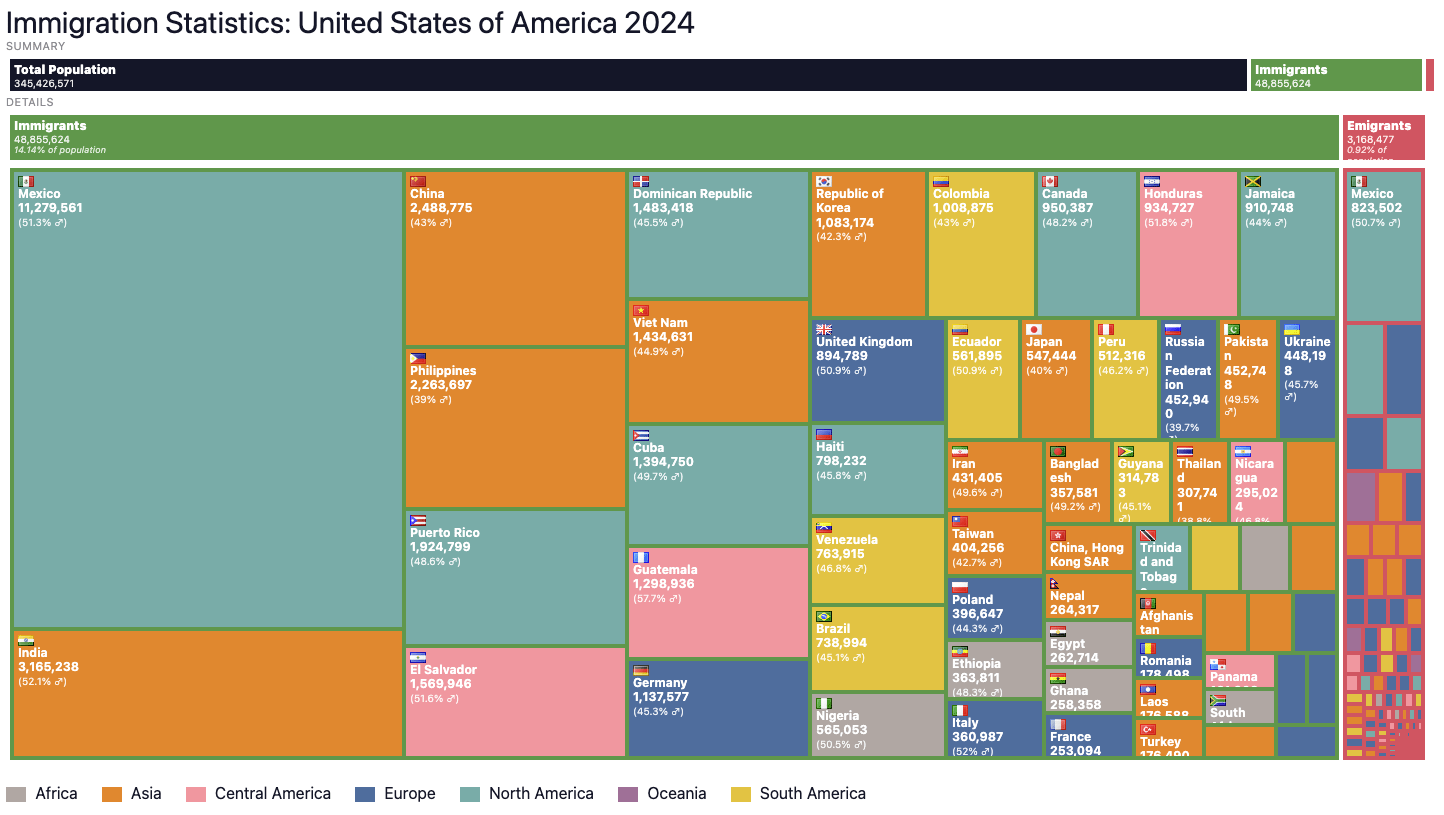
Data Source: United Nations Department of Economic and Social Affairs (UN DESA), International Migrant Stock (2024).
Figures represent the migrant stock (the total number of migrants residing in a country at a specific point in time) rather than annual migration flows.
Per UN statistical standards, residents of Puerto Rico, Guam, and American Samoa are classified separately from the U.S. mainland. While these individuals hold U.S. citizenship, the dataset focuses on geographic movement between distinct regions rather than legal nationality.
Built with D3.js and Django. You can see the full dataset and historical changes at: https://www.populationpyramid.net/immigration-statistics/en/united-states-of-america/2024/
Posted by madewulf
8 Comments
what do the percentaages mean
It can be interesting to compare with other countries like China, where immigration and emigrations are way less common:
https://preview.redd.it/he7iloe5pojg1.png?width=2216&format=png&auto=webp&s=3ba09d77b7d2e9f5544c824e8ebff959f5bb5f7b
The emigrants part is basically useless since we can’t see anything besides Mexico.
You could also fit more data if you used bars (starting left to right). you will miss the “how big it is compared to the entire cake” but nothing else since it’s hard to see the differences in the smaller countries anyway.
Also I’m sure some other indication could be used to show males vs females, this percentage as someone else said is unexplained in the graph or your text.
The male/female percentages are quite interesting. You can see how Ukraine and Russia have less males coming over.
For some feedback OP, the bottom right section near Romania all have their numbers cut off. It would be better to just not show them like you do for other squares which are too small.
Why is Puerto Rico on the graphic? Moving from PR to mainland US is no more difficult than going from Hawaii to mainland.
So, according to this, Puerto Rico are IMMIGRANTS???
Puerto Ricans are American citizens.
This is fake information.
It’d be interesting to compare these numbers to the origin countries’ populations. For instance, the number of Salvadorans in the U.S. is equivalent to about 1/4 of the population of El Salvador. That number is going to be a lot smaller with, say, India or China
Cool data viz OP, I can’t believe people can’t even bother reading your explanation about Puerto Rico.