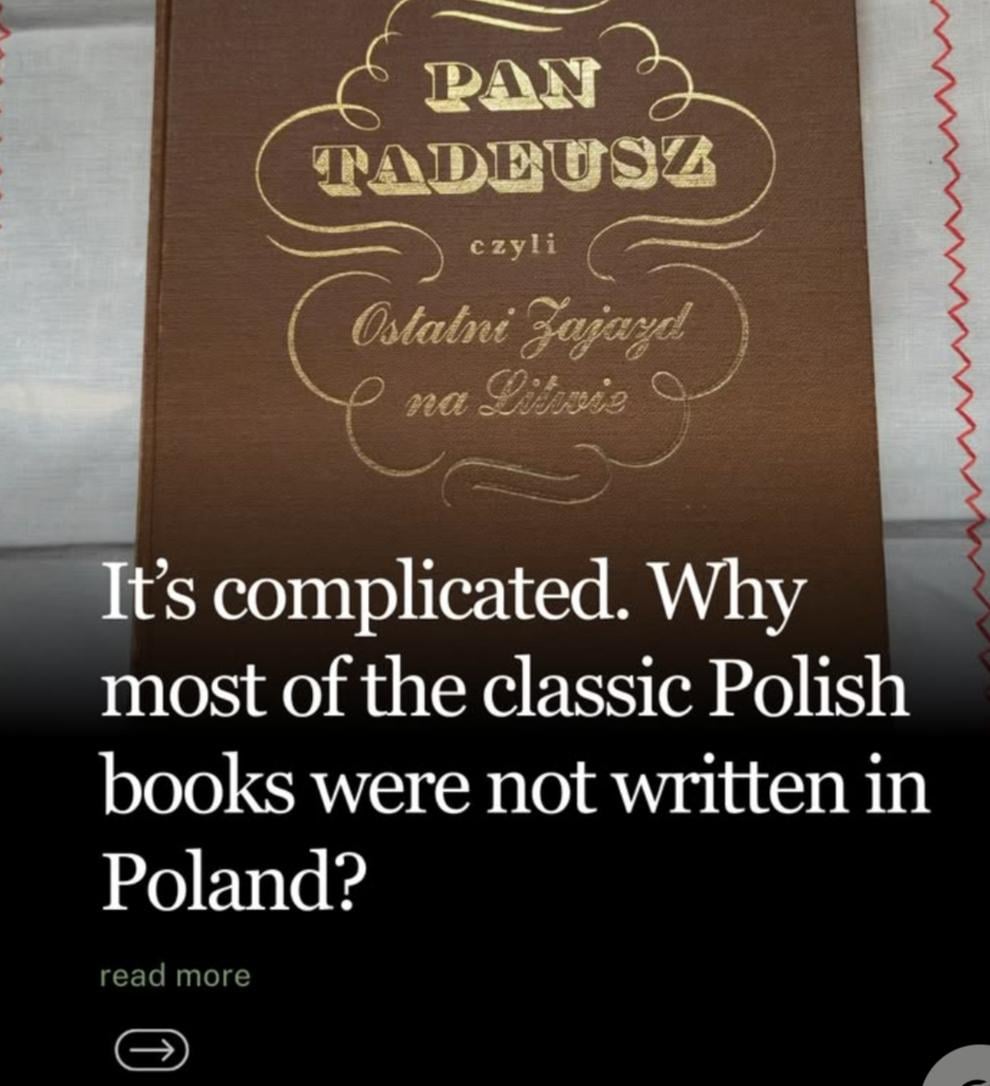
>The Stepy Akermańskie by Mickiewicz that we read at school were actually written in the now-famous Crimea area of modern-day Ukraine
Wait, really? A poem about travelling through the steppes of Crimea was written in Crimea?
Hilarious article.
Zdzisiu on
It’s truly a mystery.
Crab2406 on
well duh cuz Mickiewicz is belarussian /s
firemark_pl on
And the first line of the book is “Lithuania, my homeland!”. Today is Belarus.
WineTerminator on
You wouldnt get it
Cocoatrice on
It’s not really that complicated. It’s simply related to history. Especially when Poland had many allies and we actually mattered on the map.
cyrkielNT on
Almost as big mystery as why America’s Declaration of Independence is written in English rather than Americanish
EggLess4292 on
Yea, big mystery
edijo on
It is the conflict between what really is Polish tradition and culture and what was forcefully defined as “Polish” during occupation of the country in the 19th century. Similar problems are with definitions of other “nationalities”, too – but it is the most visible for countries which were under occupation during the 19th century.
“State nations” or “national states” are a relatively recent concept – first emerged during the French Revolution (had to replace the monarch) and then used to creation of the unified German state (too many monarchs…). For most of the European history the continent was divided between monarchies, which were defined only by the allegiance to its monarch. Usually were treated as simply owned by the monarch – parts could be sold, received, borrowed etc. … including all the population.
There is zero sense of talking about “Poland”, “Germany”, “Russia”, etc. in the context of times earlier than 16th-17th century, unfortunately we all have been hammered at schools with “national history” courses which, despite often contradicting each other, made us hesitant to abandon all the 19th century nationalistic mythology. Government-sponsored 19th-century “ethnographers” defined “ethnicities” according to who was paying for the “research”, and those are our “historical sources” today.
Every war or even threat of an armed conflict increased nationalism and created new mythology. Each “national” government guards its own version of history and considers any questioning it as an existential threat to the state. Some nationalisms were aggressive (Russian, German are prime examples in Europe), some were created as a defense – like most of the Central European ones. That’s why the definition of what is “Polish” is so narrow and so unfitting to the real history of the people and the region.
niccolololo on
LOVE IT
Rahm_Kota_156 on
Very simple : modern day borders
It’s not a remotely notable that countries change and shift borders and share culture in weird relation to geography
5thhorseman_ on
> > not written in modern-day Poland.
> > 19th century Poland
That tells me all I need to know: the author has no fucking clue about Polish history, or he’d know that “19th century Poland” is an oxymoron.

13 Comments
https://allslavic.pl/2026/01/22/its-complicated-why-most-of-the-classic-polish-books-were-not-written-in-poland/
How is “Hej sokoły” a patriotic song?
>The Stepy Akermańskie by Mickiewicz that we read at school were actually written in the now-famous Crimea area of modern-day Ukraine
Wait, really? A poem about travelling through the steppes of Crimea was written in Crimea?
Hilarious article.
It’s truly a mystery.
well duh cuz Mickiewicz is belarussian /s
And the first line of the book is “Lithuania, my homeland!”. Today is Belarus.
You wouldnt get it
It’s not really that complicated. It’s simply related to history. Especially when Poland had many allies and we actually mattered on the map.
Almost as big mystery as why America’s Declaration of Independence is written in English rather than Americanish
Yea, big mystery
It is the conflict between what really is Polish tradition and culture and what was forcefully defined as “Polish” during occupation of the country in the 19th century. Similar problems are with definitions of other “nationalities”, too – but it is the most visible for countries which were under occupation during the 19th century.
“State nations” or “national states” are a relatively recent concept – first emerged during the French Revolution (had to replace the monarch) and then used to creation of the unified German state (too many monarchs…). For most of the European history the continent was divided between monarchies, which were defined only by the allegiance to its monarch. Usually were treated as simply owned by the monarch – parts could be sold, received, borrowed etc. … including all the population.
There is zero sense of talking about “Poland”, “Germany”, “Russia”, etc. in the context of times earlier than 16th-17th century, unfortunately we all have been hammered at schools with “national history” courses which, despite often contradicting each other, made us hesitant to abandon all the 19th century nationalistic mythology. Government-sponsored 19th-century “ethnographers” defined “ethnicities” according to who was paying for the “research”, and those are our “historical sources” today.
Every war or even threat of an armed conflict increased nationalism and created new mythology. Each “national” government guards its own version of history and considers any questioning it as an existential threat to the state. Some nationalisms were aggressive (Russian, German are prime examples in Europe), some were created as a defense – like most of the Central European ones. That’s why the definition of what is “Polish” is so narrow and so unfitting to the real history of the people and the region.
LOVE IT
Very simple : modern day borders
It’s not a remotely notable that countries change and shift borders and share culture in weird relation to geography
> > not written in modern-day Poland.
> > 19th century Poland
That tells me all I need to know: the author has no fucking clue about Polish history, or he’d know that “19th century Poland” is an oxymoron.