2 out of 3 squares in the grid are in Spain. It doesn’t include Turkey.
CatL1f3 on
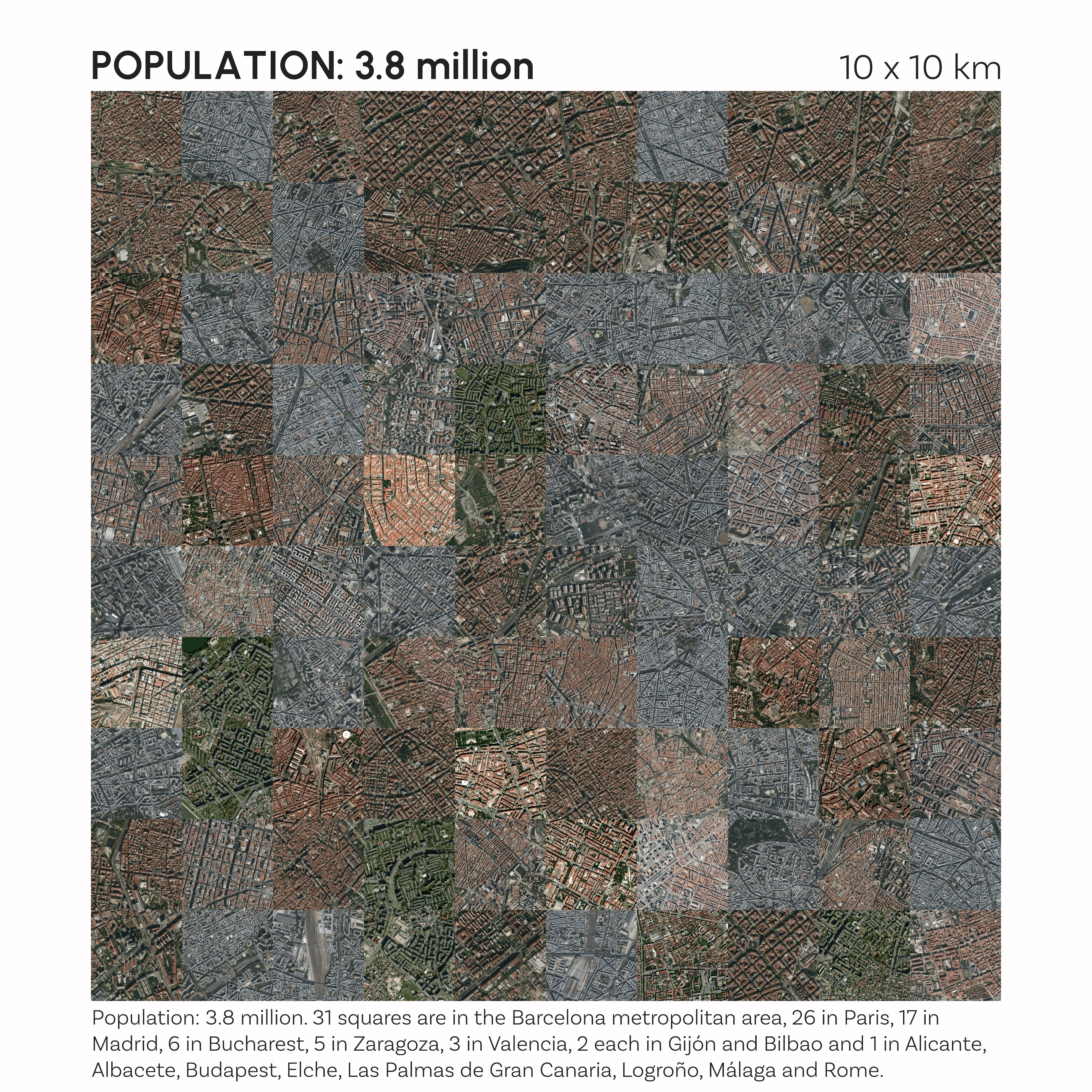
Funny how you can tell apart the cities by colour sometimes: Paris has a distinctive grey, Bucharest has green, Barcelona is full of those squares, and most of the rest are non-descript orange-grey
Xcalipurr on
TIL London is not in Europe
sajukktheeternal on
Seriously? Haven’t these guys ever been to Athens? I mean, what the f*ck
Possible-Wallaby-877 on
Las Palmas Gran Canaria? Really? That’s so strange. I would think a few other cities before that one
James-the-Bond-one on
Spain is overrepresented: 66 out of 100 squares.
Pedro likes to keep his neighbors close.
u1604 on
*in EU
Edit: For those who are curious, many balkan countries as well as the european parts of russia & turkey are excluded. still cool visualization.
youtossershad1job2do on
2 in Gijon is surprising, I have family there and I’ve never thought of it super dense
dkrandu on
Hey I found my flat on here! 🙂
orthoxerox on
It’s interesting that medium-rise housing like this is actually higher density than commieblocks.
Kalagorinor on
As a Spanish myself, I really like how dense Barcelona and Madrid are. It makes the streets much more lively and also enables very dense public transportation networks.
LDlOyZiq on
Are those parts of Bucharest nice to live in? They intrigue me, looking at them on google earth.
LordLuz on
I am pretty sure that any 1×1 square in İstanbul/Esenyurt will double these numbers.
NoRecipe3350 on
Spain is an outlier by European standards in that it’s population density as a whole is quite low but has ultra dense urban cores.
something to do with land ownership and rural-urban migration I think?
British towns and cities have really big suburbs, not American levels, but not far off. In fact until about the 2000s, a lot of British city centres were basically dead, almost no one lived in them. Brits want to live in ‘semi detatched’ houses as an aspiration.
LorpHagriff on
Kindof interesting how we’re the densest non-microstate (Netherlands) population wise but have no tiles contributing. But also makes a lot of sense from what I’ve seen travelling
^(*our housing method miiight play a role in our massive housing shortage who knows*)

15 Comments
Source: https://x.com/undertheraedar/status/1821104368315138498
2 out of 3 squares in the grid are in Spain. It doesn’t include Turkey.
Funny how you can tell apart the cities by colour sometimes: Paris has a distinctive grey, Bucharest has green, Barcelona is full of those squares, and most of the rest are non-descript orange-grey
TIL London is not in Europe
Seriously? Haven’t these guys ever been to Athens? I mean, what the f*ck
Las Palmas Gran Canaria? Really? That’s so strange. I would think a few other cities before that one
Spain is overrepresented: 66 out of 100 squares.
Pedro likes to keep his neighbors close.
*in EU
Edit: For those who are curious, many balkan countries as well as the european parts of russia & turkey are excluded. still cool visualization.
2 in Gijon is surprising, I have family there and I’ve never thought of it super dense
Hey I found my flat on here! 🙂
It’s interesting that medium-rise housing like this is actually higher density than commieblocks.
As a Spanish myself, I really like how dense Barcelona and Madrid are. It makes the streets much more lively and also enables very dense public transportation networks.
Are those parts of Bucharest nice to live in? They intrigue me, looking at them on google earth.
I am pretty sure that any 1×1 square in İstanbul/Esenyurt will double these numbers.
Spain is an outlier by European standards in that it’s population density as a whole is quite low but has ultra dense urban cores.
something to do with land ownership and rural-urban migration I think?
British towns and cities have really big suburbs, not American levels, but not far off. In fact until about the 2000s, a lot of British city centres were basically dead, almost no one lived in them. Brits want to live in ‘semi detatched’ houses as an aspiration.
Kindof interesting how we’re the densest non-microstate (Netherlands) population wise but have no tiles contributing. But also makes a lot of sense from what I’ve seen travelling
^(*our housing method miiight play a role in our massive housing shortage who knows*)