
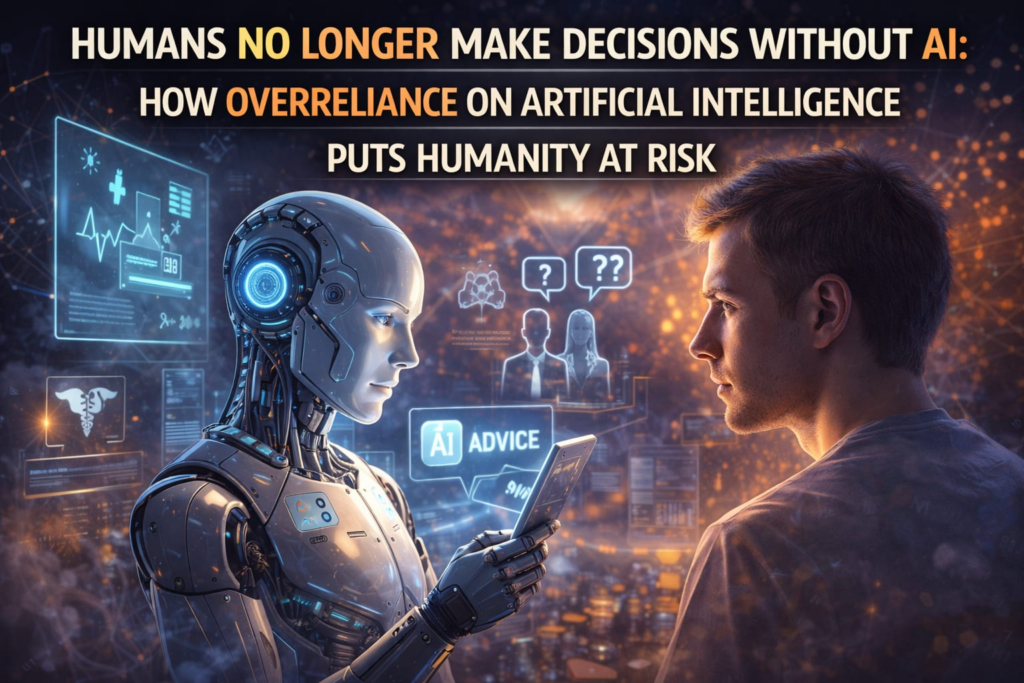
Artificial Intelligence is no longer just a futuristic concept — it is embedded in our daily lives. From recommending what we watch on streaming platforms to filtering emails and guiding GPS routes, AI has quietly transitioned from convenience to influence. But something deeper is happening. Increasingly, people are not just using AI — they are relying on AI to make decisions for them.
Career uncertainty? Ask AI.
Relationship doubts? Ask AI.
Financial planning? Medical concerns? Ethical dilemmas? Ask AI.
What once required reflection, discussion, and personal responsibility can now be summarized in seconds by an algorithm. And while this may seem efficient, it raises a critical question:
What happens when humans stop making decisions for themselves?
________________________________________
AI Is No Longer Just a Tool — It Has Become an Authority
In previous generations, guidance came from parents, teachers, doctors, mentors, or spiritual leaders. Advice required conversation. Context mattered. Trust developed through shared human experience.
Today, AI delivers answers instantly — structured, confident, and seemingly objective. That confidence is powerful. Humans are wired to trust clarity and authority. When an AI response appears logical and well-organized, it feels reliable.
But there is a subtle shift occurring:
• Tools assist decision-making.
• Authorities influence decision-making.
As AI grows more sophisticated, it moves from assistant to advisor — and sometimes from advisor to silent authority. The more often people consult AI for guidance, the more natural it becomes to defer to it.
Over time, independent judgment can quietly erode.
________________________________________
The Illusion of Objectivity in Artificial Intelligence
One of the strongest reasons people trust AI is the belief that it is neutral. Machines don’t have emotions, egos, or personal agendas — at least, that’s the assumption.
In reality, AI systems are trained on massive amounts of human-generated data. They reflect human language, human values, human patterns — and human biases. Every dataset has blind spots. Every algorithm is built with assumptions.
Bias doesn’t disappear when it becomes automated. It simply becomes less visible.
Because AI presents answers in a calm, rational tone, its outputs can feel more objective than human advice. But neutrality in presentation does not equal neutrality in origin.
The danger is not that AI intends harm. The danger is that people assume it cannot be wrong.
________________________________________
Decision Fatigue and the Temptation to Outsource Thinking
Modern life is mentally exhausting. Endless notifications, career pressure, financial uncertainty, social comparison, and information overload create constant cognitive strain.
Decision fatigue is real.
When faced with dozens of daily choices — big and small — it becomes tempting to delegate. AI offers relief. It can summarize options, weigh pros and cons, and generate recommendations instantly.
Convenience feels like progress.
But decision-making is not just a task — it is a skill.
Like any skill, it weakens when unused.
If people increasingly rely on AI to make choices, they may gradually lose confidence in their own reasoning. This creates a feedback loop:
1. Humans feel uncertain.
2. AI provides answers.
3. Humans grow more dependent.
4. Independent thinking declines.
This is not technological evolution. It is cognitive atrophy.
________________________________________
When AI Gets It Wrong — and People Follow Anyway
AI systems do not experience life. They do not feel fear, love, grief, or moral conflict. They analyze patterns and generate responses based on probability.
Yet many users apply AI advice to deeply personal situations:
• Mental health struggles
• Medical symptoms
• Legal conflicts
• Financial risks
• Ethical dilemmas
The risk is not merely incorrect information — it is misplaced confidence.
If an AI delivers an answer clearly and persuasively, users may accept it without verification, especially if the answer confirms what they already want to believe. This confirmation bias, amplified by AI, can be dangerous.
In high-stakes scenarios, blind trust in artificial intelligence could lead to delayed medical treatment, financial losses, broken relationships, or poor legal decisions.
And when consequences arise, accountability becomes blurred.
“It wasn’t my decision — the AI recommended it.”
Responsibility diffuses. Ownership weakens.
________________________________________
The Most Dangerous Shift: Outsourcing Morality
Perhaps the most concerning development is the use of AI for moral validation.
People increasingly ask:
• “Is this wrong?”
• “Am I justified?”
• “Should I feel guilty?”
Moral reasoning is deeply human. It requires empathy, cultural awareness, lived experience, and personal responsibility. It involves wrestling with uncertainty.
AI can summarize ethical theories. It can explain philosophical frameworks. But it cannot own consequences. It cannot feel remorse. It cannot grow from regret.
If future generations begin consulting AI as a moral compass, humanity risks transforming ethics into procedure rather than principle.
Growth often comes from internal conflict — from sitting with doubt, reflecting, and choosing anyway. If that struggle disappears, something fundamentally human disappears with it.
________________________________________
Who Controls the Algorithms Controls Influence
Artificial Intelligence systems are not neutral forces of nature. They are built by corporations, governments, and institutions. These entities operate with incentives, goals, and power structures.
If large populations rely on AI for guidance, those who design and train algorithms gain indirect influence over human behavior at scale.
Subtle nudges matter.
A recommendation framed a certain way.
A priority ranked slightly higher.
A perspective emphasized more frequently.
Multiply that across millions — even billions — of users, and societal norms can shift quietly.
Political attitudes. Consumer behavior. Cultural values.
The influence does not need to be dramatic to be powerful.
Behavioral shaping through algorithmic design is not science fiction — it is already happening in recommendation systems, social feeds, and search engines.
The question is not whether AI influences us. It is how much we are willing to let it.
________________________________________
The Risk of Losing Our Humanity
Not all decisions are meant to be optimized.
Love is not a formula.
Creativity is not an efficiency metric.
Courage cannot be calculated.
Forgiveness is rarely logical.
Human life is filled with ambiguity. Mistakes teach wisdom. Regret shapes character. Uncertainty builds resilience.
If AI becomes the default decision-maker, society may prioritize optimization over meaning. Faster outcomes over deeper experiences. Safer choices over courageous risks.
A world guided entirely by efficiency may be more predictable — but also less vibrant.
The very qualities that make us human — emotion, intuition, vulnerability — are not algorithmic strengths.
They are human strengths.
________________________________________
This Is Not a Call to Reject AI
Artificial Intelligence is not inherently dangerous. In many ways, it is one of humanity’s greatest technological achievements. It can analyze medical data faster than doctors, identify patterns humans might miss, and democratize access to knowledge worldwide.
Used responsibly, AI can enhance human intelligence.
The problem arises when it replaces human judgment instead of supporting it.
AI should be:
• A map, not a compass.
• A calculator, not a conscience.
• A guide, not a governor.
The responsibility remains ours.
________________________________________
The Future Depends on Human Agency
The greatest risk AI poses to humanity is not domination by machines — it is voluntary dependence.
Not a sudden takeover, but a gradual surrender of agency.
If humans continue to question, reflect, and take responsibility for their decisions, AI can remain a powerful ally. But if convenience consistently overrides critical thinking, we risk becoming passive participants in our own lives.
Technology should extend human intelligence — not replace it.
We possess emotions that algorithms cannot feel. We experience consequences that machines cannot endure. We grow from mistakes in ways AI never will.
That is what makes us human.
The most dangerous decision humanity could make may not be one dictated by artificial intelligence.
It may be the decision to stop deciding for ourselves.