

Andrew Schneider/Houston Public Media
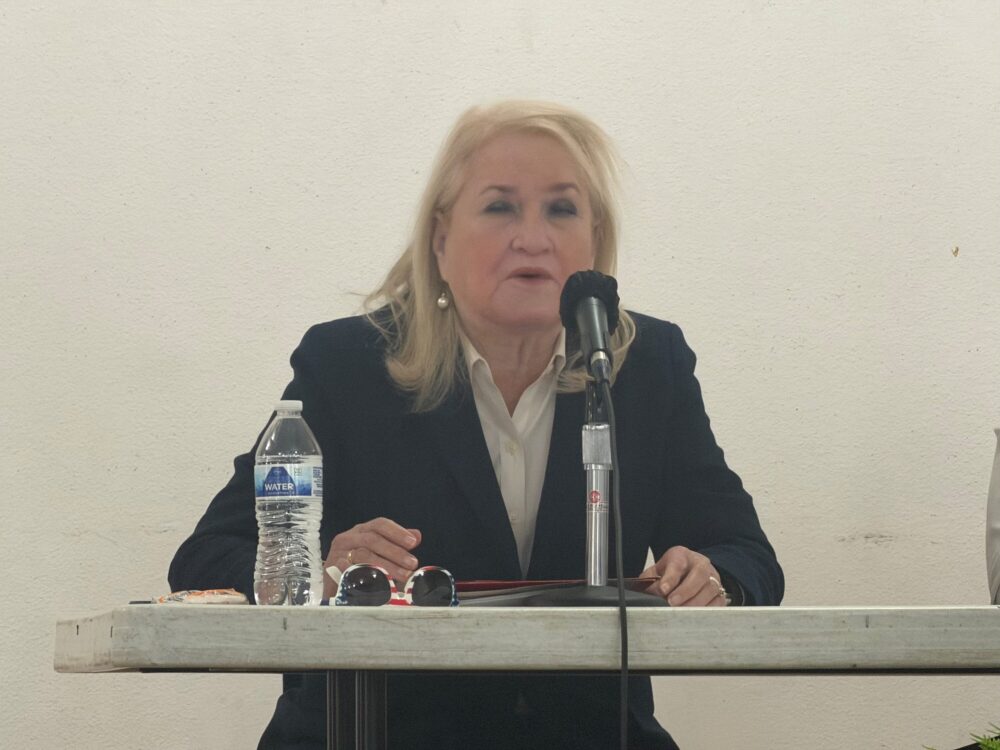
Congresswoman Sylvia Garcia (D-29), Jan. 31, 2026.
When Republican state lawmakers redrew Texas’ congressional map last year, Congresswoman Sylvia Garcia was one of their top targets. Her 29th Congressional District was redrawn in a fashion that raised the real prospect that Houston’s only Latina U.S. representative could be defeated in next month’s Democratic primary.
But despite the redistricting, Garcia may be poised to fend off the threat.
On the last day of January, residents of the redrawn 29th Congressional District packed into the Greater Zion Missionary Baptist Church in Houston’s Acres Homes. All three candidates running in the Democratic primary took the stage. Congresswoman Garcia, the incumbent, spoke to the prospective voters about her record for accountability.
“You know, we’ve answered over 53,000 phone inquiries in just this year,” Garcia said. “We’ve had dozens of town hall meetings … about issues, about policies, and it doesn’t mean that I’m in my office and they come to me. I go where they are.”
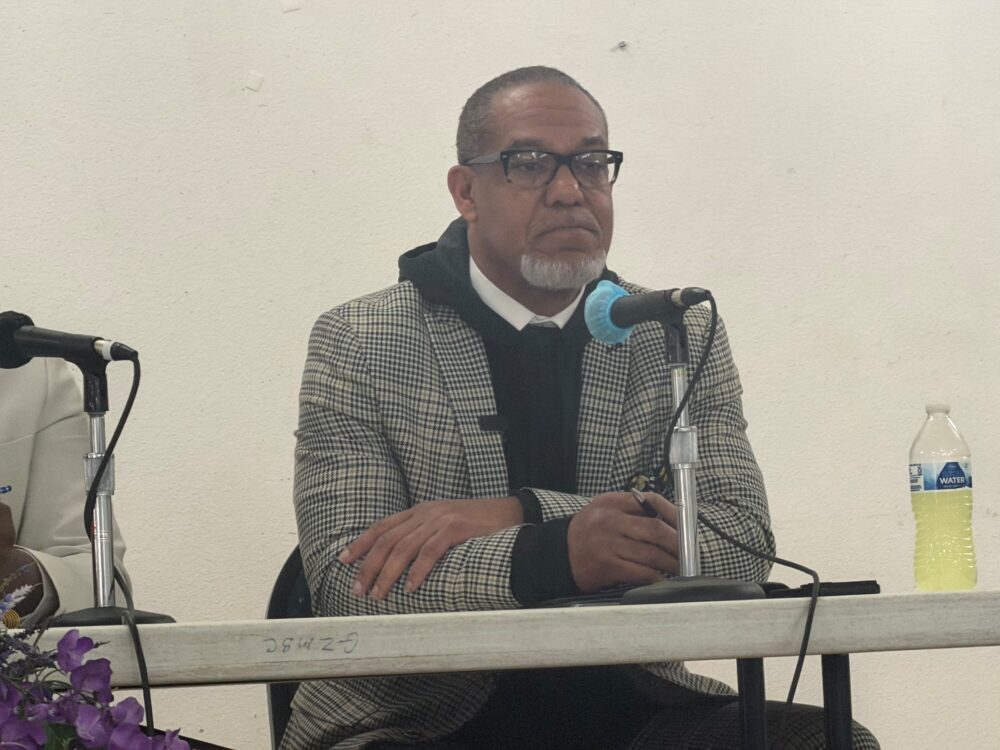
Jarvis Johnson — a former Houston City Council member, former state representative, and unsuccessful state Senate candidate — was perhaps better known to the north Houston audience. As evidence, Johnson’s was the only name on campaign posters just outside the church grounds.
“I know this community. I grew up in this community. I got married in this community. My children were raised in this community. And I got divorced while living in this community. But I still live in this community,” Johnson said, to some laughs from the audience. “My children still live in this community, and my ex-wife, who happens to be my best friend, still lives in this community and is doing a wonderful job as a state representative.”
The third candidate, restaurant owner Robert Slater, came to the new district after running unsuccessfully against the late Sheila Jackson Lee in the 18th Congressional District in the 2024 Democratic primary election. Slater, who has a criminal record, confronted his past head-on.
“One in three Black men have a criminal record … I was a statistic, and I lived through that, but then I became a success story,” Slater said. “I’m running because I have a responsibility, because of where I came from, and I want to teach so many other people to prevent them from going down that same route.”

Andrew Schneider/Houston Public Media
Robert Slater, Jan. 31, 2026
Differences in policy and experience
The three candidates sounded similar themes on the importance of addressing affordability, health care, economic inequality, flood control, environmental justice — notably related to the region’s cancer clusters and proliferating landfills — and the need for infrastructure investment.
“I used to tease Sylvester Turner when he was mayor, that, when I was city controller, my job was to watch the money,” Garcia said. “But as a member of Congress, my job is to bring home the money, and we’ve succeeded in bringing home money — not only to the city of Houston, the Flood Control district, the Port, Metro — to make sure that they can get things done. The key, however, is to making sure that they do invest in all communities, and that it doesn’t just stay downtown or the other side of town, but that it’s everywhere.”
Johnson focused on housing and financial infrastructure, speaking repeatedly about one of his signature accomplishments in the state Legislature: strengthening the Houston Land Bank to make housing more affordable in the region.
“As long as we have good infrastructure, we understand good housing will be able to come,” Johnson said. “When good housing comes, we understand businesses follow rooftops. When businesses come, then we understand that businesses are available for our young people to have jobs, and when our young people have employment, they are less likely to be involved in criminal activity,” Johnson said.
Andrew Schneider/Houston Public Media
Former state Rep. Jarvis Johnson, Jan. 31, 2026.
However, the candidates didn’t agree on everything.
Slater, and to a lesser extent Johnson, were sharply critical of U.S. support of Israel and said they would not accept campaign funding from the American Israel Public Affairs Committee — better known by its acronym, AIPAC. Garcia demurred when asked a similar question, saying she had accepted donations from AIPAC in the past but had not received any in the current cycle.
Another area where the candidates disagreed was on term limits. Garcia said she thought the best form of term limits was the power of the vote. Johnson, by contrast, said, if elected, he would serve at most ten years before handing off the baton to the next generation. Slater went further, favoring a limit of three terms for House members. In that vein, he tried to cast Garcia’s and Johnson’s greater experience as liabilities, rather than strengths.
“We’ve seen this show before,” Slater said. “I get the experience, and I respect my colleagues and their experience, but what have that experience gotten us?”
Garcia stood on the record she has compiled — as Houston city controller, Harris County commissioner, state senator, and four-term member of Congress.
In the past year alone, Garcia told Houston Public Media, “We were able to get federal dollars through community-based funding for many of our nonprofits, and those are like the smaller grants. It’s not the $20 or $30 million that you get for a road project or for the port or for more, but Metro buses, which we did do. It’s about, you know, the $1 million that makes a difference to … a clinic, to be able to start a new project or to build a new clinic in your area. Those are the ones that I’m proud of, and those you get based on your seniority and your relationships, and it is harder for a first-time member of Congress to secure.”
That seniority has brought Garcia added responsibilities. As a chief deputy whip, she played a key role in gathering Democratic support to force a vote extending health care subsidies under the Affordable Care Act. She was also a House impeachment manager during President Trump’s first impeachment trial in 2020.
“I think we convinced America — we just didn’t convince the senators — that this man was a danger to our democracy,” Garcia said. “And my biggest concern is that we have a democracy in place so that our children and our grandchildren can enjoy a democracy, and that they will not be left behind with a king or a dictator, because Donald Trump put us in that position.”
The redrawn Texas 29th Congressional District
If Texas’ 29th Congressional District bore any resemblance to the one that had elected Garcia four times since 2018, it’s unlikely any serious candidate would have tried to challenge her in this year’s Democratic primary. The old 29th stretched across eastern Houston and Harris County, with an overwhelmingly Latino population. But when Republican state lawmakers redrew the state’s congressional map last year, the 29th became a textbook example of what’s known as “cracking and packing“.
“They did a really good job of totally dismantling 29,” Garcia said. “They cut it up into four pieces and removed probably all of the identifiable Latino areas, neighborhoods from this district… And then, 18 got split up, and I got 70% that was taken from there and sent to my district.”
Much of the old 29th’s Latino population was “cracked” and grouped in with the new 9th District, where Democrats’ voting strength could be diluted by grouping them with conservative Liberty County. Garcia’s own home was just barely drawn into the 29th — she suspects, to keep her from running in the 9th, where she would have made a formidable challenger to any GOP nominee.
Meanwhile, Black voters from the old 18th were “packed” into the new 29th, which is concentrated on Houston’s north side. The new 29th could have been tailor-made for a Johnson primary challenge.
“It overlaps with his former state legislative seat and also the senatorial seat that he made a very strong run [for] in that particular race,” said Michael Adams, a political scientist at Texas Southern University.
But a new survey from the University of Houston’s Hobby School of Public Affairs suggests the Democratic primary isn’t working out as Republicans intended. Instead, 46% of likely primary voters in the new 29th say they plan to vote for Garcia. That’s compared to 27% who back Johnson and just 2% for Slater.
“While Black voters do represent the largest voting bloc in the Democratic primary in CD 29, there, Jarvis Johnson has an advantage, but it’s not an overwhelming advantage,” said Mark Jones, a political science fellow at Rice University’s Baker Institute, who coauthored the survey. “It’s about 20 points, which is strong, but it doesn’t come close to making up for Garcia’s overwhelming advantage among Latino and white voters.
Political consultant Marc Campos said he thinks Garcia is a lock to win renomination. He noted Garcia has an edge over her opponents in an area that traditionally has a low voter turnout.
“Democrats don’t spend a whole lot of time, you know, knocking on doors out there. Whoever can mobilize the ground game in those areas to take out voters … will have the advantage,” Campos said. “Right now, I think, Sylvia is the only one that has the resources to do that.”
According to the Federal Election Commission, Garcia has close to $390,000 in cash on hand. That’s more than twice as much as both her primary opponents combined.
A quarter of likely Democratic primary voters remain undecided. But whoever wins the Democratic primary is heavily favored to win the general election against the sole Republican candidate, Martha Fierro, in the fall. Even redrawn, the 29th remains solidly blue.
Garcia said one thing didn’t change in the 29th, regardless of its new boundaries and demographics. Residents are struggling to make ends meet.
“There’s no greater issue that brings people together in common, because we’re all suffering,” Garcia said. “It is the pain and the price of the groceries, gas, you know, your light bill, and I understand even water bills are getting high in some parts of the area [in] this district that have private water supply companies. So, when it comes to affordability, that hits everybody.”