
Most nuclear energy is thermal. All that complex nuclear physics and chemistry serve merely to create steam that spins a turbine, the same as any combustion-based power plant does. But what if you could convert the energy of radioactive decay into electricity directly, via charge separation in a semiconductor?
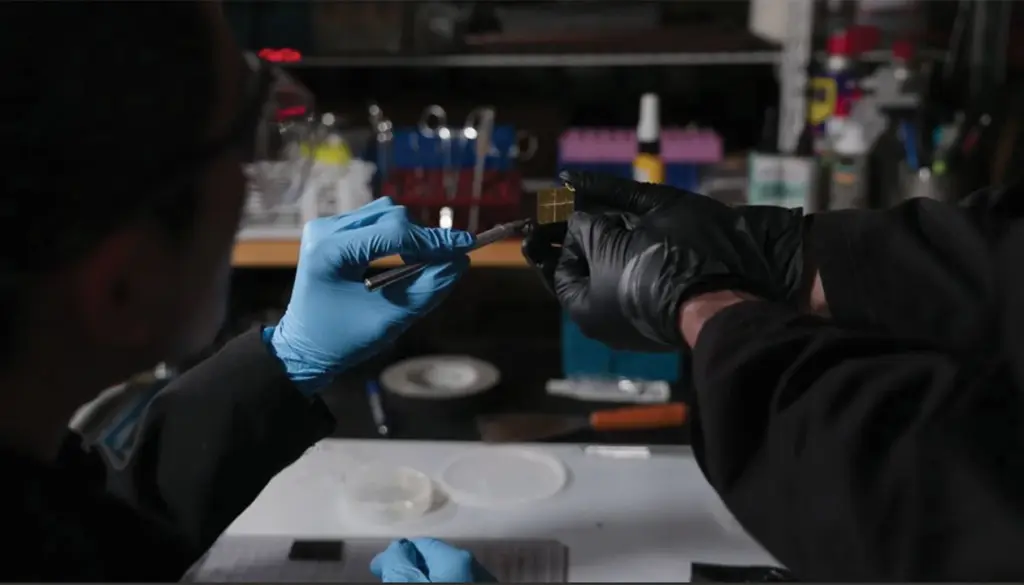
That’s the concept the nuclear chemistry start-up Project Omega is looking to commercialize. The firm, which has raised $12 million in seed funding from venture capital groups, recently came out of stealth with a working prototype of its first product, a small battery running on strontium-90 decay that could power microprocessors in remote locations for years on end, according to serial chemistry entrepreneur Staff Sheehan, who cofounded the firm with tech executive Nadav Shoval..
The technology uses the same basic idea as solar photovoltaic cells, but with electrons from radiation instead of photons from the sun. The battery exploits a phenomenon known as betavoltaics, in which a semiconductor absorbs high-energy electrons, called β particles, that are ejected from decaying atomic nuclei. Energy from the β particles excites electrons in the semiconductor’s valence band into its conduction band, where a voltage can then carry the electrons off through a circuit to do useful work.
A few other start-ups are working on betavoltaics. Betavolt has a battery that embeds nickel-63 in a diamond semiconductor, Arkenlight uses carbon-14 and tritium in diamond, and City Labs uses tritium alone in an undisclosed semiconductor.
Several large white cylinders sit vertically on a concrete slab. In the background, a machine unloads a new one.

Nuclear waste is stored in cement casks at controlled facilities.
Credit:
Nuclear Regulatory Commission
Project Omega picked 90Sr because it has a way to get the isotope from nuclear waste. The firm is also developing a separation process that uses molten salts to recycle fissionable uranium from spent nuclear fuel; 90Sr is a by-product. Sheehan expects the firm’s 90Sr battery business to be profitable soon. It will generate cash flow that the firm can use to scale up its process for nuclear-fuel recycling, which is a higher-volume but lower-margin market, he says.
The business model is similar to that of Sheehan’s previous start-up, Air Company, which started by making vodka and perfume base from carbon dioxide and hydrogen as a stepping stone to the much larger jet fuel market.
Academics have studied betavoltaics since the 1950s, and the batteries have seen limited use in pacemakers and spacefaring devices. But Sheehan says the boom in US semiconductor manufacturing and the renewed interest in nuclear power together create a “perfect storm” for the pair of technologies.
Basing a business on nuclear-waste recycling will be difficult, cautions Marta Pazos, an independent consultant who works on government energy and chemical procurement. It’s usually cheaper to make nuclear fuel from ore than by recycling, she says. Moreover, the price of uranium is a relatively small part of the cost of running a nuclear reactor, meaning power plant operators have little incentive to adopt a new supply chain for it.
“Show me some life cycle analysis,” she says. “How worth it is it to reuse the waste versus to get virgin material?”
Any nuclear-fuel recycling done at scale will have to contend with the complicated logistics of nuclear waste. “How do you plan to manage transportation of this waste? Because we already know that’s not an easy task,” Pazos says. A facility will also need to get through a tangle of federal, state, and local permitting before it can store and handle radioactive materials, she says.
Sheehan says the risks are surmountable. In addition to the seed funding, Project Omega has both funding and research partnerships with the US Department of Energy. “Recycled nuclear fuel can be the foundation of energy independence by delivering decades-long power for military systems and supplying fuel for advanced nuclear reactors,” he says. “We are now building the infrastructure to unleash this energy source.”

Chemical & Engineering News
ISSN 0009-2347
Copyright ©
2026 American Chemical Society