
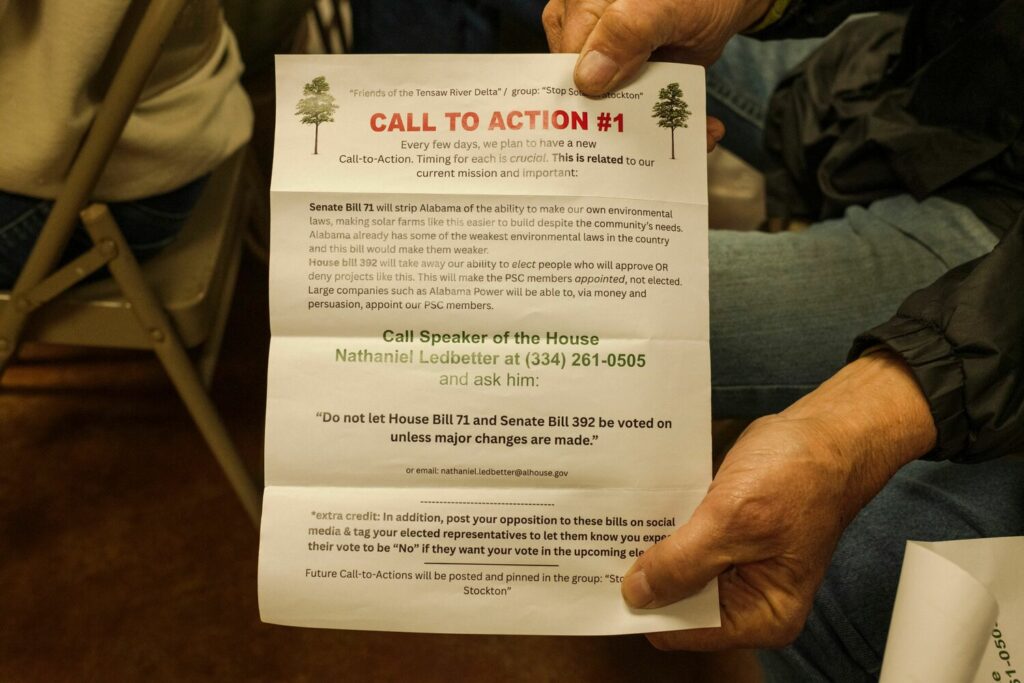
Opposition continues to mount against a planned 4,500-acre solar development near Stockton with elected officials and environmental groups raising concerns over environmental impact, transparency and long-term consequences for Baldwin County.
State Sen. Chris Elliott, R-32, announced his opposition to the project last week, citing threats to wetlands and local waterways tied to the Mobile-Tensaw River Delta.
“I passed legislation to ban mud dumping in Mobile Bay in order to protect the environment that makes Baldwin County such a special place to live, and for that same reason, I oppose the proposed solar energy complex in Stockton,” Elliott said.
He added that the state has sufficient land to host solar development without placing environmentally sensitive areas at risk.
“Alabama has more than 50,000 square miles of land, so there are plenty of other areas outside Baldwin County that could host this project without threatening wetlands that feed our commercial seafood industry and provide jobs to our friends, families and neighbors,” he said.
The project includes two large-scale solar fields planned near the intersection of Interstate 65 and Alabama Highway 59 in rural North Baldwin County. Approved by the Alabama Public Service Commission in December, the developments are tied to Meta Platforms’ Montgomery data center through its subsidiary Dotier LLC. Together, the projects are expected to generate about 260 megawatts of power and are scheduled to be operational by the end of 2028. The land has been acquired by Silicon Ranch, which will construct the facilities and connect them to Alabama Power’s grid.
Environmental organization Mobile Baykeeper also raised concerns following meetings with Silicon Ranch, the developer behind the project, citing a lack of transparency surrounding environmental studies.
In a Facebook post, Baykeeper said the private company does not plan to share written site information with the community in the near future despite requests for wetland delineations, biological reviews and geotechnical reports.
“Baldwin County deserves transparency,” the post states.
Baykeeper said the limited information it has received so far includes assurances that wetlands will not be filled and that biological assessments did not identify gopher tortoises on the site.
The project is located on privately owned land in an unzoned area of Baldwin County, limiting the county commission’s ability to regulate land use. County officials have said they do not have authority to block development in unincorporated, unzoned areas, though permits related to land disturbance, flooding and wetlands are still required under county ordinances.
Regional leaders have also weighed in, including Spanish Fort Mayor Brad Bass, who warned that environmental impacts could extend beyond Stockton and affect surrounding waterways.
Stockton sits 24 miles northeast of Spanish Fort and lies within the Mobile Bay watershed, where changes in drainage and runoff can affect coastal communities downstream.
“While I respect the importance of energy development and economic growth, I have serious concerns about the proposed 4,500-acre solar farm,” Bass said. “Potential downstream environmental impacts to Mobile Bay and the Gulf, drainage changes and long-term unknowns simply cannot be overlooked.”
He emphasized the need for careful review before any construction moves forward.
“Progress should never come at the expense of the natural resources that define our quality of life,” Bass said.
Concerns about Silicon Ranch’s environmental record have also surfaced as opposition grows.
A federal jury in May 2023 awarded a Georgia couple $135.5 million in damages after erosion and sediment runoff from a 1,000-acre solar project developed by the company near Lumpkin, Georgia, destroyed a 21-acre fishing lake and surrounding property, according to previous reporting by FOX 5 Atlanta. The lawsuit said the runoff caused significant erosion and sediment deposition that damaged the property.
Silicon Ranch executives have pushed back on concerns, saying the company views the project as a long-term investment in the community.
“We’re going to be meaningful property owners and taxpayers and active members involved with the county,” The company’s chief commercial officer, Matt Beasley, said. “Once we’re operational, people do love having us as a neighbor. There’s no light, there’s no noise, smell, traffic — we generate tremendous tax revenues that are entirely accretive to the tax base. I know there’s a lot of uncertainty and quite a bit of misinformation out there, but we look forward to continuing the conversation.”
As opposition grows, residents and advocacy groups continue calling for greater transparency and environmental oversight before construction begins.
Gabriella Chavez is a Report for America corps member who writes about growth and development in Baldwin County and our natural spaces for Gulf Coast Media. Your donation to match our RFA grant helps keep her writing stories like this one; please consider making a tax-deductible gift of any amount today by visiting https://tinyurl.com/yaf8yf5n.