
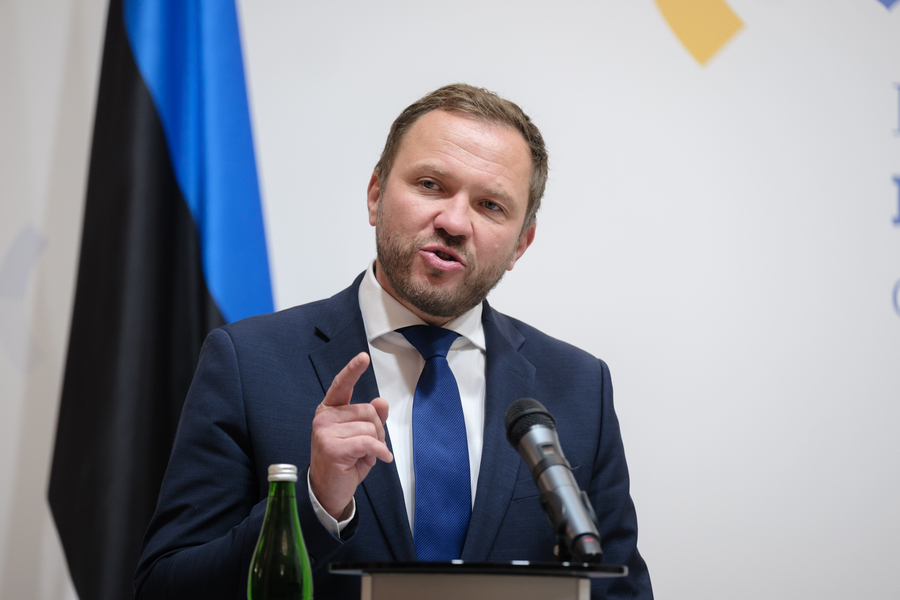
As the outlook of the Russia-Ukraine war remains uncertain, security concerns in the Baltic region continue to rise. The Telegraph reported on Monday, Feb. 16 that Estonia’s foreign minister warned that if Russia dares to invade the three Baltic states, NATO would strike deep into Russian territory. He dismissed concerns that Moscow could quickly seize territory in the eastern region. Meanwhile, a NATO war game led by Germany has provided a dual assessment of Europe’s security situation.
Tough stance: Estonia vows to bring the war into Russia
Estonia’s Foreign Minister Margus Tsahkna told The Telegraph in an exclusive interview that if Russia dares to invade the Baltic countries, NATO would carry out strikes against deep targets within Russia.
He noted that Estonia, Latvia, and Lithuania would first defend themselves, then conduct a “devastating counterattack.” Tsahkna said, “We will take the war into Russian territory and strike deep. We know exactly how to do it.”
To address potential threats, the Baltic states are accelerating military investment and capability building, planning to raise defense spending to 5% of GDP. He criticized the previous approach of “wait for Russia to come in and NATO will eventually win the war,” emphasizing that such a strategy would put Estonia at great risk. “We have no interest in that plan,” he said.
Background anxiety: Russia may test NATO
Defense circles have long feared that after the Ukraine war ends, Russian President Vladimir Putin might carry out partial occupations of the Baltic countries to test NATO’s collective defense commitments.
You are now signed up for our newsletter
Check your email to complete sign up
Previous war games have shown that if Russia invaded Lithuania, it could occupy key areas within days, including the Estonian city of Narva near the Russian border. This scenario has led NATO and European security observers to question their defensive capabilities.
German war game: NATO decision-making shows potential weakness
To address these concerns, Politico and German media outlet Die Welt disclosed details of a war game held on Dec. 1, 2025, at Helmut-Schmidt-University in Hamburg.
The simulation assumed that after Ukraine was forced into a peace agreement, Russian forces would remain after military exercises in Belarus and gather near the Lithuanian border. Fake news and cyberattacks then emerged: a forged video showed German troops in Lithuania mistreating Russian-speaking youth, while widespread cyberattacks disabled ATMs of German savings banks. The Lithuanian government warned that Russian forces might cross the border.
In the simulation, the “Red Team” represented the Russian president, foreign minister, and military leadership, while the “Blue Team” represented the German government and NATO decision-makers. Participants included retired officers, diplomats, and security experts, who tracked each other’s actions via AI-generated news clips and large-screen information, but the teams were isolated and could not communicate directly.
Results showed that the United States might hesitate to invoke NATO’s Article 5 collective defense due to fears of World War III. Germany, although deploying brigade-level forces in Lithuania, failed to effectively stop the Russian advance. The war game highlighted potential NATO vulnerabilities in rapid decision-making and identifying red lines.
Baltic states push back: refusing to be portrayed as passive
These war games sparked strong backlash in the Baltic states. Estonia’s ambassador to the UK, Sven Sakkov, posted on X that these scenarios “frankly insult frontline countries,” as they often depict them as passive and lacking initiative.
Lithuanian retired Colonel Gintaras Bagdonas said bluntly: “It’s all nonsense. I don’t know what the purpose of this war game was. Perhaps it’s overly politicized, aimed at showing the threat to German or other European publics.”
Tsahkna emphasized during the Munich Security Conference that the Baltic countries have significantly increased military budgets and operational capabilities. “In reality, we would never just sit and wait to be defeated,” he said.
The current situation indicates that the Baltic region is not only the front line of NATO’s deterrence but also a key testing ground for member states’ collective defense resolve, coordination, and the European security order.