
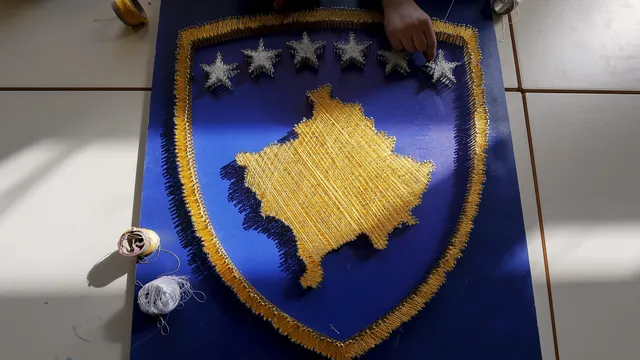
The Republic continues to resist attacks from Belgrade.
Kosovo today marks 18 years since it declared independence—an act that on February 17, 2008, gave birth to the youngest country in the Balkans.
The declaration of independence was adopted by the parliament in Pristina after years of international administration under the auspices of the UN and nearly a decade after the 1998-1999 war, marked by serious crimes against the Albanian population.
Bulgaria recognized the Republic of Kosovo on February 20, 2008. Sofia justified its decision with the need for stability in the region and support for the European perspective of the Western Balkans. Since then, Bulgaria has consistently supported Kosovo’s integration into Europe.
Repression under the Milošević regime
The road to independence was marked by serious crimes committed by the Yugoslav/Serbian dictator Slobodan Milošević. In the early 1990s, the Albanian population was subjected to systematic discrimination.
The conflict escalated in 1998-1999, when Serbian forces carried out military operations accompanied by killings of civilians, destruction of villages, and mass deportations. According to estimates by international organizations, around 13,000 people were killed and over 800,000 were driven from their homes. NATO’s decisive intervention with an air operation in March 1999 forced Serbian forces to withdraw, after which a UN international administration was established.
Tension under the Vučić regime
Under Serbian President Aleksandar Vučić, relations between Serbia and Kosovo have been marked by crises—roadblocks in northern municipalities with a Serbian majority, tension over license plates, election boycotts, mass withdrawals of Serbs from Kosovo institutions, and the creation of parallel structures.
Dialogue under the auspices of the European Union continues formally but has not yielded results.
Eighteen years after declaring independence, Kosovo continues its efforts to gain international recognition, economic development, and membership in international organizations.
The attack in Banska in 2023
Tensions between Belgrade and Pristina escalated seriously after 2008. One of the most serious examples in recent years was the armed attack in the village of Banska in northern Kosovo in September 2023.
An armed group of Serbian fighters attacked a Kosovo police patrol, killing one Kosovo police officer. A shootout ensued, in which several of the attackers were killed. The Kosovar authorities described the incident as a terrorist attack and accused Belgrade of being behind the organization and logistics of the group. The huge quantity of weapons found in caches in the region suggests that the aim was to seriously destabilize the country.
Responsibility for the attack was claimed by Milan Radoičić, a Serbian politician from northern Kosovo who is close to Aleksandar Vučić’s regime. The incident provoked a sharp reaction from the EU and the US, which called for a full investigation and de-escalation.
A few months earlier, on May 29, 2023, violent clashes broke out in northern Kosovo between protesters and soldiers from NATO’s international peacekeeping mission, KFOR. More than 30 soldiers were injured in the riots. NATO described the attacks as unacceptable and sent additional forces to Kosovo to stabilize the situation.
On November 29, 2024, a powerful explosion damaged the Ibar-Lepenci water canal in the village of Varaz, Zubin Potok municipality – a key piece of infrastructure that supplies water to several cities in Kosovo and provides cooling for thermal power plants. The authorities warned of the risk of water and electricity supply disruptions in large parts of the country, and Prime Minister Albin Kurti stressed that the organizers were linked to state structures in Belgrade. | BGNES