
Sign up for the Slatest to get the most insightful analysis, criticism, and advice out there, delivered to your inbox daily.
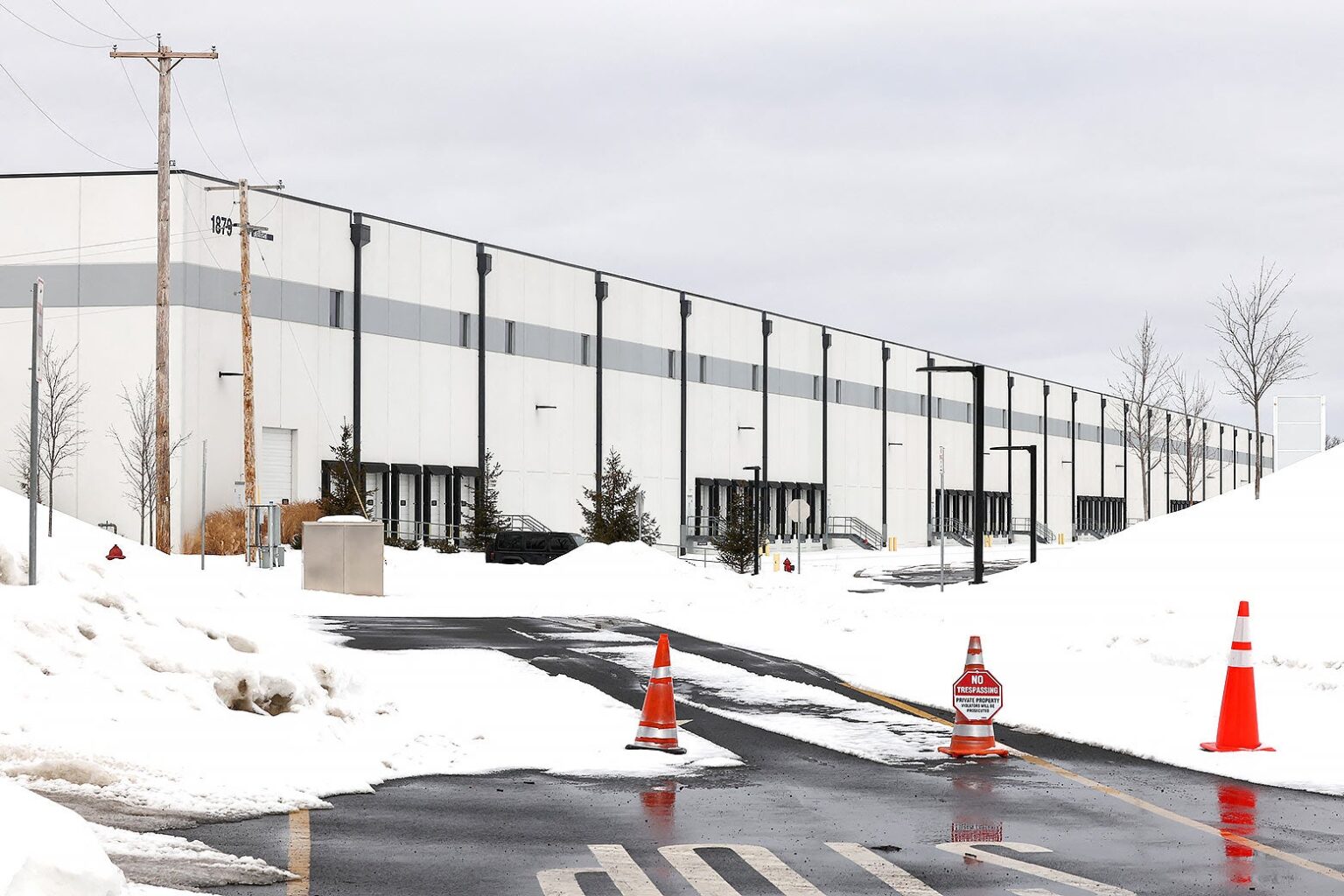
The United States government has begun construction of a multibillion-dollar detention camp system in the newest phase of Stephen Miller’s mass deportation strategy. The Department of Homeland Security has purchased two megawarehouses to be converted into 8,000-to-10,000-bed detention centers, with reported plans to buy and convert more than a dozen other warehouses for “processing” masses of new detainees. On this week’s Amicus podcast, Dahlia Lithwick discussed, with journalist Andrea Pitzer, the clear and chilling picture of what the Trump administration is building. Pitzer is the author of several books, including One Long Night: A Global History of Concentration Camps, and her most recent newsletter post is “Building the Camps: The Warehouseification of Detention and Initial Thoughts on Stopping It.” The following conversation has been edited and condensed for clarity.
Dahlia Lithwick: What is being built? At what speed is it being built? At what cost is it being built? How is it that we’re at the place where the language that you use in your post, concentration camps, actually is not just apt but has become fairly obvious?
Andrea Pitzer: The U.S. already had a pretty extensive immigration deportation system. In the first Trump administration, the White House wanted to prioritize the kinds of optics that signaled that it could go after anybody at any time. That led to a sort of a Keystone Cops approach, and so the numbers of people deported were in fact lower than under Barack Obama. But the optics of things like family separations and the deliberate cruelty were really apparent. The administration learned from that first outing that it needed to do more planning and be more strategic. Now that Donald Trump has returned to office, we’re still seeing a lot of Keystone Cops stuff that the administration probably didn’t intend for people to see, but we’re also seeing a lot of deliberate cruelty on the streets that it does intend for people to see.
Meanwhile, the White House is hoovering up warehouses. Before all these warehouse purchases, there was a turn toward facilities like Camp East Montana, which is this enormous facility that was stood up just last August within Fort Bliss, near El Paso, Texas. They were literally building it out with tents as they were bringing people in. They’ve decided that it doesn’t really meet their needs, and so they are now turning to acquiring these warehouses. There are over 100 the administration in the process of working toward. It’s spent about three-quarters of a billion dollars on buying these so far.
The infrastructure of all that is extraordinary. When you look at some of the biggest concentration camp systems across the world, we are actually approaching or ahead of the numbers for those massive famous ones. The Nazis came to power in 1933 and immediately, within weeks, had opened Dachau—which, I will note, was founded on a converted factory site—so we’re echoing this history right from the beginning. It was not until about five and a half years later, with Kristallnacht, that they started doing large sweeps of German Jews into camps. In that 48-hour period, more than 30,000 Jews were sent into concentration camps. That was five years into Nazi rule.
We are at the end of the first year of this second Trump administration. And even when you look at, let’s say, 1940 to 1941, World War II had started, Germany was putting a lot more people into camps, and yet we have more people in immigrant detention today than Nazi Germany did seven years into the Third Reich, which I think is just astounding when you think about it.
Even before he was elected, Trump was talking about this mass deportation campaign, that there were up to 20 million people in the United States illegally. Historians debate how many people moved through the Soviet gulag, whether it was 18 million or 20 million people in more than two decades who went through that system. What the Trump administration is talking about are those numbers in a four-year period. If you know anything about how horrific the Soviet gulag was, you’ll recall that it transformed the country for generations that followed, and it wrecked lives.
The Soviets didn’t know in advance what they were doing, but Stephen Miller has that context. That is something key people in the administration are openly embracing. We are already seeing conditions in those camps that rival early Nazi concentration camps, with illness, disease, and reports of limited access to medical care. We’ve had a killing in Camp East Montana that has been declared a homicide. People have already died.
This is not something this administration stumbles into sideways, right? This was the plan. Last April, acting ICE Director Todd Lyons was heard to say that what he really, really wanted to do was to just run deportations like a business: “Like Amazon Prime, but with human beings,” he said. We are witnessing the construction of a system for just warehousing people systematically. How much of what we are seeing playing out right now is just the tip of the iceberg for what is imagined?
If we look at that “Amazonification,” different concentration camps evolved over time in different ways. I often use the Nazi example because it’s almost the only concentration camp system people know, even though there have been a bunch of different ones. The Nazis were the very first who took this logistical approach that we think of as Amazonification now. There was a detainee named Margarete Buber-Neumann, who wrote an amazing memoir, Under Two Dictators. She was detained in the Soviet gulag system, then later held in the Nazi concentration camp system. The Soviets handed her over to the Gestapo at the beginning of World War II, and she describes coming to the Nazi camp system and being issued clothes and utensils to eat with. It was this whole system that was very sadistic, but it was incredibly scripted and organized. Of course, that went to hell once the war started, but this warehouse-ification of people was exactly the initial Nazi goal. The extermination of people through that warehouse system became the later explicit goal.
In terms of what our government is doing, I want to make clear: This can happen in a country only when things have been deeply wrong for a number of years in a number of ways. What we’ve already seen in the U.S., with prisons, with decades of demonizing immigrants, with the already existing nature of our punitive immigration system, where detention is literally used as a deterrent and to do harm to people—all that gives Trump these initial tools that they are clearly planning to expand on in tremendous ways.
People are waking up to what’s happening on the ground, which is amazing and offers all kinds of potential for things to do. But I don’t think people understand the scope of it. If they end up with all these warehouses, what automatically follows from that is you have transit camps and you have hub camps and you have whole communities whose identities become bound up with these warehouses. This is why we see some of these small towns and cities already working to reject the Immigration and Customs Enforcement warehouses. Dachau is the name of the town. Just think, for how many places in our country is that what is going to be meant by their names going forward?
According to the plans that we see from Miller and Trump, this will be as large as—and potentially even larger than—the U.S. prison system, which is already so much larger than almost anything else in the world. It will exist almost entirely outside the realm of oversight, of accountability. Concentration camp systems are always an end run around the existing legal system in a country at a given time. This isn’t just going to be criminal detainees. We’re already seeing people with documentation disappearing in this system, people who are here lawfully. We have seen U.S. citizens that have ended up in some of these settings. The goal is never to do detention against just the targeted group. The goal with these is always political: the expansion of political power and the entrenchment of political power. By definition, that means that other people will be going into these camps over time. The objective is really expanding and locking down control over public life in America. It is the ability to silence any kind of dissent.

Jim Newell
Republicans Have Found the Real Victims of Trump’s Effort to Build Mass Immigrant Detention Centers
Read More
Americans are waking up to the reality of horrifying dispatches from Camp East Montana, located near El Paso, Texas: reports of hunger, of violence, of sexual assault, of death. Who is accountable for this?
I think everybody involved has to run the risk of accountability. The sooner we can shut down the largest wave of this as it’s growing, the smaller that number will be. And it is better not only that less harm comes to people; even on the other side of this, the fewer people who will have to be held accountable in some way, the better it is for society. So even for the perpetrators, it is better if we can shut this down, but especially for the people that would have harm done to them.
It may be hard to imagine accountability in this moment, when so many systems are collapsing, but I think of the people I talked to in Argentina who had been tortured and held. In some cases, they had been sexually assaulted, their friends killed. There was never a hard end where the military made itself accountable there. The dictatorship ended, but there was never this moment of accountability. That came years later. One woman I interviewed remembered that while she was blindfolded, she was able to peek under her blindfold and see a tile pattern on the floor. When it came time to testify, they testified to everything that they could remember. Somebody went and found that tile pattern, and they found the floor, they found the house she had been held in, and they talked to the neighbors, and the neighbors recalled hearing the screams. They were able to work their way through these unbelievably difficult investigations to bring leading military figures to justice, but also people underneath them.
-
George Washington and Donald Trump Have a Similar Obsession. They’ve Expressed It … Shall We Say … Differently.
-
Where Are You Most Likely to Find a Cenotaph?
You have to, first of all, for PR purposes, make everybody think they’re going to be accountable for everything going forward. Then, in the end, on the other side of this, you decide how you deal with the small potatoes. But there is going to have to be some kind of accountability. It was a serious shame from the Obama era that this was not done when he came to power in early 2009, in the face of what had happened in the war on terror. The lack of accountability at that point has enabled much of what has followed. Obama’s not personally responsible as if he had launched the war on terror himself, but he bears some of that responsibility, because without those accountability moments, this is exactly where you end up.
Reforms are good, for sure, but if you’re focused on them, the correct response to Dachau was not better training for the guards. So we can talk about better training, and we can talk about standards, but that ultimately is not going to be what addresses this. Everybody needs to face accountability.

Sign up for Slate’s evening newsletter.