
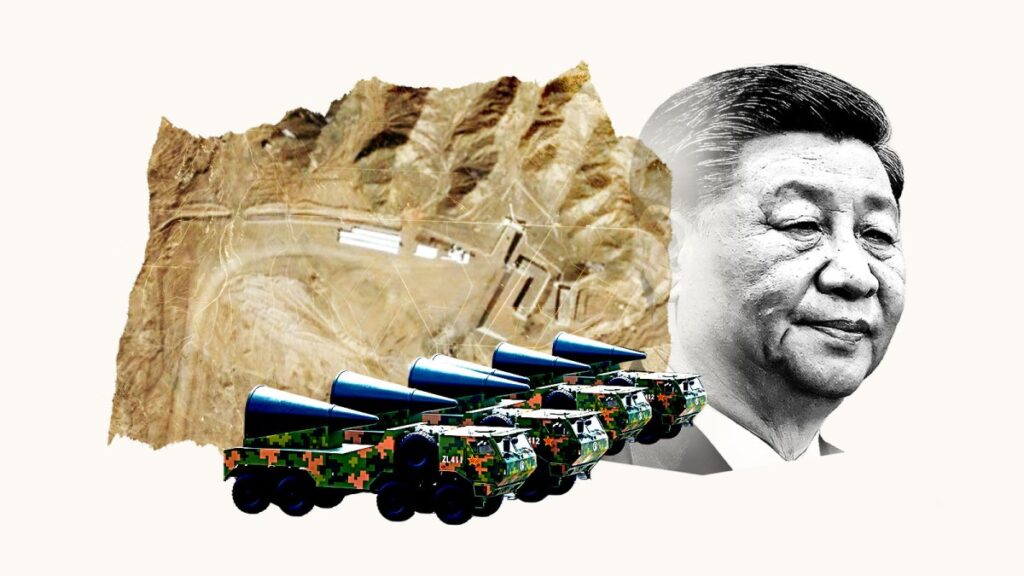
The United States has accused China of conducting a secret underground nuclear weapons test, as President Trump prepares the ground to expand America’s atomic arsenal.
Senior state department officials have made the claims twice in recent days, giving details at an event on Tuesday in Washington. One official, Christopher Yeaw, an assistant secretary of state, said the test took place in June 2020, in contravention of the Comprehensive Nuclear Test Ban Treaty, to which China is a signatory.
The UN body set up to monitor the treaty’s implementation has not confirmed the test but has not denied it either, saying that the evidence was “inconclusive”. The US believes China tried to conceal it.
The last nuclear arms control deal between the US and Russia expired two weeks ago. The Trump administration said there was no point in resuscitating an agreement to which Russia did not stick and China was not subject.
The other US official, Thomas DiNanno, undersecretary for arms control and international security, said this month: “China’s entire nuclear arsenal has no limits, no transparency, no declarations and no controls.”
During the later years of the Cold War, the US and the Soviet Union led a worldwide effort to bring order to the nuclear arms race amid popular fears of global catastrophe and annihilation.

Satellite images of what analysts believe are intercontinental ballistic missile silos near Hami, China
PLANET LABS INC/AP
The 1970 Nuclear Non-Proliferation Treaty attempted to limit nuclear weapons to the five nuclear powers — the US, the Soviet Union, Britain, France and China — that had already tested and declared their atom bombs.
Strategic arms limitation treaties followed, but these focused on the US and the Soviet Union, which had by far the most extensive arsenals. However, China’s arsenal, from a much smaller start, is now the fastest growing, with an extra 100 warheads being added each year.
China has about 600 warheads, according to most estimates. Russia has the largest arsenal, at 5,580 “active” warheads, while the US has about 5,200 warheads, of which approximately 1,500 are retired and waiting to be dismantled.
• Are we entering a new nuclear arms race?
The US now believes the modernisation programme that President Xi demanded of the People’s Liberation Army (PLA) has extended to testing. That is a violation of the Comprehensive Nuclear Test Ban Treaty, agreed in 1998 — though it was never ratified by the three major nuclear powers, America, Russia and China, nor by the four smaller nuclear powers that are not members of the Nuclear Non-Proliferation Treaty: Israel, Pakistan, India and North Korea.
In a statement to the international Conference on Disarmament this month, DiNanno accused Russia and China of taking their nuclear arsenals in new directions. He said Russia had conducted “supercritical” tests on its weapons and tested novel delivery systems such as a nuclear-powered missile and its “doomsday” Poseidon drone torpedo.
China, he said, had conducted a “yield-producing test” on June 22, 2020. “The PLA sought to conceal testing by obfuscating the nuclear explosions because it recognised these tests violate test ban commitments,” he said. “China has used decoupling — a method to decrease the effectiveness of seismic monitoring — to hide their activities from the world.”
• Russia ‘risks nuclear catastrophe’ by restarting Zaporizhzhia reactor
On Tuesday, Yeaw defended the claim at an event at the Hudson Institute, a conservative think tank in Washington.
He said a small earthquake, registering 2.75 on the standard scale, had been detected at a remote monitoring station run by the Comprehensive Nuclear Test Ban Treaty Organisation (CTBTO) in Kazakhstan. The central Asian country borders the Xinjiang region of China, which is home to Lop Nur, its main nuclear test site.
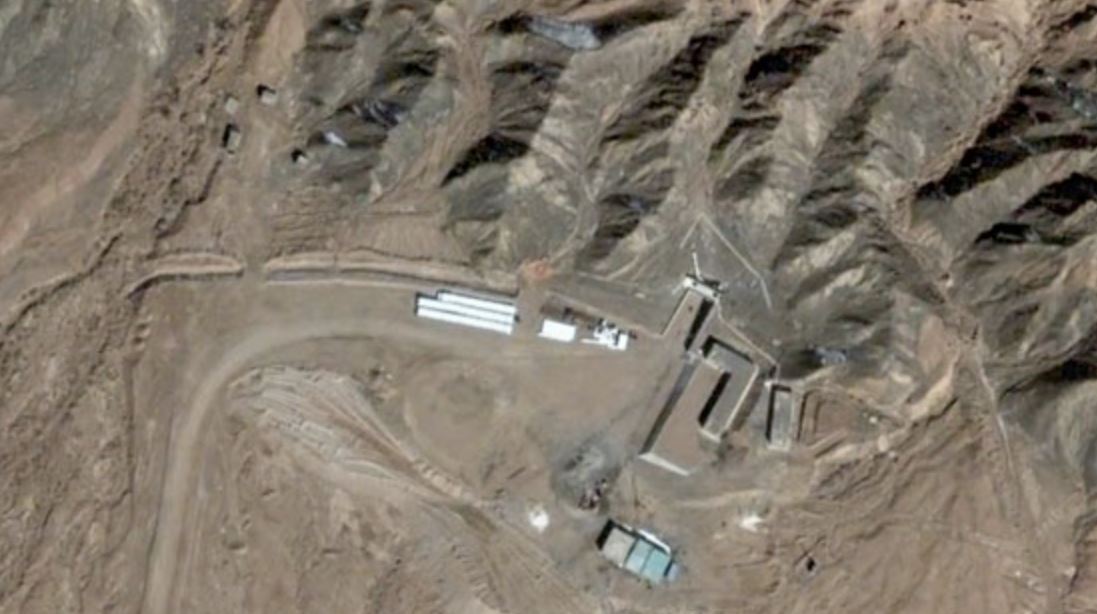
Part of the Lop Nur nuclear testing site in Xinjiang, China
GOOGLE MAPS
Yeaw added that the earthquake had been traced to Lop Nur, 450 miles away. “There is very little possibility that it is anything other than an explosion, a singular explosion,” he said. “It is quite consistent with what you would expect from a nuclear explosive test.”
The CTBTO said its international monitoring system (IMS) had detected two “very small” seismic events, 12 seconds apart, at 9.18am universal time, equivalent to GMT.
Robert Floyd, the executive secretary of the CTBTO, said: “The IMS is currently capable of identifying events consistent with nuclear test explosions with a yield equivalent to or greater than approximately 500 tonnes of TNT.
“These two events were far below that level. As a result, with this data alone, it is not possible to assess the cause of these events with confidence.”
The CTBTO said until all the relevant countries had ratified the treaty, it could not put into place additional verification mechanisms.
The Chinese government has denied the claim, accusing Washington of fabricating the allegation as cover for its own proposed resumption of nuclear testing. A spokesman for the Chinese embassy in Washington said: “This is political manipulation aimed at pursuing nuclear hegemony and evading its own nuclear disarmament responsibilities.”
However, satellite photos have revealed an increase in activity at Lop Nur in recent years.

The US, which in the heyday of nuclear tests from the 1950s to the 1980s conducted far more than China, also continues to work on its arsenal, albeit using computer simulations.
Trump said last October on his Truth Social media platform that he was ordering the Pentagon to resume nuclear testing “on an equal basis”, despite the treaty. He did so as he prepared to meet Xi for the first summit of his second term in office in South Korea, and subsequently said they discussed the issue.
It is not clear what kind of tests he wants, but DiNanno suggested they would match the tests he was accusing Russia and China of carrying out.
DiNanno reiterated Trump’s belief that the New Start nuclear arms reduction treaty between the US and Russia, which expired on February 5, imposed a one-sided burden on the US.
He said the US wanted a new arms control “architecture” that included Russia and China — something China has rejected, pointing out its arsenal is much smaller than those of the US and China.